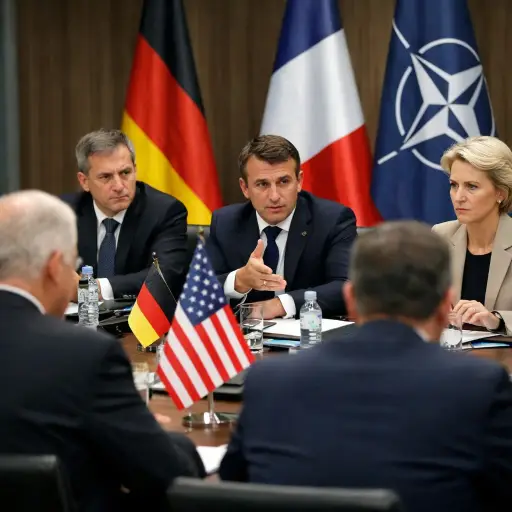
Internal proposals signal a shift toward coercive alliance management as European governments push back against pressure to support military action

The United States is actively considering measures to penalize NATO allies that decline to support potential military action related to Iran, according to officials familiar with internal deliberations, a move that could mark one of the most significant tests of alliance unity in decades.
Policy discussions underway in Washington include options ranging from reduced intelligence sharing to the repositioning of US troops currently stationed across Europe. While no final decisions have been announced, the exploration of such measures reflects mounting frustration within parts of the US national security establishment over what is seen as uneven burden-sharing and political reluctance among key European partners.
The debate comes at a moment of heightened tension surrounding Iran, with US officials signaling that military options remain on the table amid ongoing disputes over regional security and nuclear concerns. Yet across much of Europe, governments have expressed caution, emphasizing diplomacy and warning against escalation.
Several European officials, speaking on condition of anonymity due to the sensitivity of the issue, described the emerging US posture as “deeply concerning” and potentially counterproductive. They argue that coercing allies risks undermining the very cohesion that has long been NATO’s greatest strength.
“There is a difference between consultation and pressure,” one senior European diplomat said. “If decisions of war and peace become subject to punitive mechanisms within the alliance, that changes the nature of NATO fundamentally.”
At the center of the US deliberations is a longstanding tension: the expectation that NATO allies align with Washington on major security challenges versus the political realities within European democracies, where public opinion often favors restraint. Recent polling across several European countries indicates limited support for direct military involvement in a conflict involving Iran, complicating governments’ room for maneuver.
US officials defending the discussions argue that alliance credibility depends on unity in moments of crisis. Some policymakers contend that without clear consequences for non-alignment, NATO risks becoming a fragmented political forum rather than a cohesive security bloc.
Among the measures reportedly under consideration is the reallocation of US military assets away from countries deemed uncooperative. Such a move would not only carry symbolic weight but could also alter the strategic landscape in Europe, particularly in regions where US presence has been central to deterrence.
Another proposal involves limiting access to high-level intelligence or joint planning structures for allies that opt out of supporting military operations. Advocates of this approach argue that shared intelligence should be contingent on shared commitments, though critics warn it could degrade collective situational awareness at a critical time.
European leaders have responded with a mix of concern and quiet resistance. Several governments are said to be coordinating behind the scenes to present a unified position emphasizing diplomacy and adherence to international law. Publicly, officials have struck a careful tone, reaffirming commitment to NATO while underscoring the importance of independent national decision-making.
“This alliance has always been strongest when it respects the sovereignty of its members,” another European official said. “Forcing alignment through pressure risks creating divisions that adversaries could exploit.”
Analysts note that the current dispute echoes past transatlantic disagreements, including divisions over interventions in the Middle East. However, the introduction of potential punitive measures represents a sharper edge than previous episodes, suggesting a shift toward a more transactional approach to alliance management.
The implications extend beyond immediate policy choices. A sustained rift could influence long-term decisions about defense spending, strategic autonomy, and the future role of the United States in European security. Some European policymakers have already revived discussions about strengthening independent defense capabilities, a conversation that has gained momentum in recent years.
Within Washington, the debate remains fluid. Officials acknowledge the risks of escalation within the alliance but argue that the stakes of the broader geopolitical situation demand clarity and resolve. Others caution that pressuring allies could backfire, driving wedges at a time when unity is most needed.
For now, the situation remains in flux, with diplomatic channels active and both sides seeking to avoid an outright rupture. Yet the mere consideration of punitive measures has introduced a new layer of tension into transatlantic relations, raising fundamental questions about the balance between solidarity and sovereignty in one of the world’s most enduring alliances.
As discussions continue, the outcome may redefine not only how NATO responds to crises beyond its borders but also how its members navigate disagreement within.