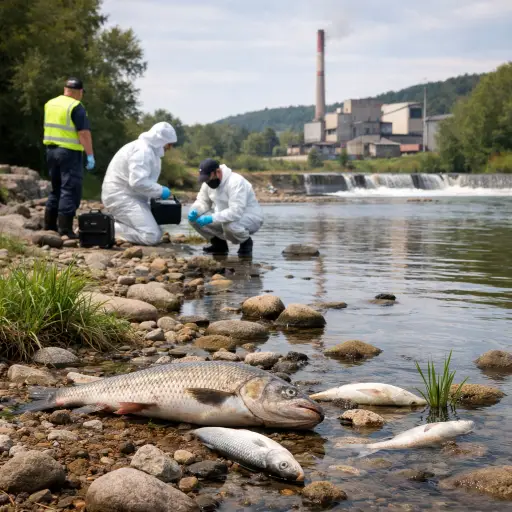
Energoaqua faces renewed scrutiny as authorities confirm penalty over toxic discharge, while the company considers further legal action

In a development that renews attention on one of the Czech Republic’s most controversial environmental disasters, the Ministry of the Environment has upheld a multi-million fine against the Rožnov-based company Energoaqua over its role in the poisoning of the Bečva River. The decision reinforces earlier findings by the Czech Environmental Inspectorate, which concluded that the firm discharged wastewater containing excessive levels of cyanide, triggering a large-scale ecological crisis that continues to resonate years later.
The ruling comes after Energoaqua appealed the original penalty, arguing both procedural flaws and insufficient evidence linking its operations directly to the disaster. However, the ministry has now confirmed that the inspection authority acted in accordance with environmental law, dismissing the company’s objections and affirming the severity of the breach.
The case centers on a catastrophic incident that saw tens of tons of fish killed along a significant stretch of the Bečva River. The event shocked the public, not only because of its scale but also due to the prolonged uncertainty surrounding its cause. Investigators spent months analyzing water samples, industrial discharge records, and river flow dynamics before identifying Energoaqua as responsible for releasing contaminated effluent.
According to the ministry’s spokesperson, the confirmed fine reflects the seriousness of the violation, particularly given the concentration of cyanide detected in the wastewater. Cyanide is highly toxic to aquatic life even in small quantities, and its presence in industrial discharge is tightly regulated under Czech and European environmental standards.
For environmental advocates, the decision marks a rare instance of accountability in a case that has often been criticized for delays and conflicting conclusions. Activists have long argued that the Bečva incident exposed systemic weaknesses in environmental oversight, including gaps in monitoring infrastructure and ambiguity in responsibility among industrial operators along the नदी.
“The confirmation of the fine is important, but it does not close the chapter,” said one environmental campaigner familiar with the case. “What matters now is ensuring that such an event cannot happen again.”
Energoaqua, for its part, maintains that it did not intentionally violate environmental regulations and continues to question the methodology used in the investigation. Company representatives have indicated that they are reviewing the ministry’s decision and may pursue further legal remedies, potentially prolonging a case that has already spanned several years.
Legal experts note that while administrative penalties such as fines can be challenged in court, the burden of proof shifts significantly once an appellate authority has confirmed the original ruling. Any further action by Energoaqua would likely focus on technical details of the evidence or procedural compliance during the investigation.
The Bečva River case has also had broader implications for environmental policy in the Czech Republic. In the aftermath of the disaster, authorities initiated reviews of industrial discharge permits and introduced tighter monitoring requirements for facilities located near sensitive waterways. The incident has been cited in policy discussions as a turning point in how environmental risks are assessed and managed.
Despite these measures, questions remain about enforcement capacity and the coordination between regulatory bodies. Critics argue that while legislation is robust on paper, practical oversight can lag behind, particularly in regions with dense industrial activity.
For local communities along the Bečva, the memory of the ecological disaster is still vivid. Anglers, residents, and conservation groups have reported gradual recovery in fish populations, but concerns persist about long-term impacts on biodiversity and water quality.
The ministry’s decision sends a clear signal that violations of environmental standards will carry significant consequences. Yet it also underscores the complexity of attributing responsibility in industrial pollution cases, where multiple factors and actors can complicate the investigative process.
As Energoaqua weighs its next legal steps, the case continues to serve as a test of the country’s commitment to environmental protection and corporate accountability. Whether the confirmed penalty will stand as the final word remains uncertain, but the broader message is unmistakable: the cost of environmental negligence is rising, both legally and in the court of public opinion.