Brussels signals up to €1.5 billion could be withheld as scrutiny intensifies over governance standards and geopolitical alignment

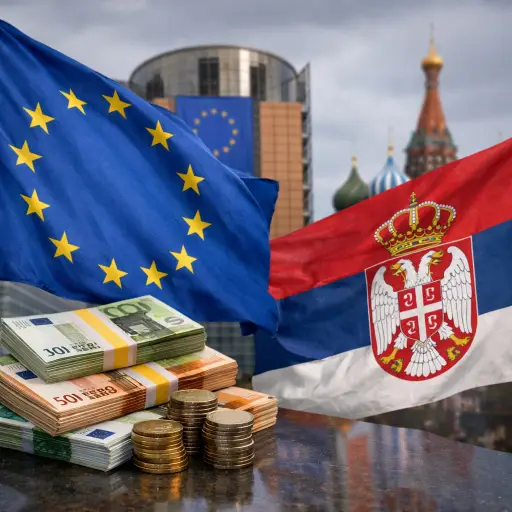
Serbia is facing the prospect of losing significant financial support from the European Union, as concerns deepen in Brussels over the country’s democratic trajectory and its increasingly close relationship with Russia. According to reporting by Politico, senior EU officials are considering measures that could suspend or reduce funding amounting to as much as €1.5 billion.
The warning comes amid growing unease within EU institutions about the state of democratic governance in Serbia, a candidate country that has long aspired to join the bloc. Marta Kos, the EU’s enlargement commissioner, has publicly indicated that financial assistance is increasingly tied to adherence to democratic norms, rule of law, and alignment with EU foreign policy positions.
At the center of the dispute is Serbia’s balancing act between its European ambitions and its historical, political, and economic ties with Russia. While the EU has imposed extensive sanctions on Moscow following geopolitical tensions in Eastern Europe, Serbia has refrained from fully aligning with these measures, maintaining diplomatic and economic links with the Kremlin.
European officials, speaking on condition of anonymity, have described the situation as reaching a “critical juncture.” According to these sources, the EU is prepared to use financial leverage to signal that progress toward membership cannot continue without tangible reforms. The potential loss of funding would represent one of the most significant punitive measures taken against a candidate country in recent years.
The funds in question are part of broader EU pre-accession assistance programs designed to support infrastructure, institutional reforms, and economic development. For Serbia, these resources have been crucial in modernizing its economy and preparing for eventual integration into the EU single market. A suspension or reduction would not only slow development projects but also send a strong political message to both domestic and international audiences.
Critics within the EU argue that Serbia has shown signs of democratic backsliding, including concerns over media freedom, judicial independence, and electoral transparency. Reports from international watchdogs have highlighted increasing pressure on independent journalists and opposition figures, raising questions about the robustness of democratic institutions.
At the same time, Serbia’s leadership has defended its foreign policy approach as pragmatic and rooted in national interests. Officials in Belgrade argue that maintaining ties with Russia is essential for energy security and historical reasons, while also insisting that EU membership remains a strategic goal. This dual-track policy, however, is becoming increasingly difficult to sustain as geopolitical divisions sharpen.
The European Commission has emphasized that alignment with EU foreign policy is not merely symbolic but a core requirement for accession. Divergence on key issues, particularly those involving security and international relations, risks undermining trust between Brussels and candidate countries.
Public opinion within Serbia adds another layer of complexity. While there is substantial support for EU membership, there is also a strong current of pro-Russian sentiment among segments of the population. This has made decisive policy shifts politically sensitive for Serbian leaders, who must navigate both domestic expectations and external pressures.
Analysts note that the EU’s potential move reflects a broader shift toward a more conditional enlargement process. In recent years, Brussels has sought to ensure that candidate countries demonstrate sustained commitment to democratic values before gaining access to full membership benefits. Financial instruments are increasingly being used as tools to enforce compliance.
For Serbia, the coming period could prove निर्णative. The possibility of losing up to €1.5 billion in funding represents not only an economic challenge but also a test of its strategic direction. Whether Belgrade chooses to recalibrate its policies in line with EU expectations or continue its current course may determine the pace and viability of its accession process.
As discussions continue within EU institutions, the situation remains fluid. However, the message from Brussels is becoming clearer: progress toward membership is inseparable from democratic standards and geopolitical alignment. For Serbia, the stakes have rarely been higher.