Colombian content creator faces scrutiny after triggering a foul-smelling stunt on a transatlantic flight, raising questions about safety, accountability, and the boundaries of online entertainment

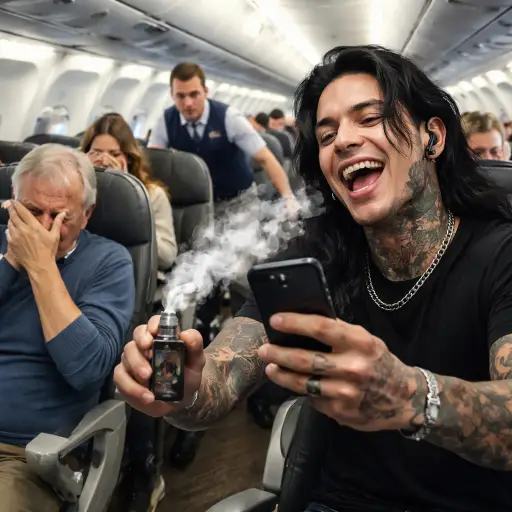
High above the Atlantic Ocean, inside the confined space of a commercial aircraft cruising at altitude, a stunt unfolded that has since ignited debate far beyond the cabin walls. Colombian influencer Yeferson Cossio, known for his elaborate pranks and massive online following, activated what he described as a “smell bomb” during a flight to Europe, recording the reactions of passengers and crew before sharing the footage with millions.
The incident, which quickly circulated across social media platforms, shows visible discomfort among passengers as the odor spreads through the cabin. Some are seen covering their noses, others looking around in confusion, while flight attendants attempt to assess the situation. What may have been intended as entertainment has instead triggered a wave of criticism, with many questioning the judgment behind carrying out such a stunt in a sealed, high-altitude environment.
Cossio, who has built a career on shock value and boundary-pushing content, appeared amused in the footage, narrating the prank and reacting to the unfolding scene. Within hours of posting, the video amassed significant engagement, but the tone of the response was sharply divided. While a portion of his audience praised the audacity of the act, a growing chorus of voices condemned it as irresponsible and potentially dangerous.
Aviation experts have been quick to weigh in, emphasizing that aircraft cabins are highly controlled environments where even minor disruptions can escalate. While a “smell bomb” may sound harmless, any unexpected event mid-flight can trigger concern among passengers and crew, particularly in an era where safety protocols are stringent and threats—real or perceived—are taken seriously.
“This is not a public park or an open space,” said one aviation safety consultant in response to the footage. “At cruising altitude, passengers and crew rely on a predictable environment. Introducing an unknown substance, even if it turns out to be benign, can cause unnecessary panic.”
Airlines typically maintain strict policies regarding passenger behavior, including prohibitions against actions that could disturb or endanger others. Although it remains unclear whether any formal action will be taken in this case, legal analysts note that such stunts could fall into a gray area depending on jurisdiction, airline regulations, and the perceived level of risk.
The controversy also highlights a broader issue within the digital ecosystem: the escalating pressure on influencers to produce ever more sensational content. As algorithms reward engagement, creators often find themselves pushing boundaries to capture attention in an increasingly crowded space. What once might have been considered a harmless prank now competes with a global stream of extreme and attention-grabbing material.
For Cossio, whose following spans millions across platforms, the incident represents both the power and the peril of digital fame. His content has long relied on eliciting strong reactions, but the setting of this particular stunt—an aircraft in flight—has struck a nerve with audiences who see it as crossing a line.
Social media users have pointed out the lack of consent from those involved. Unlike staged pranks with willing participants, this scenario placed unsuspecting passengers into the center of a viral moment without their approval. Privacy advocates argue that such practices raise ethical concerns, particularly when individuals are filmed in distress and broadcast to a global audience.
The backlash has not been limited to viewers. Industry voices, including fellow creators, have also expressed concern about the implications of such behavior. Some warn that incidents like this could lead to stricter regulations on content creation in public spaces, affecting not only high-profile influencers but also everyday users.
At the same time, the episode underscores the enduring appeal of viral spectacle. Despite criticism, the video continues to circulate, illustrating the complex relationship between outrage and visibility. In the attention economy, controversy often amplifies reach, blurring the line between negative and positive exposure.
As the conversation unfolds, questions remain about accountability and consequences. Will platforms take action against content that endangers or disturbs others? Should airlines pursue penalties for disruptive behavior? And perhaps most importantly, where should the line be drawn between entertainment and responsibility?
For now, the midair prank serves as a stark reminder of the real-world impact of digital actions. What begins as a bid for views can ripple outward, affecting not just an online audience but also the unsuspecting individuals caught in the frame. In an age where the boundaries of content creation are constantly tested, the incident invites a moment of reflection on how far is too far.
As millions continue to watch, react, and share, the story of a single stunt at cruising altitude has become a broader commentary on the culture of virality—one that shows no signs of slowing down.