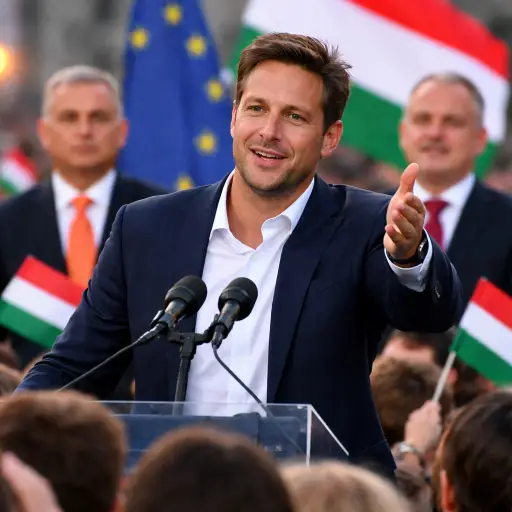
A historic election result has redrawn Hungary’s political landscape, as Péter Magyar’s Tisza movement swept to a decisive parliamentary victory, bringing an end to sixteen years of uninterrupted rule by Viktor Orbán’s Fidesz.

The outcome marks one of the most significant turning points in the country’s post-communist history, signaling both public fatigue with entrenched leadership and a desire for systemic change. Yet despite the scale of the victory, Hungary now enters a delicate and constitutionally complex transition period in which power does not immediately change hands.
Although Magyar has emerged as the clear winner, Viktor Orbán remains prime minister for the time being, retaining full executive authority until the newly elected parliament is formally convened. This interim phase, often overlooked in public discourse, is governed by constitutional procedure and political convention rather than electoral momentum. As a result, Hungary finds itself in a moment of dual reality: a defeated government still in control, and a victorious opposition not yet able to govern.
Under Hungary’s constitutional framework, the mandate of the sitting prime minister does not expire on election night. Instead, it continues until the new parliament holds its inaugural session and a new government is appointed. This means that Orbán, despite his electoral defeat, continues to exercise all powers of the office, including control over state administration, security structures, and ongoing policy decisions. In practice, this period is expected to be short, but its political significance is substantial.
During this interim, the outgoing government typically operates in a caretaker capacity, avoiding major long-term decisions. However, the constitution does not strictly limit its authority, leaving room for interpretation and, potentially, controversy. Analysts note that while political norms suggest restraint, the legal framework allows the incumbent leadership to act until the formal transfer of power is completed.
A central figure in this transition is President Tamás Sulyok, whose constitutional role becomes pivotal once the election results are finalized. The president is responsible for initiating the formation of a new government by inviting a candidate—typically the leader of the winning party or coalition—to form a cabinet. This step sets in motion the parliamentary process that ultimately leads to the appointment of a new prime minister.
Sulyok’s actions are expected to follow established democratic norms, but his position carries symbolic and procedural weight. He must balance constitutional duty with political sensitivity, ensuring that the transition reflects the will of the electorate while maintaining institutional continuity. His timing and decisions will shape how quickly Hungary moves from electoral outcome to governing reality.
For Péter Magyar, the period between victory and taking office presents both opportunity and limitation. Without formal executive power, he cannot enact policy or control state institutions. However, he can begin shaping the political agenda, negotiating coalition arrangements if necessary, and preparing the groundwork for governance. This includes selecting key personnel, outlining legislative priorities, and engaging with both domestic stakeholders and international partners.
Magyar’s rapid rise has been fueled by a message of transparency, institutional reform, and a break from what many voters perceive as an increasingly centralized system of power. His challenge now is to translate electoral success into effective governance, a task that will require not only political skill but also administrative readiness. The expectations placed upon him are high, particularly given the scale of change implied by his victory.
Meanwhile, Orbán’s remaining time in office is being closely watched, both within Hungary and abroad. After more than a decade and a half of dominance, his departure marks the end of a political era defined by strong leadership, nationalist rhetoric, and frequent clashes with European institutions. Even in defeat, his influence over the political system, party structures, and segments of the electorate remains significant.
The coming days are therefore likely to be characterized by careful maneuvering on all sides. Markets, international observers, and Hungarian citizens alike are seeking signals of stability and continuity. Any perception of institutional friction or delay could carry political and economic consequences, making the orderly conduct of the transition a priority.
As Hungary stands on the threshold of change, the contrast between electoral clarity and procedural complexity is striking. The voters have spoken decisively, yet the machinery of democracy requires time to translate that verdict into power. Until the new parliament convenes and a new government is formally installed, the country remains in a state of suspended transition.
What follows will not only determine the immediate direction of Hungary’s politics but also serve as a test of its democratic institutions. The peaceful and orderly transfer of power, especially after such a prolonged period of one-party dominance, will be closely scrutinized as an indicator of the system’s resilience.
For now, Hungary waits—between past and future, between mandate and authority—watching as a historic shift unfolds step by step.