Investigators say a deputy principal in frontline Kramatorsk passed Ukrainian troop locations to Russian intelligence after being recruited early in the invasion

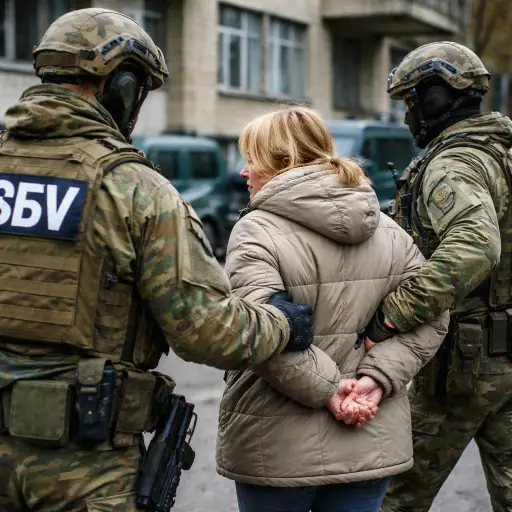
In the industrial city of Kramatorsk, where the distant rumble of artillery has become part of daily life, Ukrainian counterintelligence officers have detained a local school administrator accused of aiding Russian military operations. The arrest underscores the persistent challenges faced by Ukraine’s security services in regions close to the front line, where civilian life continues under the constant shadow of war.
According to Ukrainian authorities, the woman, who served as a deputy director at a local school, is suspected of transmitting sensitive information about Ukrainian troop positions to Russian handlers. Investigators allege that she passed along coordinates identifying locations where Ukrainian soldiers were stationed, potentially exposing them to targeted strikes.
Kramatorsk, located in the Donetsk region, remains one of the most strategically significant urban centers under Ukrainian control in the east. As a logistical hub and a symbol of Ukrainian resistance in the Donbas, the city has long been a focal point for both military operations and intelligence activity. The proximity to active combat zones has made it particularly vulnerable to infiltration attempts and covert operations.
Security officials say the suspect’s cooperation with Russian intelligence dates back to the early phase of the full-scale invasion. During that period, she reportedly traveled to Belarus, a country closely aligned with Moscow and used as a staging ground for Russian forces. It was there, investigators claim, that she was recruited by Russia’s Federal Security Service, or FSB.
The alleged recruitment fits a broader pattern identified by Ukrainian counterintelligence: individuals with access to local infrastructure or community networks are targeted and persuaded—sometimes through coercion, sometimes through ideological alignment or financial incentives—to gather and relay information. In frontline regions, even seemingly minor details can carry significant military value.
Authorities have not publicly disclosed the full extent of the information the suspect is believed to have shared, but officials emphasize that such leaks can have immediate and deadly consequences. Providing precise coordinates or movement patterns of troops can enable enemy forces to carry out artillery strikes or drone attacks with increased accuracy.
The case also highlights the difficult position of civilians living in contested areas. In cities like Kramatorsk, residents navigate a complex reality shaped by war, economic hardship, and constant security risks. Ukrainian officials have repeatedly warned that Russian intelligence services actively seek to exploit these conditions, identifying individuals who may be vulnerable to recruitment.
At the same time, Ukrainian security services have intensified their efforts to detect and neutralize such threats. The Security Service of Ukraine, known as the SBU, has carried out numerous operations aimed at dismantling espionage networks across the country. These operations often involve digital surveillance, monitoring of communications, and cooperation with local communities.
The detention of a school official has drawn particular attention because of the trust typically placed in educators and public servants. Schools in wartime Ukraine are not only places of learning but also centers of community resilience. Many have adapted to extraordinary circumstances, shifting between in-person and remote instruction while also serving as shelters or aid distribution points.
Officials have been careful not to generalize or cast suspicion broadly, emphasizing that the vast majority of educators continue to support their communities under extremely challenging conditions. Nonetheless, the case serves as a reminder that the lines between civilian and military spheres can blur in times of conflict.
Legal proceedings against the suspect are expected to follow Ukrainian law concerning collaboration with enemy forces. If convicted, she could face a lengthy prison sentence. Authorities say the investigation is ongoing and may uncover additional contacts or networks linked to the case.
For residents of Kramatorsk, the arrest is another indication of how deeply the war has penetrated everyday life. Beyond the visible destruction and the audible threat of shelling, there is an invisible dimension of conflict—one fought through information, allegiance, and trust.
As Ukraine continues to defend its territory, officials stress that vigilance remains essential, not only on the battlefield but within communities themselves. The war, they note, is being fought on multiple fronts, and the outcome can hinge as much on intelligence and counterintelligence as on conventional military strength.