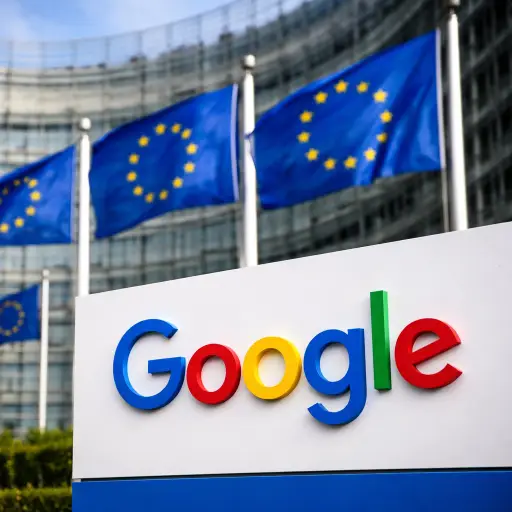
European regulators push for fairer competition under digital markets rules, requiring broader access to search data for rivals

The regulatory standoff between European authorities and major technology companies has entered a new phase, as the European Commission moves to enforce stricter compliance measures on the American tech giant Google. In its latest preliminary findings, the Commission has outlined a set of proposed remedies aimed at aligning the company’s practices with the European Union’s Digital Markets Act, a sweeping regulatory framework designed to curb the dominance of large digital platforms.
At the heart of the Commission’s concerns lies the question of access to search data. Regulators argue that Google, as a designated “gatekeeper” under the new rules, must provide competing search engines with access to key datasets, including search rankings, user queries, click data, and impression metrics. These datasets are considered essential for enabling smaller competitors to improve their services and challenge Google’s long-standing dominance in the search market.
According to officials familiar with the matter, the proposed measures emphasize that such access must be granted under fair, reasonable, and non-discriminatory conditions. This principle, often referred to as FRAND, has been a cornerstone in competition policy, particularly in sectors where control over data and infrastructure creates significant barriers to entry.
The European Commission has framed the move as a necessary step to ensure that the digital economy remains open and contestable. “Access to high-quality data is a critical factor in innovation and competition,” one official noted, speaking on condition of anonymity. “Without it, new entrants face structural disadvantages that cannot be overcome through market forces alone.”
The Digital Markets Act, which came into force as part of the European Union’s broader effort to regulate Big Tech, imposes a range of obligations on companies identified as gatekeepers. These include requirements to avoid self-preferencing, ensure interoperability, and provide greater transparency in how services are ranked and displayed. The latest findings suggest that, in the Commission’s view, Google’s current practices fall short of these standards.
Industry observers say the implications could be far-reaching. By mandating data-sharing at this level of granularity, regulators are effectively challenging one of the core assets that underpin Google’s business model. Search data not only drives the quality of results but also fuels the company’s advertising ecosystem, which remains its primary source of revenue.
Google has responded cautiously to the Commission’s findings, signaling a willingness to engage while defending its approach. In a brief statement, the company said it is reviewing the proposals and remains committed to complying with European regulations, while also ensuring that user privacy and security are maintained.
Privacy advocates have been quick to weigh in, warning that increased data-sharing must not come at the expense of user protections. While the Commission has stressed that any data access must comply with existing privacy laws, including the General Data Protection Regulation, questions remain about how these competing priorities will be balanced in practice.
Meanwhile, smaller search providers and digital startups have welcomed the Commission’s stance. Many have long argued that limited access to meaningful data has prevented them from scaling their services or offering viable alternatives to dominant platforms. For these companies, the proposed measures represent a potential turning point.
“This could level the playing field in a way we haven’t seen before,” said one executive at a European search startup. “If implemented effectively, it would allow us to innovate and compete based on quality rather than being locked out of critical resources.”
The developments also carry geopolitical undertones, reflecting ongoing tensions between the European Union and the United States over the regulation of technology firms. While European policymakers insist that the rules apply equally to all qualifying companies, critics in the U.S. have occasionally framed such measures as disproportionately targeting American firms.
Still, within Europe, there is broad political support for a more assertive approach to digital regulation. Lawmakers argue that ensuring fair competition is essential not only for economic reasons but also for preserving technological sovereignty and reducing dependence on a handful of global players.
The next steps in the process will be closely watched. Google will have the opportunity to respond formally to the Commission’s preliminary findings, after which regulators may refine or finalize the proposed remedies. If the company is ultimately found to be in breach of the Digital Markets Act, it could face significant fines or further corrective measures.
For now, the case serves as a test of the European Union’s ability to translate its ambitious regulatory vision into concrete action. As the digital landscape continues to evolve, the outcome could set a precedent for how competition is enforced in the data-driven economy.
Whether the proposed changes will succeed in fostering a more competitive environment remains uncertain. What is clear, however, is that the balance of power between regulators and technology giants is shifting, with Europe positioning itself at the forefront of that transformation.