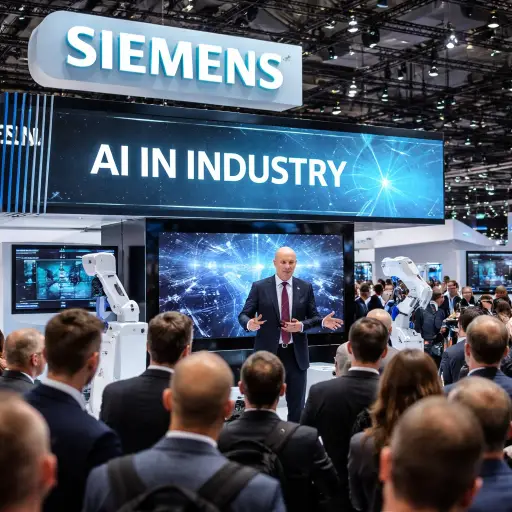
CEO Roland Busch warns that stricter EU rules on artificial intelligence and data protection risk pushing innovation toward the United States and China

At one of Europe’s most prominent industrial gatherings, a clear message emerged from Siemens: the future of artificial intelligence investment may not lie within the European Union unless regulatory conditions evolve. Speaking on the sidelines of the Hannover trade fair, chief executive Roland Busch indicated that the company is increasingly inclined to prioritize AI investments in markets such as the United States and China, citing what he described as overly restrictive European rules.
According to remarks reported by Bloomberg, Busch expressed concern that Europe’s regulatory framework—particularly around artificial intelligence and user data protection—could hinder innovation and slow industrial competitiveness. His comments reflect a growing unease among major technology and manufacturing players about the balance between safeguarding citizens and fostering technological leadership.
The debate comes at a critical moment for the European Union, which has positioned itself as a global leader in setting ethical and legal standards for emerging technologies. The bloc’s AI legislation aims to ensure transparency, accountability, and safety, especially in high-risk applications. However, critics argue that these safeguards may come at the cost of agility and speed—two factors widely seen as essential in the rapidly evolving AI sector.
Busch’s remarks underscore a broader shift in corporate strategy. For Siemens, a company deeply embedded in industrial automation, digital infrastructure, and smart manufacturing, artificial intelligence is not a peripheral technology but a central pillar of future growth. AI systems are increasingly integrated into factory operations, energy management, and transportation networks—areas where Siemens has long maintained a strong presence.
Yet, the regulatory environment plays a decisive role in determining where such technologies are developed and deployed. In the United States, a more market-driven approach has enabled rapid experimentation and scaling of AI solutions, supported by substantial venture capital and a dynamic startup ecosystem. China, meanwhile, continues to invest heavily in AI as part of its broader industrial and geopolitical strategy, combining state support with large-scale data access.
By contrast, European companies often face a more complex compliance landscape. Data privacy laws, including those governing user consent and cross-border data flows, impose additional layers of scrutiny. While these measures are widely praised for protecting individual rights, industry leaders argue that they can slow down the development cycle and create uncertainty for investors.
The implications extend beyond Siemens. Europe’s industrial base, long regarded as one of its strongest economic assets, is increasingly intertwined with digital technologies. If companies begin shifting their AI investments abroad, the region risks losing not only capital but also talent, innovation capacity, and strategic influence.
At the same time, policymakers face a delicate balancing act. Public trust in AI remains a critical issue, and concerns about misuse, bias, and surveillance continue to shape the regulatory agenda. European leaders have repeatedly emphasized that their approach seeks to create “trustworthy AI,” positioning ethics as a competitive advantage rather than a constraint.
Still, voices like Busch’s suggest that the current framework may need recalibration. Industry stakeholders are calling for clearer guidelines, faster approval processes, and greater support for research and development within Europe. Some propose regulatory sandboxes—controlled environments where companies can test AI applications under supervision—as a way to bridge the gap between innovation and oversight.
The discussion is likely to intensify as global competition in AI accelerates. With major economies racing to define the next generation of industrial and digital leadership, the stakes are high. For Siemens and its peers, the question is not only where to invest, but where innovation can thrive most effectively.
As the Hannover fair draws attention to the future of industry, Busch’s warning serves as a signal to European policymakers: maintaining leadership in artificial intelligence will require not just strong principles, but also a regulatory environment that enables companies to act on them. Whether the European Union can strike that balance may determine its role in the next phase of technological transformation.