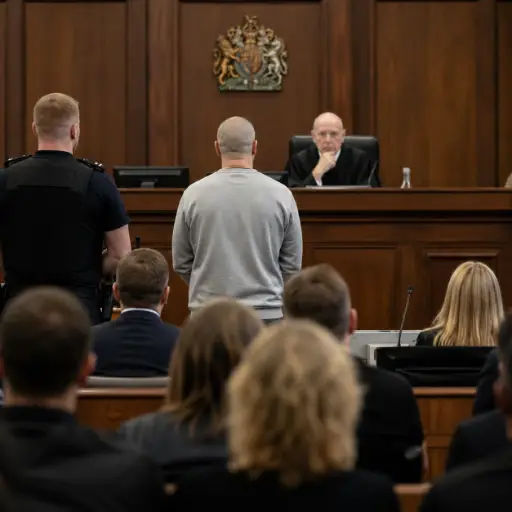
A violent assault driven by mistaken identity has reignited concerns in Britain over radicalized hate, misogyny, and the dangerous consequences of cultural intolerance.

A Birmingham court has sentenced a thirty-two-year-old British man, John Ashby, to life imprisonment after he was convicted of raping a young woman in an attack prosecutors described as being motivated by hatred and prejudice. The case has shocked the United Kingdom not only because of the brutality of the crime, but because the victim was targeted after the attacker wrongly assumed she was Muslim.
The sentence, delivered on Friday at Birmingham Crown Court, closes one of the most disturbing criminal proceedings in recent months and has renewed public debate over the rise of extremist attitudes, anti-Muslim hostility, and gender-based violence across parts of British society.
According to evidence presented during the trial, the assault took place during the autumn of last year after Ashby encountered the victim during the evening in a residential area near the city centre. Prosecutors stated that the attacker became fixated on the woman because of her appearance and clothing, which he interpreted as indicating a Muslim background. Investigators later confirmed that the victim was not Muslim, though the court emphasized that the mistaken assumption did not lessen the ideological nature of the crime.
During the proceedings, the prosecution described the assault as a “hate-fuelled act of domination and humiliation,” arguing that the defendant’s hostility toward Muslims played a direct role in the violence. Witness testimony and digital evidence presented to the court reportedly revealed that Ashby had consumed extremist online content and had previously expressed anti-immigrant and anti-Islamic views.
The presiding judge condemned the attack in unusually strong language, calling it “an act of profound cruelty rooted in ignorance, hatred, and misogyny.” The court heard that the victim suffered severe psychological trauma following the assault and has remained under long-term medical and emotional care.
Legal analysts noted that while hate crimes in Britain are commonly associated with verbal abuse, vandalism, or physical assault, cases involving sexual violence motivated by ideological hatred remain comparatively rare and deeply alarming. Human rights organizations have warned that such attacks represent a dangerous intersection between violent extremism and misogyny.
Outside the courthouse, advocacy groups gathered to express solidarity with the victim and to call for stronger measures against online radicalization. Several campaigners argued that social media platforms continue to underestimate the real-world consequences of extremist rhetoric and conspiracy-driven hatred.
“This case demonstrates how prejudice can escalate into devastating violence,” said one representative from a Birmingham-based anti-racism organization. “The victim was dehumanized because the attacker believed she belonged to a community he hated.”
The case has also intensified political discussions surrounding social cohesion and the growing visibility of extremist narratives in online spaces. Security experts in Britain have repeatedly warned that inflammatory anti-Muslim discourse has become increasingly normalized in certain digital communities, especially during periods of political tension and economic uncertainty.
Police officials involved in the investigation praised the victim for her courage throughout the judicial process. Detectives stated that her testimony was crucial in securing the conviction and ensuring what they described as “a significant sentence for a deeply dangerous offender.”
Community leaders across Birmingham reacted with a mixture of relief and concern following the verdict. While many welcomed the life sentence as a clear message that ideologically motivated violence would not be tolerated, others warned that the underlying social divisions exposed by the case remain unresolved.
Religious organizations, women’s rights advocates, and local civic groups have since called for expanded educational programs aimed at combating hate speech, discrimination, and misogynistic extremism among young people.
The British government has in recent years increased attention on the relationship between online radicalization and violent criminal behaviour, particularly after several high-profile incidents involving ideologically motivated attacks. However, critics argue that preventive measures remain fragmented and insufficient, especially in monitoring smaller extremist networks operating through encrypted or semi-private online platforms.
For many observers, the Birmingham case stands as a stark reminder that hatred based on ethnicity, religion, or perceived identity can rapidly evolve into acts of devastating personal violence. It has also highlighted the vulnerability of women who become targets not only because of gender, but because they are associated — correctly or incorrectly — with marginalized communities.
As Britain continues to confront questions surrounding extremism, integration, and social division, the verdict delivered in Birmingham is likely to resonate far beyond the courtroom. The life sentence handed to John Ashby may bring a measure of justice to the victim, but the broader fears raised by the case are unlikely to disappear soon.