As factories, robotics and semiconductors remain central to Japan’s economy, the country’s harder-to-copy advantage may be the trust, culture and national reputation that keep drawing the world in.

TOKYO, May 4, 2026
This month, Japan Airlines is due to begin testing humanoid robots at Tokyo’s Haneda Airport, using machines to help move luggage and cargo in a country short of workers and crowded with travelers. It is an image almost too neat: Japan, the factory nation, turning again to hardware to solve a social problem. Yet the more revealing asset at Haneda may not be the robot. It is the thing surrounding it — the order, choreography, service discipline and national reputation that make Japan feel, to millions of visitors, like a place where the future still works.
For decades, Japan’s durable economic image was forged in factories: Toyota production systems, Sony electronics, precision machine tools, ceramics, cameras and components hidden deep inside global supply chains. That industrial base still matters. Manufacturing has recently accounted for roughly one-fifth of Japan’s nominal GDP, and the government is again pouring money into strategic sectors from batteries to semiconductors.
But Japan’s most resilient asset in 2026 may be harder to depreciate, harder to copy and impossible to assemble on a production line. It is Japan’s accumulated cultural capital: the trust attached to its name, the export value of its stories, the magnetism of its places, and the quiet premium the world is willing to pay for things that feel Japanese.
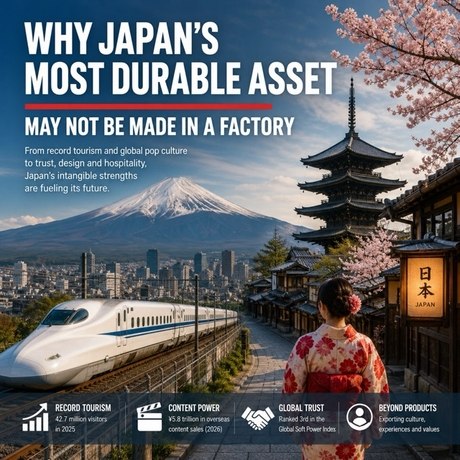
The numbers are no longer decorative. Japan welcomed a record 42.7 million foreign visitors in 2025, crossing 40 million for the first time, while international visitor spending rose to a record ¥9.5 trillion. The momentum has continued into 2026: Japan received 3.46 million inbound visitors in February, a record for that month, and 3.62 million in March, also a March record.
That spending is not simply tourism. It is monetized confidence. Visitors are buying trains that run on time, convenience stores that feel curated, neighborhoods that stage modernity beside shrines, and a service culture in which the transaction is often more memorable than the object purchased. Japan’s brand is no longer confined to goods leaving ports. It is increasingly earned by people arriving at airports.
The same shift is visible in entertainment. Japan’s anime industry reached a record ¥3.84 trillion in market value in 2024, helped by overseas demand, while Tokyo has set a target of lifting overseas sales of Japanese content to ¥20 trillion by 2033. METI said in January 2026 that overseas sales of Japanese content had already reached ¥5.8 trillion, outstripping semiconductors.
This is the strategic point. A car has a model cycle. A chip plant can be subsidized elsewhere. A factory process can be studied, licensed, reverse-engineered or undercut. But a trusted national mythology compounds over generations. Manga read in São Paulo becomes a reason to study Japanese. A sushi counter in Paris becomes a gateway to Osaka. A Nintendo character, a Studio Ghibli landscape, a Muji shelf, a Shinkansen ride and a Kyoto alley all point back to the same intangible: Japan as a system of taste, restraint and reliability.
Brand Finance’s 2026 Global Soft Power Index ranked Japan third in the world, ahead of the United Kingdom, and described gains connected to tourism, familiarity and appeal as a place to visit. That ranking is not a trophy; it is a balance-sheet clue. In a low-growth, aging society, attraction itself has become productive capital.
The timing matters because Japan’s old economic model is under pressure. The IMF expects Japan’s growth to slow to 0.7% in 2026 and 0.6% in 2027, after an estimated 1.2% expansion in 2025. The country is wrestling with inflation, energy exposure, a weak yen and labor scarcity. Its birth count fell to a record low in 2024, continuing a long demographic slide.
Factories can cushion some of that. Japan is still a formidable producer, and its manufacturers remain embedded in autos, robotics, materials and precision equipment. Recent data have been mixed rather than bleak: exports rose in March, while factory output unexpectedly fell and April manufacturing activity jumped partly on stockpiling amid supply-chain anxiety.
Yet the wider lesson is that Japan cannot rely on making things alone. Its strongest competitive advantage may be making meaning around things.
That meaning has economic consequences. A tourist who first encountered Japan through anime may later buy cosmetics, knives, whisky, ceramics, stationery, headphones or a rail pass. A foreign company choosing a Japanese supplier may be influenced not only by price, but by a reputation for consistency. A luxury traveler paying Kyoto hotel rates is not buying square footage; she is buying atmosphere, seasonality, craftsmanship and the right to feel briefly inside a civilization that has made detail a form of power.
The risk is that this asset can be damaged by overuse. Japan’s visitor boom has brought congestion, resident frustration and local countermeasures. The government has adopted plans to expand anti-overtourism measures to 100 regions, while places such as Fujiyoshida have struggled with crowds drawn by viral views of Mount Fuji.
That is the paradox of Japan’s intangible economy: the more successful it becomes, the more carefully it must be managed. Culture cannot be scaled like a factory line without losing the scarcity that gives it value. Kyoto cannot be treated like a theme park. A neighborhood cannot be optimized only for visitor flow. Anime cannot become merely an export target if the creators behind it remain overworked and underpaid. Hospitality cannot survive if workers are replaced by efficiency without respect.
Japan’s challenge, then, is not to choose between factories and feeling. It is to understand that the two now reinforce each other. The country’s best products have always carried an aura beyond functionality: a Toyota as reliability, a Shiseido bottle as refinement, a camera lens as discipline, a game console as play engineered with care. The future version of that advantage will depend as much on preserving credibility as on raising output.
This may explain why Japan’s most durable asset is not steel, silicon or robotics, but the promise attached to “Japan” itself. It tells the world that complexity can be made orderly, that modern life can retain ritual, that mass systems can still feel personal, and that design is not decoration but behavior.
Factories built modern Japan. But in 2026, the asset with the longest shelf life may be the one no factory can manufacture: the world’s enduring willingness to believe that Japan means quality, care and cultural depth — before the product is even opened.