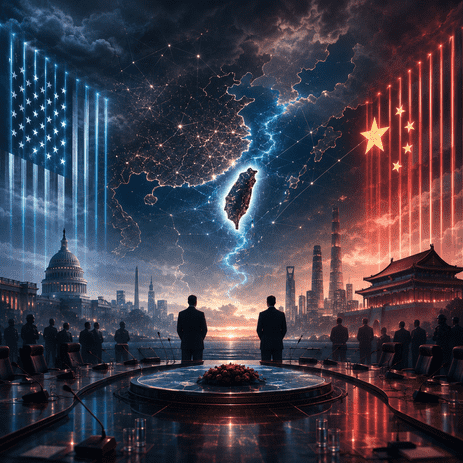
Taipei fears Beijing may use next week’s meeting to pressure Washington over one of the world’s most sensitive flashpoints

Taiwan has become the central diplomatic fault line ahead of next week’s meeting between U.S. President Donald Trump and Chinese President Xi Jinping in Beijing, as Taipei warns that China may try to use the summit to reshape Washington’s position on the island.
Taiwan’s National Security Bureau Director-General Tsai Ming-yen said China could attempt political “manoeuvring” over Taiwan during the Trump-Xi talks, while stressing that the United States has reaffirmed that its Taiwan policy has not changed. The warning reflects growing anxiety in Taipei that Beijing may seek concessions from Washington as part of a wider negotiation involving trade, technology, rare earths and regional security.
The summit, scheduled for May 14–15, is expected to focus on managing tensions between the world’s two largest economies rather than resolving their deepest disputes. Reuters reported that Taiwan, trade, the Iran war, semiconductor controls and access to critical minerals are all likely to feature on the agenda. Both sides are seeking limited progress, but no major breakthrough is expected.
For Beijing, Taiwan remains the most politically sensitive issue in relations with Washington. China claims Taiwan as part of its territory, while Taiwan’s government rejects Beijing’s sovereignty claims and maintains that only its people can decide the island’s future. China has repeatedly pressed the United States to adjust its language and commitments on Taiwan, seeing American support for Taipei as a direct challenge to its core national interests.
The diplomatic pressure has intensified in recent days. China’s Foreign Ministry said U.S. adherence to the “One China principle” is essential for stable relations, while senior Chinese officials have again described Taiwan as a red line in bilateral ties. A bipartisan group of U.S. senators visiting Beijing called for stability and peaceful cooperation, but Chinese Premier Li Qiang underlined that Taiwan remains a critical issue for China.
The issue is especially delicate because Taiwan sits at the intersection of military deterrence, democratic governance, semiconductor security and great-power rivalry. Any perceived shift in U.S. language could be interpreted in Taipei as a weakening of support, while Beijing could present even symbolic wording changes as a diplomatic victory. That makes the summit’s communiqués, press statements and informal remarks almost as important as any formal agreement.
Washington’s position is deliberately complex. The United States does not maintain formal diplomatic relations with Taiwan, but it remains the island’s most important security partner and supplies defensive support under U.S. law. Secretary of State Marco Rubio has said Taiwan is likely to be discussed, while also indicating that neither Washington nor Beijing wants to destabilize the Indo-Pacific region.
For Trump, the meeting presents both an opportunity and a risk. A trade truce extension, agricultural purchases, aircraft deals or cooperation over global crises could offer visible diplomatic wins. But any agreement that appears to soften U.S. support for Taiwan would face scrutiny from Congress, allies and security officials concerned about deterrence in the Taiwan Strait.
For Xi, raising Taiwan directly allows Beijing to reinforce its long-standing claim that the island is the foundation of U.S.-China political trust. It also gives China leverage in a broader negotiation at a moment when both countries are seeking economic relief and strategic stability.
The outcome may depend less on dramatic announcements than on language. In international relations, especially over Taiwan, phrasing can become policy. As the summit approaches, Taipei will be watching not only what Trump and Xi decide, but how they describe it.