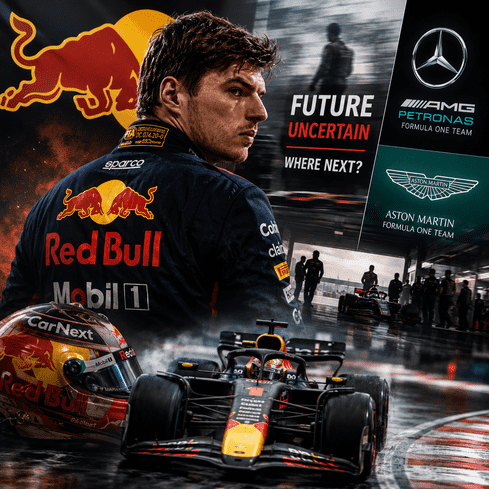
Internal pressure, leadership uncertainty, and growing interest from rival teams are fueling speculation over the Formula One champion’s long-term future.

Fresh uncertainty surrounding Max Verstappen’s future at Red Bull Racing has reignited debate across the Formula One paddock, as tensions inside the reigning world champions continue to overshadow the early stages of the 2026 season.
Despite remaining one of the sport’s dominant drivers, Verstappen has faced increasing questions about his long-term commitment to Red Bull amid growing instability within the organization. Team leadership changes, internal political struggles, and concerns over the competitiveness of Red Bull’s next-generation engine program have all contributed to speculation that the three-time world champion could eventually consider a move elsewhere.
The latest wave of rumors intensified following reports that Mercedes and Aston Martin remain highly interested in securing Verstappen should his relationship with Red Bull deteriorate further. While no formal negotiations have been confirmed publicly, senior figures throughout Formula One increasingly believe the Dutch driver’s future may no longer be guaranteed beyond the next two seasons.
At the center of the uncertainty is Red Bull’s ongoing transition following major structural changes inside the organization. The departure of key engineering figures and mounting pressure surrounding the team’s new power-unit project have raised concerns about whether Red Bull can maintain the technical dominance that defined recent championships.
Formula One’s sweeping regulation changes scheduled for 2026 have only increased the stakes. Teams are preparing for one of the largest technical resets in modern F1 history, with major revisions affecting aerodynamics, hybrid systems, and sustainable fuel integration. Analysts say the competitive order could shift dramatically once the new rules take effect, potentially reshaping the balance of power across the grid.
For Verstappen, whose career has been defined by relentless competitiveness, long-term technical stability is considered a critical factor. Sources close to the paddock suggest the driver’s camp is closely monitoring whether Red Bull’s in-house engine development can compete with established manufacturers such as Mercedes and Ferrari under the new regulations.
Meanwhile, rival teams are positioning themselves aggressively. Mercedes team principal Toto Wolff has repeatedly praised Verstappen publicly over recent months, comments many observers interpret as a strategic signal that the German manufacturer remains open to pursuing the reigning champion if an opportunity emerges.
Aston Martin has also become an increasingly serious player within the sport. Backed by major investment and strengthened by the arrival of renowned designer Adrian Newey, the British team is seeking to establish itself as a long-term championship contender capable of attracting elite driving talent.
Despite the speculation, Verstappen has continued to perform at an exceptionally high level on track. His consistency and race management remain among the strongest in Formula One, even as Red Bull faces mounting competitive pressure from Ferrari, McLaren, and Mercedes.
The growing uncertainty reflects a broader shift underway inside Formula One. Once dominated by stable dynasties, the sport is entering a period of significant transformation driven by financial regulation, new manufacturers, expanding global audiences, and technological change.
For Red Bull, retaining Verstappen may ultimately become about more than salary or contract duration. It may depend on convincing Formula One’s most valuable driver that the team can remain at the forefront of the sport’s next technological era.
As the 2026 season unfolds, the battle over Verstappen’s future is increasingly becoming one of Formula One’s defining storylines — one that could shape the competitive landscape of the championship for years to come.