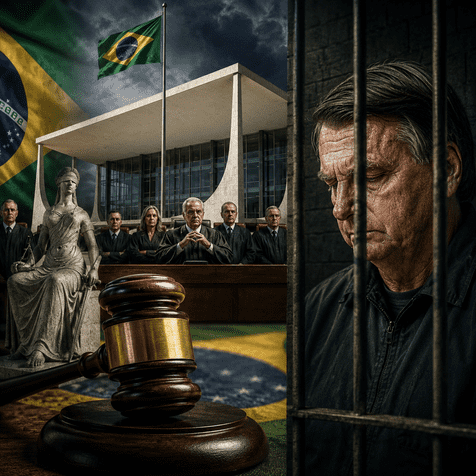
The ruling keeps the former president’s 27-year sentence intact and deepens Brazil’s struggle over democracy, accountability and political polarization

Brazil’s Supreme Court has blocked a congressional measure that would have sharply reduced the prison sentence of former President Jair Bolsonaro, preserving one of the most consequential criminal penalties ever imposed on a former Brazilian leader.
Justice Alexandre de Moraes suspended the implementation of a bill that would have enabled Bolsonaro’s early release, after the former president was sentenced to 27 years in prison for plotting a coup following his defeat in the 2022 election. The decision places the court once again at the center of Brazil’s most divisive political battle: how far democratic institutions should go in punishing attempts to overturn an election.
The ruling is politically explosive. Bolsonaro remains a powerful figure on Brazil’s right, and his supporters have long accused the judiciary of targeting him for political reasons. His critics, however, argue that the sentence is essential to defending the constitutional order after years of attacks on Brazil’s electoral system.
The blocked legislation had been seen by Bolsonaro’s allies as a legal pathway to reduce the impact of his conviction and potentially restore his influence ahead of future political contests. By suspending it, Moraes signaled that the court would not allow Congress to undermine penalties linked to anti-democratic crimes.
The case is also a test for President Luiz Inácio Lula da Silva’s Brazil. Lula’s government has sought to present the country as a restored democracy after the turbulence of the Bolsonaro years, but the political environment remains deeply polarized. Any decision involving Bolsonaro quickly becomes a national confrontation between rival visions of justice, sovereignty and democratic legitimacy.
The Supreme Court’s intervention may strengthen confidence among those who believe Brazil’s institutions survived a direct threat. But it is also likely to inflame Bolsonaro’s base, which sees the former president’s prosecution as evidence of judicial overreach.
Brazil is therefore entering another tense chapter in its post-2022 political crisis. The question is no longer only whether Bolsonaro will remain in prison. It is whether Brazil’s institutions can enforce accountability without further deepening the divisions that made the crisis possible in the first place.