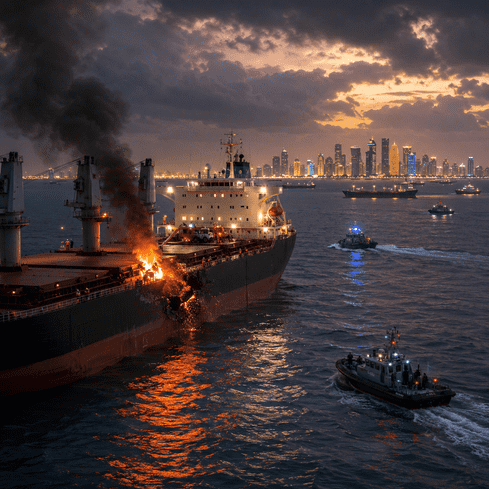
A cargo ship was struck by an unknown projectile near Doha, underscoring how quickly maritime tensions can threaten energy markets and regional stability.

A cargo ship caught fire off the coast of Qatar on Sunday after being struck by an unknown projectile, in the latest sign that the fragile ceasefire around the Persian Gulf is under growing pressure.
The incident occurred about 23 nautical miles northeast of Doha, according to the United Kingdom Maritime Trade Operations centre. The strike caused a small fire on the vessel, which was later extinguished, and no casualties or environmental damage were reported. Authorities are investigating the source of the projectile, while ships in the area have been advised to proceed with caution.
The attack comes amid a tense regional standoff following the U.S.-Iran conflict and repeated disruptions around the Strait of Hormuz, one of the world’s most important energy corridors. The Trump administration says a month-old ceasefire with Iran remains in effect, but that truce has been repeatedly tested by restrictions on shipping, attacks on vessels and threats of renewed military action.
The security concerns are already feeding into global energy anxiety. Saudi Aramco’s chief executive warned on Sunday that the world has lost about one billion barrels of oil over the past two months and that markets will take time to stabilize even if shipping flows resume. Reuters reported that disruptions through Hormuz have squeezed global supply and pushed prices higher.
For Gulf states, the attack near Qatar is more than a maritime security incident. It is a reminder that even limited strikes can carry strategic consequences when they occur near shipping lanes that connect Asian, European and global energy markets.
Diplomatically, the timing is also sensitive. Washington is awaiting Tehran’s response to a proposal aimed at ending the war, reopening shipping routes and rolling back Iran’s nuclear program. But the latest incident shows how easily battlefield restraint can be undermined by maritime confrontation, proxy activity or miscalculation.
For now, the immediate damage appears limited. The wider risk is not. In a region where oil, security and diplomacy are tightly connected, a single projectile at sea can quickly become a test of whether the Gulf’s fragile ceasefire is holding — or beginning to unravel.