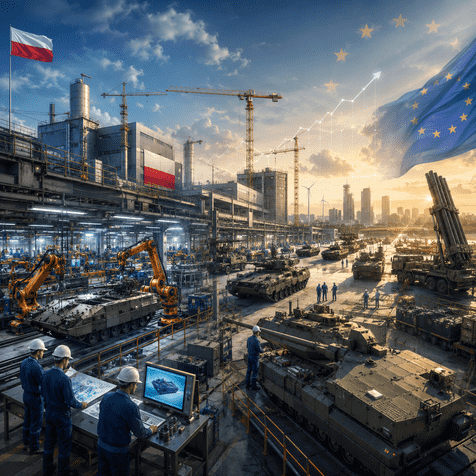
Poland’s €43.7 billion EU loan signals a shift in Europe’s economic strategy, where security, industry and public investment are becoming increasingly intertwined.

Europe’s economic debate is moving beyond inflation and interest rates. A new priority is emerging at the center of the continent’s growth strategy: defence investment.
Poland has become the first EU country to sign a loan agreement under the bloc’s Security Action for Europe programme, securing €43.7 billion to expand its military capabilities and strengthen domestic defence production. The deal marks one of the clearest signs yet that Europe is treating security spending not only as a geopolitical necessity, but also as an industrial and economic policy tool.
The programme comes at a moment when European governments are under pressure to increase military readiness while also supporting sluggish growth. Poland is already one of Europe’s most aggressive defence spenders, with plans to allocate 4.8% of GDP to defence in 2026. The new EU-backed financing is expected to support weapons procurement, air-defence systems, artillery, tanks and local manufacturing capacity.
For Brussels, the significance goes beyond Poland. The SAFE programme reflects a broader attempt to build a stronger European defence-industrial base, reduce dependence on external suppliers and direct public money toward sectors with high technological spillover potential. In practical terms, that means defence could become one of the few areas where governments are willing to spend heavily despite tight budgets.
The economic logic is straightforward: large-scale defence contracts can support manufacturing, engineering, electronics, cybersecurity and advanced materials. They can also create demand for European firms at a time when many industries are struggling with weak consumption, high energy costs and uncertain export markets.
But the strategy carries risks. Defence spending can stimulate industry, but it does not automatically solve Europe’s deeper competitiveness problems. The continent still faces fragmented capital markets, limited private investment and slow productivity growth. The European Central Bank recently warned that euro-area stock markets remain fragmented, a weakness that limits Europe’s ability to channel savings into investment.
Poland’s deal therefore represents both an opportunity and a test. If EU defence financing strengthens European production chains and generates technological innovation, it could become a new pillar of economic resilience. If it mainly funds imported equipment or short-term procurement, the broader economic benefits may be more limited.
For now, the message is clear: Europe’s economy is being reshaped by security concerns. Defence is no longer only a military question. It is becoming a major part of the continent’s industrial future.