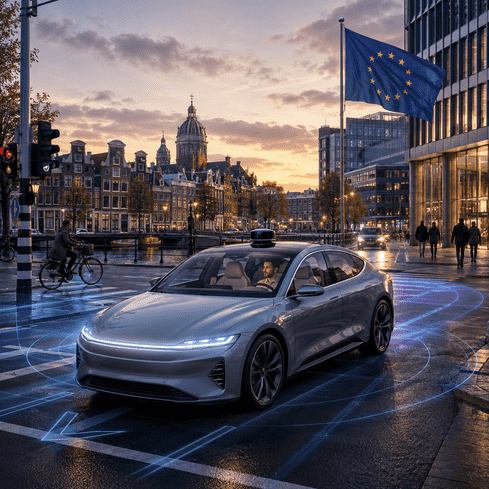
Dutch approval has opened the door for Tesla’s supervised autonomous-driving system in Europe, but regulators across the EU remain divided over whether the technology is ready for wider use.

Tesla’s long-running effort to bring its “Full Self-Driving” technology to Europe has reached a critical moment, as Dutch regulators push for broader EU approval while several European authorities remain skeptical about the system’s safety claims.
The technology, officially called Full Self-Driving (Supervised), allows a Tesla vehicle to steer, turn and accelerate on its own, but still requires the driver to remain alert and ready to intervene. In April, the Dutch vehicle authority RDW granted provisional approval for the system on Dutch roads, making the Netherlands the first European market to move toward real-world deployment of Tesla’s supervised self-driving software.
Tesla and RDW are now seeking a wider EU green light through a special regulatory route that treats the software as a new technology not yet fully covered by existing vehicle-approval rules. The proposal has been sent to the European Commission and is under review by the Technical Committee on Motor Vehicles, with a possible vote expected between July and October 2026.
The stakes are high. If approved, Tesla could roll out the system across the European Union, giving the company a significant advantage in the race to commercialize advanced driver-assistance technology. If rejected, individual countries may still allow limited national use, but that would risk fragmenting Europe’s single automotive market.
The debate also reflects a broader tension in the car industry. Automakers are increasingly shifting investment from traditional electric-vehicle expansion toward software, artificial intelligence and autonomous-driving systems. At the same time, regulators are under pressure to ensure that new technology does not move faster than safety standards. Reuters reported that records show some European regulators have expressed skepticism toward Tesla’s claims about the benefits of the system.
For Tesla, European approval would be more than a product milestone. It would strengthen the company’s position at a time when competition from Chinese and European electric-vehicle makers is intensifying. At Beijing’s 2026 auto show, artificial intelligence, autonomous driving and drive-by-wire systems dominated the agenda, underlining how quickly the global car industry is becoming a technology race rather than only a manufacturing contest.
For European regulators, however, the question is not simply whether autonomous-driving software is innovative. It is whether it is predictable, transparent and safe enough for complex European roads, where legal liability, driver responsibility and national traffic rules remain sensitive issues.
Tesla’s next test will therefore be political as much as technical. The company has already convinced one European regulator. Now it must persuade the rest of the bloc that supervised self-driving can be trusted at continental scale.