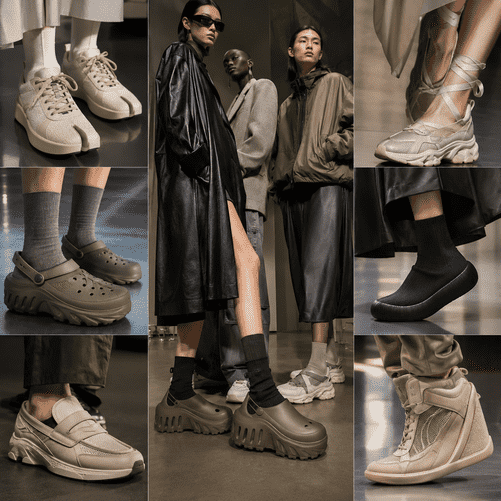
From split-toe sneakers to mucus-colored clogs, a new wave of hybrid footwear is challenging traditional elegance, driven by a desire for comfort, cultural signaling, and a rejection of digital perfection.

In 2026, the definition of a statement shoe has undergone a radical transformation. Gone are the days when the pinnacle of footwear elegance was exclusively reserved for the sleek lines of a Manolo Blahnik stiletto. Today, the fashion-forward are turning their attention to the flat, the wide, and the undeniably strange. A new genre of footwear, characterized by bizarre silhouettes and “ugly” aesthetics, has taken the global style scene by storm, merging practical utility with high-concept design.
This movement is defined by two primary categories: the “weird,” which laughs in the face of traditional taste, and the “Frankenshoe,” a hybrid that mashes disparate shoe styles into a single, unexpected form.
The Era of the Hybrid and the Weird
The current landscape is dominated by footwear that prioritizes the unexpected. Examples range from the five-toed sneaker, which encases each toe individually, to the “snoafer”—a portmanteau of sneaker and loafer that The Wall Street Journal has dubbed “the footwear equivalent of the spork.”
Other notable entries include the sneakerina, a dainty hybrid of a ballet pump and a trainer; the sock-boot; and the resurgence of the wedge-trainer. Perhaps the most recognizable of the “weird” category is the Gardana gardening clog, a mucus-colored shoe that has migrated from horticultural utility to the streets of Brooklyn and Paris.
The influence of avant-garde design remains potent. Jonathan Anderson’s 2023 reintroduction of the Wellipet frog wellington boot on the runway signaled a shift toward the absurd, while Parisian brand Y/Project offered jelly clogs with embossed rococo designs. Yet, the most enduring icon of this trend remains the cloven-toe shoe, popularized by Maison Margiela’s Tabi. Since its 1988 debut, inspired by 15th-century Japanese socks, the split-toe design has become a staple, with nearly every major trainer brand now offering a variation.
From Stunt to Consumer Demand
While some of these designs, such as the MSCHF Big Red Boot, were created primarily to generate memes and provoke reactions, the market data suggests a deeper consumer appetite.
“People increasingly enjoy fashion items that provoke reactions, become conversational objects, or function almost like visual memes,” says J’Nae Phillips, creator of the Fashion Tingz newsletter.
However, the trend is not merely about shock value. Sales figures indicate a shift from editorial hype to genuine demand. According to Brendan Dunne of the resale platform StockX, sales of Mary Jane-inspired sneakers surged by more than 350% year-over-year in the first quarter of 2026. Similarly, the New Balance 1906L “snoafer” has recorded over 13,000 sales since its launch.
“There is huge interest in hybrid silhouettes that blend sport, fashion, and a bit of unexpected design,” Dunne notes.
The Psychology of the “Wrong Shoe”
The rise of these unconventional styles aligns with the “wrong-shoe theory,” a styling concept popularized on TikTok in 2023 by stylist Allison Bornstein. The theory posits that footwear that looks slightly “off” or mismatched adds personality and breaks the stiffness of an outfit.
In an era of algorithmic curation and AI-generated content, these shoes serve as a form of “anti-perfection energy.” They signal a refusal to be overly polished or predictable.
“In a moment where personal style feels increasingly performative and optimised, an unusual shoe can signal individuality, humour, discernment, or even a refusal to dress in a way that is overly predictable,” Phillips explains.
For the fashion-literate, wearing a split-toe shoe or a hybrid silhouette also functions as a cultural shibboleth. Meg Palmer of market research agency Verve describes it as an “If You Know You Know” moment. “It shows that you are part of an elite subculture,” she says, noting that the trend signals cultural fluency. However, she warns that as these styles become widespread, the status signal may require even more obscure variants to maintain its exclusivity.
Comfort as the Ultimate Driver
Beyond the cultural and psychological drivers, there is a pragmatic reality underpinning the “ugly shoe” phenomenon: they are comfortable.
The collapse of boundaries between utility wear, sportswear, and luxury fashion has brought orthopaedic and hiking-inspired designs into the mainstream. Approach shoes, which combine the grip of climbing footwear with the comfort of hiking boots, have scaled fashion’s heights by offering intrigue without sacrificing function.
As Palmer succinctly puts it, “You can talk a lot about rebellion, AI slop fatigue, taste, status etc. But it’s all just as simple as… they’re really, really comfy.”
In a world of blurring lines between work and leisure, and masculine and feminine codes, the “ugly shoe” has emerged as the perfect symbol of the times: functional, unconventional, and unapologetically comfortable.