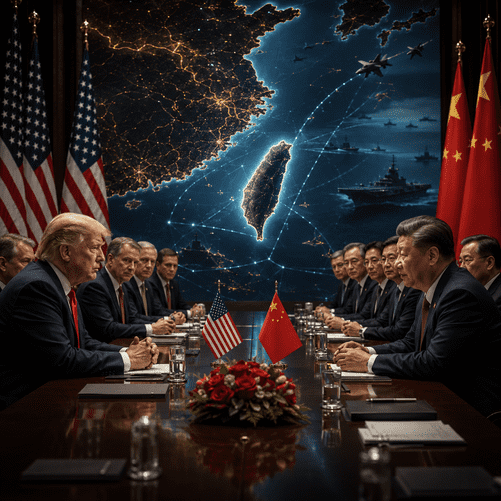
Behind the diplomatic choreography in Beijing, the world’s two largest powers remain divided over Taiwan, trade, technology and the future balance of power in Asia.

Chinese President Xi Jinping used a high-profile summit with U.S. President Donald Trump in Beijing to deliver a blunt warning over Taiwan, underscoring how the island remains the most dangerous fault line in U.S.–China relations despite renewed efforts to stabilize diplomatic and economic ties. According to reporting from the summit, Xi warned that mishandling Taiwan could lead to “clashes and even conflicts,” while pressing Washington to reduce support for Taipei.
The meeting came at a volatile moment for global politics. Washington and Beijing are trying to manage a relationship strained by tariffs, technology controls, military competition in the Indo-Pacific and diverging positions on major international crises. The summit also took place as the war involving Iran continues to disrupt energy markets and trade routes, adding urgency to discussions between the two powers.
Taiwan dominated the strategic backdrop. Beijing claims the self-governed island as part of its territory and has not ruled out the use of force to achieve unification. Taipei rejects China’s sovereignty claim, while the United States maintains unofficial relations with Taiwan and supplies it with defensive arms. U.S. Secretary of State Marco Rubio said there was no change in Washington’s Taiwan policy, despite China’s pressure during the talks.
The summit was not limited to security tensions. Trade, artificial intelligence, energy security and Iran were also on the agenda. U.S. and Chinese officials have reportedly discussed possible guardrails for advanced artificial intelligence, particularly to prevent powerful models from being misused by criminal groups or non-state actors.
Economically, the talks were watched closely by international institutions and markets. The International Monetary Fund said constructive U.S.–China dialogue and reduced tensions between the two largest economies would be positive for the global economy, especially at a time of elevated uncertainty linked to energy prices and conflict in the Middle East.
Still, the summit produced more symbolism than certainty. Both sides presented the meeting as an opportunity to manage rivalry, but the central disputes remain unresolved. For Washington, the challenge is to reassure allies in Asia without triggering a direct confrontation with Beijing. For China, the objective is to pressure the United States to limit its support for Taiwan while preserving economic access to Western markets and technology.
The result is a fragile diplomatic pause rather than a breakthrough. The Beijing summit showed that the United States and China still recognize the danger of uncontrolled escalation. But Xi’s warning over Taiwan also made clear that the political relationship between the two powers is entering a more precarious phase, where cooperation on trade and technology may coexist with an increasingly sharp military and strategic rivalry.