Finance ministers meeting in Paris say trade fragmentation, energy shocks and dependence on China are exposing structural weaknesses in Europe’s economy.

PARIS — Europe’s economic model came under renewed scrutiny on Tuesday as G7 finance ministers warned that global trade imbalances are becoming unsustainable, with Europe singled out for chronic under-investment at a time of rising geopolitical and energy risks.
Meeting in Paris, G7 finance ministers and central bank governors agreed that the world economy is becoming more fragmented and vulnerable to shocks. The talks were dominated by the economic fallout from the Iran war, instability in global bond markets, and the need to reopen the Strait of Hormuz, a critical route for energy and food supplies.
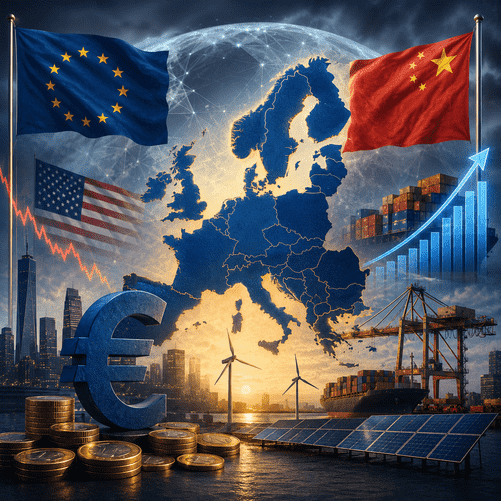
French Finance Minister Roland Lescure described the imbalance bluntly: China under-consumes, the United States over-consumes, and Europe under-invests. He warned that this pattern is fuelling trade friction and could trigger turbulence in financial markets if it unwinds suddenly.
For Europe, the warning comes at a delicate moment. Inflation remains above the European Central Bank’s target, with Eurostat reporting euro area inflation at 2.6% in March 2026, driven in part by a renewed rise in energy prices. At the same time, major institutions have lowered their eurozone growth forecasts, with the IMF projecting only 1.1% growth for 2026 and the ECB forecasting 0.9%.
The combination of weak growth and renewed inflation pressure leaves policymakers facing a difficult balance. Higher interest rates could help contain price rises, but they would also risk further slowing investment, housing and industrial activity. Financial conditions are already tightening: euro area long-term government bond yields rose to 3.34% in March from 3.12% a month earlier, according to Eurostat.
The G7 also focused on Europe’s dependence on China for rare earths and critical minerals, which are essential for electric vehicles, renewable energy systems and defence technologies. Ministers pledged deeper cooperation on supply chains, strategic reserves and pricing mechanisms designed to prevent China from undercutting alternative suppliers.
The message from Paris was clear: Europe’s next economic challenge is not only inflation or slow growth, but the deeper question of competitiveness. Without stronger investment in industry, energy security, technology and supply chains, European economies risk being squeezed between American consumption power and Chinese industrial dominance.
For Brussels and national capitals, the debate is likely to intensify. The Financial Times reported this week that the EU is already examining measures to reduce reliance on Chinese suppliers and manage trade tensions with Washington, signs that Europe’s economic policy is moving from crisis management toward strategic protection and industrial resilience.