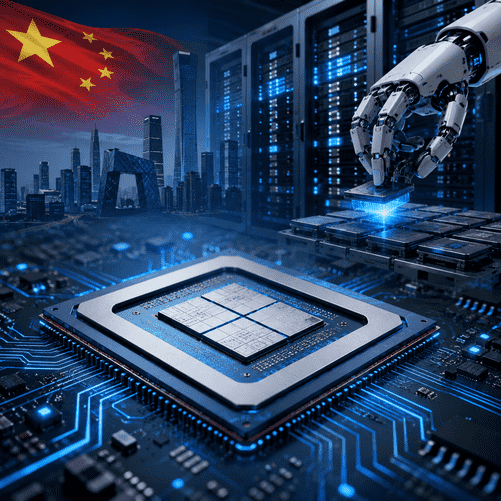
The Zhenwu M890 marks Beijing’s latest step toward building a domestic AI supply chain as U.S. export restrictions reshape the global semiconductor race.

Alibaba has unveiled a new artificial intelligence chip designed to power demanding AI workloads, in a move that signals China’s accelerating effort to reduce reliance on U.S. semiconductor technology.
The Chinese technology group introduced the Zhenwu M890, developed by its T-Head semiconductor division, at the Alibaba Cloud Summit on May 20. According to Reuters, the chip delivers roughly three times the performance of its predecessor and is aimed at advanced AI agent workloads requiring large memory capacity and real-time coordination.
The launch comes at a critical moment in the global AI race. U.S. restrictions on exports of advanced semiconductors have limited Chinese firms’ access to top-end Nvidia chips, pushing companies such as Alibaba, Huawei, Tencent and others to invest more aggressively in domestic alternatives. Alibaba’s new chip is not just a product announcement; it is part of a broader technological and geopolitical strategy.
Alibaba also presented a long-term chip roadmap, including plans for a V900 chip in 2027 and a J900 chip in 2028. The company said these future processors are expected to bring further performance gains as Chinese firms try to close the gap with U.S. semiconductor leaders.
Alongside the chip, Alibaba introduced the Panjiu AL128, a server system integrating 128 accelerators per rack. The system is already available to Chinese enterprise customers, underlining Alibaba’s ambition to offer not only chips, but a full AI infrastructure stack for cloud computing, enterprise automation and large-scale model deployment.
The announcement fits into Alibaba’s broader investment strategy. The company has committed about $53 billion over three years to AI and cloud infrastructure, reflecting how central artificial intelligence has become to China’s technology sector. T-Head has already shipped more than 560,000 Zhenwu chips across 20 industries and to more than 400 external customers, according to Reuters.
Alibaba also introduced Qwen 3.7-Max, a new version of its large language model designed for long-duration operations and complex coding tasks. The company said the model can operate for up to 35 hours without degraded performance, suggesting a focus on AI agents capable of sustained reasoning, software development and enterprise workflows.
The broader significance is clear: AI competition is increasingly becoming a contest over hardware sovereignty. The companies that control chips, servers, cloud infrastructure and models will shape the next phase of technological power. For China, domestic AI chips are no longer optional; they are essential to maintaining momentum under U.S. pressure.
The Zhenwu M890 may not immediately displace Nvidia’s most advanced processors, but it represents another step in China’s drive to build a self-sufficient AI ecosystem. As export controls tighten and global demand for computing power rises, the semiconductor race is becoming one of the defining fronts of international technology competition.