House vote becomes a major test of presidential authority as lawmakers question a conflict launched without congressional approval

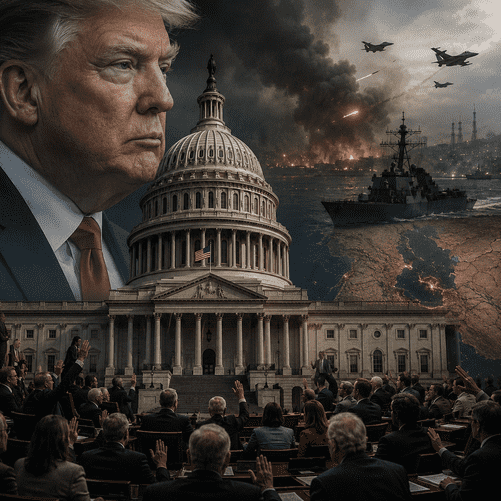
The U.S. House of Representatives is expected to vote Thursday on legislation that would compel President Donald Trump to withdraw from the war with Iran, setting up one of the most consequential political tests of his second term.
The measure, led by Democrats, invokes the War Powers Resolution of 1973, the post-Vietnam law designed to limit a president’s ability to keep U.S. forces in combat without congressional authorization. The vote comes more than two months after Trump launched the conflict without formal approval from Congress, intensifying a long-running constitutional dispute over who controls America’s war-making power.
The political pressure is rising because the Iran war has moved beyond a foreign-policy crisis and become a domestic issue. The stalemate around the Strait of Hormuz has disrupted global shipping and pushed fuel prices higher, increasing voter frustration ahead of the November midterm elections. AP reported that a previous House war-powers resolution nearly passed last week, ending in a tie after three Republicans joined Democrats.
Democrats believe Thursday’s vote could mark a turning point. Rep. Gregory Meeks, the sponsor of the House resolution, has argued that Congress has a constitutional duty to act rather than simply endorse an open-ended conflict. The effort gained momentum after Democratic Rep. Jared Golden, who previously opposed the resolution, said he would now support it.
The Senate has also shown signs of resistance. Earlier this week, four Republican senators helped advance a separate war-powers resolution, though Republican leaders still expect to block final passage once all GOP senators are present. Even so, the defections indicate growing unease inside Trump’s own party over the legal and political limits of the conflict.
The White House argues that the War Powers Resolution no longer applies because of a ceasefire with Iran. But Trump has also warned that U.S. forces should be ready for a “large scale assault” if negotiations fail, leaving lawmakers skeptical that the conflict has truly ended. Reuters reported Thursday that U.S.-Iran talks remain stalled, with Washington demanding access to Iran’s enriched uranium stockpile and opposing Iranian efforts to impose controls or fees on ships passing through the Strait of Hormuz.
The international stakes are significant. The Strait of Hormuz is one of the world’s most important energy corridors, and the conflict has already contributed to a sharp oil shock. Reuters reported that U.S. crude rose above $101 a barrel and Brent climbed above $107 on Thursday, while diplomatic efforts led by Pakistan have made little visible progress.
For Congress, the vote is about more than Iran. It is a test of whether lawmakers can reassert their constitutional role in decisions of war and peace after decades in which presidents of both parties have expanded military authority. If the resolution advances, it could trigger a legal and political confrontation with the White House.
For Trump, the risk is also domestic. Rising fuel prices, uncertain war aims and congressional dissent could weaken his political position at a sensitive moment before the midterms. For America’s allies and rivals, the debate reveals a deeper question: whether U.S. foreign policy is being shaped by institutional consensus, or by a presidency increasingly willing to test the limits of executive power.