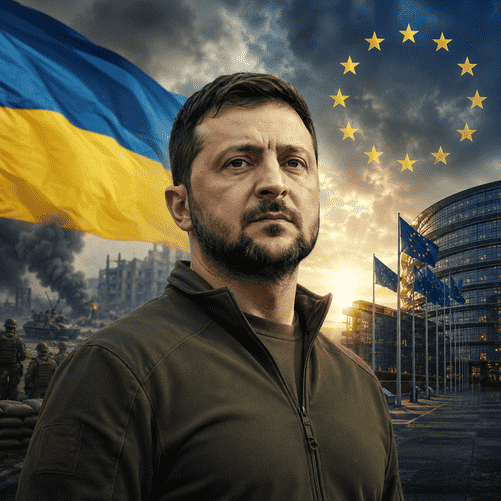
The Ukrainian president says the “time is right” to begin the next stage of accession, rejecting proposals for second-tier membership while Kyiv and Moscow fight for advantage on the battlefield.

Ukrainian President Volodymyr Zelenskyy has urged European leaders to move forward with Ukraine’s accession to the European Union, arguing that the country has earned a full and equal place in the bloc while continuing to resist Russia’s invasion.
His appeal comes at a sensitive moment for both diplomacy and the war. Kyiv is seeking deeper political integration with Europe as a security guarantee, while Moscow continues to test Ukraine’s defenses and tries to shape the battlefield before any future negotiations. Zelenskyy’s message to Brussels is clear: Ukraine does not want symbolic partnership or partial status. It wants the formal accession process to advance.
The latest debate was triggered by a proposal associated with German Chancellor Friedrich Merz for a form of “associate membership” that could allow Ukraine to participate in some EU structures before becoming a full member. The idea was presented as a pragmatic bridge while accession remains politically and technically difficult. But Zelenskyy rejected the concept as unfair, warning that any arrangement without voting rights would leave Ukraine in a second-class position inside Europe’s political architecture.
Ukraine has already made significant progress on its EU track. The country received official candidate status in June 2022, accession negotiations formally began in June 2024, and the European Commission says Ukraine completed its screening process in September 2025. That screening is a major technical step, allowing Brussels and Kyiv to assess how Ukrainian laws and institutions align with EU rules.
For Kyiv, the accession process is not only bureaucratic. It is strategic. Zelenskyy has repeatedly framed EU membership as part of Ukraine’s long-term security, arguing that Ukraine is defending not only its own territory but also the wider European order. In that view, accession would send Moscow a political signal that Russia cannot veto Ukraine’s future through military force.
The timing also reflects changes inside Europe. Ukraine’s path has previously been slowed by resistance from Hungary, whose government repeatedly raised objections linked to minority rights and the risks of integrating a country at war. But recent political shifts in Budapest have raised hopes in Kyiv that the blockage could ease, opening space for the EU to move forward on accession clusters.
Still, Ukraine’s road to membership remains difficult. EU enlargement requires unanimous approval from member states, deep legal reforms from the candidate country and agreement on sensitive questions including agriculture, budgets, anti-corruption standards and institutional voting power. Ukraine’s size, agricultural strength and wartime reconstruction needs make its accession one of the most complex enlargement cases in EU history.
The battlefield adds urgency. Both Kyiv and Moscow are trying to improve their positions militarily while diplomatic channels remain uncertain. Ukraine wants Europe to act before fatigue, domestic politics or Russian pressure slow the process further. Russia, meanwhile, continues to bet that time, attrition and political division in the West will weaken support for Kyiv.
That is why Zelenskyy’s statement carries weight beyond EU procedure. By saying the “time is right,” he is arguing that Europe faces a strategic decision: treat Ukraine as a future full member now, or risk leaving it in a grey zone that Moscow can exploit.
For the European Union, the choice is equally consequential. Advancing Ukraine’s accession would strengthen Europe’s geopolitical role but also force the bloc to confront its own limits on enlargement, defense and institutional reform. Delaying the process may reduce short-term political friction, but it could also undermine the message that Ukraine’s future lies firmly inside Europe.
Zelenskyy’s demand is therefore both diplomatic and symbolic. Ukraine is asking not merely to be helped, but to be admitted into the political community it says it is fighting to defend.