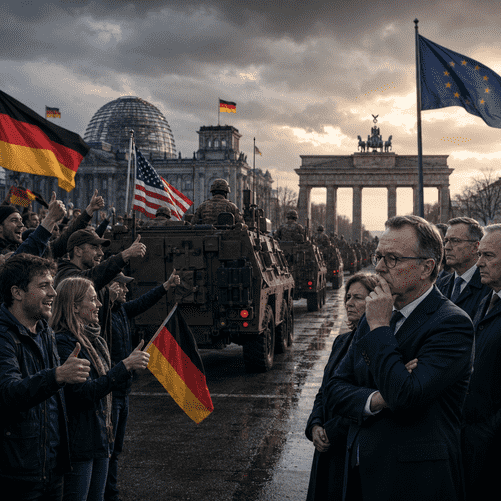
From the far right to the far left, parties representing a significant share of German voters are welcoming Washington’s military drawdown — even as Berlin’s mainstream leaders warn of a dangerous blow to NATO deterrence.

A new fault line has opened in German politics after U.S. President Donald Trump moved to reduce America’s military presence in Germany, a decision that has drawn alarm from Berlin’s governing establishment but applause from an unlikely coalition on the country’s political extremes.
Trump’s decision to pull around 5,000 U.S. troops from Germany, and to abandon plans for stationing long-range missiles there, was widely interpreted by European officials as a punitive move following tensions between Washington and Berlin over the war with Iran. The Pentagon framed the step as part of a broader reassessment of U.S. deployments in Europe, while NATO officials have said they do not expect further large-scale American reductions beyond the announced drawdown.
For Germany’s mainstream leadership, the announcement was a warning sign. Chancellor Friedrich Merz has sought to downplay the diplomatic row with Trump, but the withdrawal has intensified concerns that Washington’s security guarantees are becoming less predictable at precisely the moment Europe faces renewed strategic pressure from Russia and instability in the Middle East.
Yet inside Germany, not everyone sees the move as a setback. Politicians from the far-right Alternative for Germany, the far-left Die Linke, and the Sahra Wagenknecht Alliance have welcomed the American decision, arguing that Germany should no longer host large numbers of foreign troops or serve as a platform for U.S. military strategy. According to reporting on the debate, these parties together represent roughly a third of German voters and are using the troop reduction to revive long-running arguments over sovereignty, neutrality and dependence on Washington.
Their positions differ ideologically, but the message overlaps. The far right frames the withdrawal as a restoration of German national independence. The far left describes it as a necessary step away from militarization and confrontation with Russia. The Wagenknecht camp, which blends left-wing economics with a strongly critical view of NATO policy, sees the drawdown as evidence that Germany should pursue a more autonomous security strategy.
The unusual convergence reflects a deeper unease in German society. For decades, U.S. bases in Germany symbolized the postwar transatlantic order: American protection, NATO integration and the country’s role as a central logistics hub for Western military operations. But that arrangement has become more contested as German voters question whether U.S. policy still aligns with European interests.
Trump’s return to power has sharpened those doubts. His pressure on NATO allies to spend more on defense, his willingness to link military commitments to political disputes, and his confrontational approach toward European governments have all strengthened calls in Germany for a security policy less dependent on Washington. European officials have increasingly described the troop reduction as proof that Europe must assume a greater role inside NATO and build stronger defense capabilities of its own.
The cancellation of the planned long-range missile deployment is especially sensitive. Supporters of the deployment argued that it would strengthen deterrence against Russia. Critics countered that it would make Germany a more likely target in any future confrontation. For anti-NATO voices on both the left and right, Trump’s reversal offers a political opportunity: they can claim that even Washington now sees Germany as overexposed.
But security analysts warn that celebrating the withdrawal may ignore the strategic risks. Germany remains a key NATO hub, and U.S. forces stationed there support operations across Europe, the Middle East and Africa. A reduced American footprint could weaken rapid-response capabilities, complicate deterrence planning and raise pressure on Germany to accelerate its own military modernization.
The debate now facing Berlin is larger than the number of troops involved. It is about whether Germany should respond to American unpredictability by doubling down on NATO, building a more independent European defense posture, or moving toward the kind of strategic distance from Washington long advocated by the country’s anti-establishment parties.
For Merz and Germany’s centrist leadership, the challenge is delicate. They must reassure allies that Berlin remains committed to NATO while acknowledging that public confidence in U.S. reliability has weakened. For the far right and far left, Trump’s drawdown is a rare gift: an American president delivering, for his own reasons, a policy they have demanded for years.
What began as a dispute between Washington and Berlin has therefore become something larger — a test of Germany’s postwar security consensus. The U.S. troop withdrawal may be limited in scale, but politically, it has opened a debate that reaches to the core of Germany’s identity as a European power, a NATO ally and a country still negotiating the limits of its sovereignty.