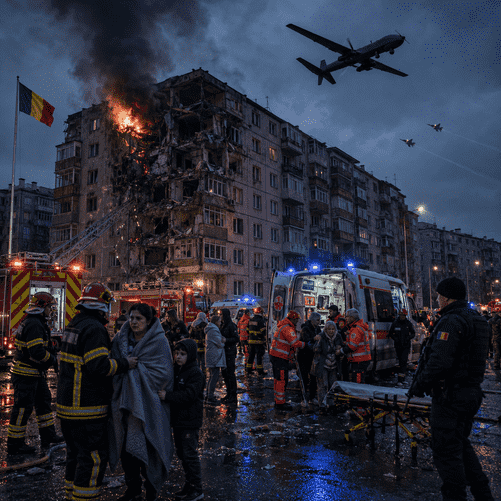
The attack on a residential building in Galați marks a dangerous new spillover from Russia’s war in Ukraine

A Russian drone has struck a residential building in Romania, injuring two people and sharply escalating concerns that Moscow’s war in Ukraine is increasingly spilling into NATO territory.
The incident took place in Galați, a southeastern Romanian city close to the Ukrainian border and the Danube River, an area that has become increasingly exposed as Russia intensifies strikes on Ukrainian port infrastructure. Romanian authorities said the drone hit a 10-storey apartment block, triggering a fire, damaging cars and forcing the evacuation of dozens of residents.
The drone was identified as a Russian-origin Geran-2, the type widely used by Moscow in long-range attacks against Ukraine. Romania scrambled two F-16 fighter jets and a helicopter during the incident, but officials acknowledged the difficulty of tracking and intercepting low-flying drones near the border.
The strike is significant not only because it injured civilians, but because it hit a densely populated area inside a NATO and European Union member state. Romania has reported repeated drone fragments and airspace violations since Russia began targeting Ukrainian ports across the Danube, but this incident represents one of the most serious spillovers of the war onto allied territory.
Bucharest condemned the attack as a grave violation of international law and summoned the Russian ambassador. Romanian officials also informed NATO allies and requested faster delivery of anti-drone capabilities, warning that the country’s eastern regions face a growing threat from Russian aerial operations.
NATO responded by reaffirming its commitment to defend allied territory and strengthen air defenses along the alliance’s eastern flank. The incident adds pressure on the alliance to improve its response to low-cost drones, which can cross borders quickly and operate at altitudes that make them difficult to detect.
The attack came as Russia was reportedly carrying out strikes on Ukrainian infrastructure near the border, including areas around Izmail, one of Ukraine’s key Danube ports. Since the start of the full-scale invasion, Moscow has repeatedly targeted Ukraine’s export routes, energy facilities and logistics hubs. Those attacks have increasingly placed Romania in the path of debris, stray drones and air-defense alerts.
For Romania, the strike is a warning that the war is no longer a distant conflict beyond the border. Galați is a civilian city, not a battlefield. The image of a drone slamming into an apartment building inside NATO territory will deepen public anxiety and intensify political calls for stronger protection.
For NATO, the challenge is delicate. The alliance must reassure Romania and other eastern members without allowing Moscow to dictate the tempo of escalation. Every drone incursion tests the credibility of allied air defense, while every military response must be calibrated to avoid a broader confrontation.
The incident also underscores a larger shift in the war: Russia’s drone campaign is not only wearing down Ukraine’s defenses, but also creating persistent danger for neighboring states. Even when Romania is not the intended target, its territory is increasingly exposed to the consequences of Russia’s attacks.
The strike in Galați may not trigger a direct NATO military response, but it will almost certainly accelerate discussions on air-defense systems, border surveillance and anti-drone technology. It is a reminder that the war’s geography is expanding—and that NATO’s eastern flank is now living under the shadow of Russia’s drone war.