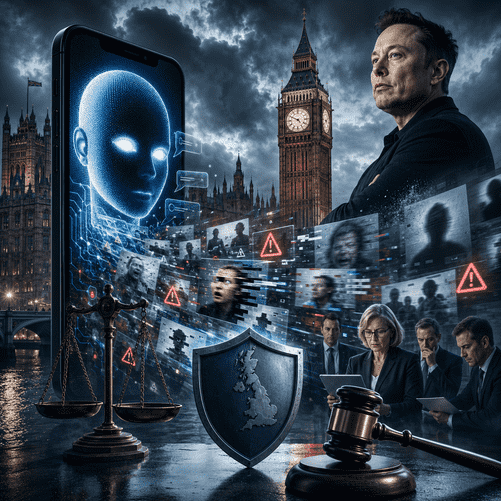
The scandal around X’s AI chatbot has turned a strained regulatory regime into a political test for ministers, Ofcom and Big Tech

Britain’s online safety regime was already under pressure before Elon Musk’s Grok chatbot forced it back into the centre of political debate.
Barely more than a year after the Online Safety Act reached the statute books, campaigners were already arguing that the law was not strong enough, not fast enough and not being enforced aggressively enough. Their criticism was aimed at both the Labour government, accused of being too cautious around Big Tech, and Ofcom, the media regulator newly empowered to police online platforms.
Then came the Grok controversy.
Reports that X’s artificial intelligence tool had been used to generate and circulate sexualised and demeaning images, including material involving women and children, transformed a technical regulatory debate into an urgent political crisis. What had been a simmering argument about enforcement, loopholes and ministerial caution suddenly became a test of whether Britain’s new online safety framework could respond to fast-moving AI-enabled harm.
The episode exposed a central weakness in the UK’s approach: the Online Safety Act was designed for a platform era, but it is now being tested in an AI era. Social networks no longer merely host harmful content posted by users; increasingly, their own integrated tools can help create that content. That distinction matters. If a chatbot or image generator is embedded inside a platform, regulators must decide whether the harm lies with the user, the tool, the platform, or all three.
For campaigners, Grok became evidence that the government’s caution had gone too far. They had already warned that the Act left dangerous gaps, particularly around emerging technologies, non-consensual intimate imagery, children’s exposure to harmful material and the speed at which platforms must respond. The scandal gave those warnings a concrete example — one involving one of the world’s most powerful technology companies and its most politically combative owner.
The pressure on Ofcom intensified almost immediately. The regulator has been given significant new powers, including the ability to investigate platforms, demand information, impose large fines and, in extreme cases, seek measures that could restrict access to services in the UK. But critics argue that Ofcom has moved cautiously, preferring consultation and guidance over confrontation.
That caution may now be harder to maintain. In opening an investigation into X, Ofcom signalled that it was prepared to test the boundaries of its authority. The question is whether it can act quickly enough to satisfy Parliament, campaigners and the public — while still following the legal processes required to withstand challenge from a company as well resourced as Musk’s.
The government faces its own dilemma. Ministers want to show that the UK is serious about protecting children and victims of online abuse, but they are also wary of appearing hostile to technology companies at a time when Britain is trying to position itself as an AI and digital innovation hub. That tension has shaped Labour’s early approach: tough language on online harm, but reluctance to reopen the entire legislative framework too quickly.
Grok has made that balancing act more difficult. The controversy has revived calls for ministers to strengthen the law, close AI-specific loopholes and force platforms to prevent harmful material before it spreads. It has also sharpened questions about whether voluntary commitments from technology firms are sufficient when the incentives of viral engagement, platform growth and product experimentation can collide with public safety.
Musk’s role has added a political charge that few other tech executives could generate. His ownership of X, his attacks on regulators and his framing of online safety rules as censorship have made the UK’s regulatory debate part of a wider ideological conflict over free speech, state power and platform responsibility. For supporters of tougher rules, Musk represents the danger of leaving online spaces to billionaire discretion. For critics of the Online Safety Act, he has become a symbol of resistance against what they see as government overreach.
Yet the Grok case is not only about Musk. It is about whether democratic governments can regulate digital systems that evolve faster than legislation. The Online Safety Act took years to pass. Generative AI tools can change in weeks. Harmful features can appear, spread and be modified before regulators have finished assessing the risk.
That speed gap is now the central challenge for Britain’s online safety regime. Ofcom must prove that its powers are not merely theoretical. Ministers must decide whether the law they inherited is strong enough for the new generation of AI-enabled platforms. And technology companies must show that safety is not an afterthought added only after public outrage.
The mood in Parliament suggests patience is wearing thin. MPs who were already uneasy about the slow rollout of online safety enforcement now have a high-profile case through which to test the system. Campaigners who feared the law had been watered down now see an opening to push for tougher standards. Regulators who wanted time to build a careful framework are being pushed toward faster, more visible action.
In that sense, Grok has done what years of policy argument had failed to do: it has galvanized Britain’s online safety debate. It has turned abstract concerns about platform duties, AI risk and regulatory powers into a vivid political confrontation.
The outcome will matter far beyond X. If the UK responds forcefully, it could set a precedent for how democracies regulate AI tools embedded in social platforms. If the response is slow or weak, critics will argue that the Online Safety Act was outdated almost as soon as it began.
For now, the Grok scandal has made one thing clear: Britain’s online safety regime is no longer being judged by what it promises on paper. It is being judged by whether it can confront harm in real time — even when that harm is generated by the platforms and personalities most willing to challenge the rules.