A Franco-German proposal for “gradual integration” seeks to revive enlargement hopes, but it may also expose how far full membership still remains.

France and Germany are pushing a new model for bringing Western Balkan countries closer to the European Union, proposing that candidate states receive earlier access to parts of the bloc’s benefits before becoming full members.
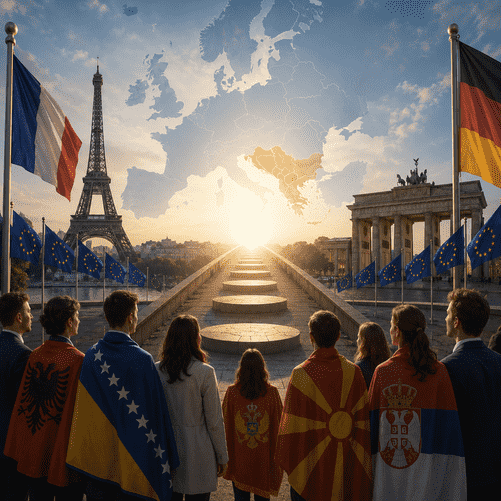
The Franco-German discussion paper, reported by Reuters, comes as frustration grows across the Western Balkans over the slow pace of EU enlargement. Countries including Albania, Montenegro, North Macedonia, Serbia, Bosnia and Herzegovina, and Kosovo have spent years — in some cases decades — trying to move toward accession, only to face repeated delays, political vetoes and shifting conditions.
The idea is known as “gradual integration.” Instead of waiting until every accession requirement is complete, EU hopefuls would be allowed to participate step by step in selected European programs and policy areas once they meet specific standards. According to the Franco-German proposal, this could include access to parts of the single market, student exchanges, research initiatives, energy cooperation, industry policy and even the EU’s Emissions Trading System.
The paper also suggests giving candidate countries a place at some EU ministerial meetings and summits as non-voting participants. That would not amount to membership, but it would offer political visibility and a sense of belonging inside the European project before formal accession is complete.
For Paris and Berlin, the proposal is partly an answer to a credibility problem. EU leaders repeatedly describe enlargement as a strategic priority, especially after Russia’s full-scale invasion of Ukraine shifted the geopolitical map of Europe. But in the Western Balkans, many governments and citizens see a gap between Brussels’ promises and actual progress.
European Council President António Costa has recently told Western Balkan leaders that enlargement is “real” and strategically important for Europe’s peace, stability and security. He is due to attend a summit in Tivat, Montenegro, with leaders from the region, where the EU is expected to discuss faster ways to move the accession process forward.
The urgency is geopolitical as much as institutional. Brussels is concerned that slow enlargement has opened space for Russia, China and other external powers to build influence in the region. Serbia’s refusal to impose sanctions on Russia, continuing tensions between Belgrade and Pristina, and political instability in Bosnia and Herzegovina have all sharpened EU concerns over the region’s strategic direction.
Yet the proposal also reflects divisions inside the EU itself. Full enlargement would require institutional reforms, budget decisions and agreement among all member states. Some governments fear importing unresolved disputes, democratic backsliding or weak rule-of-law systems into the Union. Others argue that delaying enlargement only makes those problems harder to solve.
Gradual integration is designed to bridge that divide. It offers candidate countries tangible benefits in exchange for reforms, while giving EU members more control over the pace and conditions of accession. The model would be merit-based, meaning countries could advance in specific sectors once they meet the required standards — but could also face safeguards or reversals if they backslide.
For the Western Balkans, the proposal may bring both hope and caution. Montenegro and Albania are currently viewed as the most advanced candidates, while North Macedonia has been blocked for years by bilateral disputes despite significant concessions. Serbia’s path is complicated by its relations with Kosovo and its foreign-policy alignment. Bosnia and Herzegovina remains held back by internal divisions, while Kosovo still faces non-recognition by five EU member states.
The risk is that gradual integration becomes a substitute for membership rather than a bridge to it. Western Balkan leaders have long warned against being offered symbolic participation while the door to full accession remains politically closed. If the proposal does not include a credible timeline or clear end point, it could deepen rather than reduce frustration.
Still, the Franco-German initiative shows that the EU is searching for a new enlargement formula. The old model — long negotiations, limited interim rewards and uncertain political approval — has lost much of its persuasive power. A more flexible approach could help restore trust, especially if it delivers visible benefits to citizens before formal accession.
The coming test will be whether Paris and Berlin can convince the rest of the EU to turn the idea into policy, and whether Western Balkan countries believe it is more than another waiting room.
For a region that has been promised a European future for more than twenty years, gradual integration may be welcome. But it will only matter if it leads somewhere real.