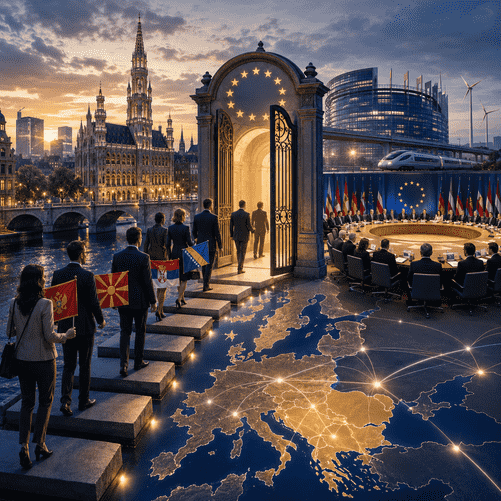
Proposed system would grant aspiring members early access to European markets, programmes and political meetings, while Estonia insists that gradual integration must still lead to full membership

The European Union is moving closer to adopting a new model of gradual integration that would allow candidate countries to receive some of the economic and political benefits of membership before formally joining the bloc.
European leaders discussed the emerging approach at a summit with Western Balkan counterparts in Tivat, Montenegro, as governments seek to revive an enlargement process that has delivered no new EU members since Croatia joined in 2013.
Often described as “membership-lite” or associate membership, the model could give qualifying candidate countries early access to parts of the EU single market, funding programmes and selected ministerial meetings. However, they would not initially receive the full voting rights held by the bloc’s 27 existing members.
Supporters argue that the system would reward countries for completing reforms and provide tangible benefits during an accession process that frequently lasts more than a decade.
Estonian Prime Minister Kristen Michal said Europe must “keep its promises” to countries seeking membership, reflecting concern that repeated delays could weaken public support for European integration and allow rival powers to expand their influence.
For Estonia and other strong supporters of enlargement, gradual integration should serve as a bridge toward full membership rather than becoming a permanent substitute for it.
Early Benefits in Exchange for Reform
Under proposals advanced by Germany and France, candidate countries could progressively participate in European programmes once they meet the required legal and regulatory standards.
Potential areas of cooperation include student exchanges, scientific research, energy, industry and the EU’s emissions-trading system. Candidate governments could also attend some EU summits and ministerial meetings as non-voting participants.
The approach would allow aspiring members to demonstrate their ability to follow EU rules while giving their citizens earlier access to some of the practical advantages associated with membership.
Western Balkan countries are already being gradually connected to parts of the single market. Several have joined the Single Euro Payments Area, making cross-border euro payments easier, while the EU has begun discussions on extending its free mobile-roaming system to the region.
Advocates hope that such measures will make the enlargement process feel more credible to populations that have spent years waiting for accession talks to produce meaningful results.
A Response to Geopolitical Pressure
The renewed urgency surrounding enlargement has been driven largely by Russia’s invasion of Ukraine and growing concern over Moscow and Beijing’s influence in the Western Balkans.
Ukraine and Moldova are pursuing membership as part of a broader effort to secure their political and economic position within Europe. Albania and Montenegro have also made significant progress, with Montenegro seeking to become the EU’s next member by 2028.
German Chancellor Friedrich Merz said the EU must demonstrate that it is both capable of expanding and genuinely willing to accept new members.
The Franco-German proposal attempts to address a central problem facing the bloc: European leaders increasingly view enlargement as a strategic necessity, but many governments remain concerned that adding more members could make decision-making slower and more difficult.
Existing accession rules require unanimous approval from all EU countries at numerous stages, allowing individual governments to delay or block negotiations.
Fears of a Two-Tier Europe
Despite its potential advantages, the membership-lite concept remains controversial.
Some candidate countries fear that partial integration could leave them permanently excluded from the EU’s most important decisions. Without voting rights, associate members could be required to follow European rules without having an equal role in shaping them.
Ukraine has repeatedly insisted that it expects full and equal membership rather than a reduced status. Western Balkan governments are similarly wary that a new intermediate category could become another reason to postpone accession indefinitely.
Concerns have also emerged among current EU members. Some governments worry that changing the established accession process could weaken standards on democracy, judicial independence and the rule of law.
European officials have stressed that gradual integration would remain merit-based and that candidates would still need to meet the EU’s established political and economic criteria.
Keeping Europe’s Promise
The debate reflects a broader struggle over how the European Union should expand while preserving its ability to function.
Countries including Estonia argue that enlargement is essential to Europe’s long-term security and credibility. Leaving reforming candidate countries in a prolonged waiting room, they warn, risks creating frustration and political instability on the EU’s borders.
At the same time, governments in Paris, Berlin and other capitals are seeking safeguards to prevent a larger union from becoming paralysed by national vetoes and competing interests.
The membership-lite proposal attempts to balance those priorities by allowing candidates to move closer to the EU in stages while full accession negotiations continue.
Its success, however, will depend on whether candidate countries view it as a genuine path toward membership—or as a more sophisticated way of keeping them outside.
For Europe’s aspiring members, the distinction will be crucial. As Michal’s warning suggests, the EU’s influence ultimately depends not only on the benefits it can offer, but also on whether it delivers on the commitments it has made.