Missile and drone attacks on Gulf states hosting American bases mark a dangerous escalation after Washington shot down Iranian drones and struck radar sites near the Strait of Hormuz.

Iran has launched missile and drone attacks toward Kuwait and Bahrain after an exchange of fire with U.S. forces in and around the Strait of Hormuz, sharply escalating tensions in the Gulf and threatening a fragile ceasefire between Washington and Tehran.
The latest confrontation began when U.S. forces said they intercepted Iranian drones that were moving toward the Strait of Hormuz, one of the world’s most important energy corridors. Washington said the drones posed an immediate threat to maritime traffic and responded by striking Iranian radar and command-and-control sites used to support drone operations.
The U.S. strikes reportedly targeted facilities in Goruk and on Qeshm Island, near the strategic waterway that links the Gulf to global oil markets. American officials described the action as defensive, saying it was intended to prevent further attacks on shipping and allied positions.
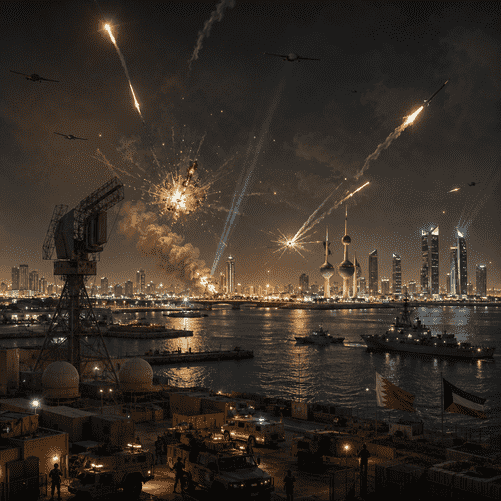
Iran condemned the strikes and responded by firing missiles and drones toward U.S.-linked targets in the Gulf. Kuwait and Bahrain, both key security partners of Washington, were placed on high alert as air-defense systems were activated. Sirens were reported in affected areas, while authorities urged residents to follow emergency instructions.
The attacks are especially sensitive because both countries host important American military assets. Bahrain is home to the U.S. Navy’s Fifth Fleet, which plays a central role in securing Gulf waters and monitoring maritime traffic. Kuwait also hosts U.S. forces and logistics facilities that support American operations across the region.
For Gulf governments, the strikes represent a direct expansion of the conflict onto their territory. Kuwait and Bahrain have long sought to balance close defense ties with Washington against the need to avoid becoming front-line targets in a broader U.S.-Iran confrontation. The latest attacks show how difficult that balance has become.
The escalation comes amid a wider regional crisis involving Iran, the United States, Israel and several Gulf states. Although ceasefire efforts have been under way, repeated violations and retaliatory strikes have kept the region close to open conflict. Each new exchange raises the risk that a limited military incident could spiral into a broader confrontation.
The Strait of Hormuz remains the central strategic concern. A significant share of the world’s seaborne oil passes through the narrow waterway, making any military activity there a potential shock to global energy markets. Even limited drone or missile attacks can raise insurance costs, disrupt shipping routes and push oil prices higher.
Washington has framed its actions as necessary to protect freedom of navigation and defend U.S. forces. Tehran, by contrast, has accused the United States of violating Iranian sovereignty and destabilizing the region. Both sides claim to be acting defensively, but the sequence of drone launches, interceptions, radar strikes and retaliatory attacks has left little room for de-escalation.
The timing is also politically fraught. U.S. officials have been trying to preserve diplomatic channels while avoiding the appearance of weakness. Iran, facing military pressure and economic strain, appears determined to show that attacks on its infrastructure will carry costs for U.S. allies and regional partners.
For Kuwait and Bahrain, the immediate priority is air defense, public safety and damage assessment. But the broader issue is strategic: Gulf states are increasingly vulnerable to becoming targets whenever Washington and Tehran exchange fire.
The latest attacks underline a dangerous reality of the Gulf crisis. Even when the United States and Iran avoid full-scale war, their confrontation can quickly spill across borders, threatening smaller states, energy infrastructure and international shipping. The region is now facing not only a military standoff, but a test of whether diplomacy can still contain a conflict that is spreading faster than negotiators can control.