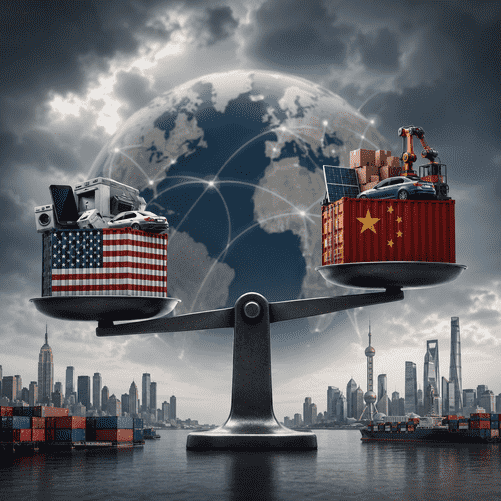
Persistent American deficits, China’s export-driven surplus and Europe’s chronic underinvestment will dominate discussions at the G-7 summit in Évian-les-Bains

The world’s leading advanced economies are preparing to confront a problem that once appeared to be receding but is again becoming a serious threat to global financial stability: the widening gap between countries that consume and borrow too much and those that save and export too heavily.
When Group of Seven leaders gather in Évian-les-Bains, in the French Alps, from June 15 to 17, global economic imbalances will be near the top of the agenda. France, which holds the G-7 presidency this year, has warned that the growing divergence between national economic models is fuelling trade disputes, protectionism and geopolitical tension.
At the centre of the debate is the enormous US current-account deficit, a broad measure covering trade in goods and services as well as cross-border investment income. On the opposite side are the substantial surpluses accumulated by China and, to a lesser extent, the European Union and Japan.
Trade deficits and surpluses are not inherently dangerous. Countries may borrow to finance productive investment, while others may save more because of their demographic structures or stages of development. The danger emerges when these positions become excessively large, persistent and dependent on policies that distort consumption, investment or exchange rates.
According to International Monetary Fund estimates cited ahead of the summit, the combined scale of global current-account deficits and surpluses reached approximately 3.7 per cent of world gross domestic product last year. The figure has risen again after declining steadily in the period following the global financial crisis.
Three Different Economic Problems
Although political criticism frequently concentrates on Chinese exports, the imbalance is the product of three interconnected economic weaknesses.
China’s economy continues to depend heavily on manufacturing and foreign demand. Weak household consumption, high savings and industrial support policies have enabled Chinese companies to produce more goods than the domestic market can absorb. The result has been a surge in exports ranging from machinery and consumer electronics to electric vehicles, batteries and other clean-energy technologies.
China recorded a current-account surplus of around $735 billion, intensifying concerns that excess industrial capacity is being redirected into overseas markets. European governments increasingly fear that an influx of competitively priced Chinese goods could weaken domestic manufacturers and create new strategic dependencies.
Beijing rejects accusations that its success is primarily the result of unfair state support, arguing that Chinese companies benefit from efficiency, innovation and highly developed supply chains. It has also warned Western governments against using economic imbalances as a justification for protectionism.
The United States faces the opposite problem. Strong domestic demand, low national savings and large government budget deficits have produced persistent external deficits. American households, businesses and public authorities collectively spend more than the country produces, with the difference financed partly by foreign investors purchasing US assets.
President Donald Trump has repeatedly blamed the US trade deficit on foreign tariffs, subsidies and other barriers. His administration has used import duties as a central instrument for attempting to reduce the gap and encourage manufacturing to return to the United States.
However, many economists argue that tariffs alone cannot correct an imbalance rooted in America’s fiscal and savings behaviour. Import restrictions may redirect trade between countries, raise prices or alter supply chains without significantly reducing the overall deficit. Unless the United States narrows its budget deficit and increases domestic savings, demand for foreign capital and imported goods is likely to remain high.
Europe, meanwhile, occupies a more complicated position. The European Union runs an external surplus, but France argues that it reflects not only export strength but also insufficient investment. European savings are frequently invested abroad because the continent lacks enough productive opportunities at home, particularly in technology, energy infrastructure and rapidly expanding industries.
This means the global imbalance cannot be resolved simply by demanding that China export less or that the United States impose more tariffs. China would need to strengthen household consumption, the US would need to reduce excessive borrowing, and Europe would need to mobilise more capital for domestic investment.
Financial Risks Behind the Trade Debate
The immediate political consequence of these imbalances is growing pressure for tariffs, subsidies and restrictions on foreign investment. Yet the longer-term danger may lie in financial markets.
Deficit countries must attract continuous inflows of foreign capital. This system can remain stable for years, particularly in the case of the United States, whose dollar and government debt remain central to the international financial system. But dependence on foreign financing can become dangerous if investors suddenly lose confidence or demand substantially higher returns.
A disorderly adjustment could weaken currencies, increase borrowing costs and cause sharp falls in asset prices. Surplus economies would also suffer because their industries and financial institutions depend on continued demand from deficit markets.
The pattern recalls the years preceding the 2008 global financial crisis, when excess savings in some economies helped finance property bubbles, government borrowing and consumer spending elsewhere. Although today’s vulnerabilities are different, policymakers fear that large imbalances could again amplify an unrelated shock.
The political environment may make coordinated action even more difficult than it was in previous decades. Relations between Washington, Beijing and European capitals are increasingly shaped by national security concerns, industrial competition and disputes over technology.
Unlike the 1985 Plaza Accord, when major economies cooperated to weaken the dollar and correct trade distortions, a comparable agreement today would require participation from China and broad consensus over exchange rates, fiscal policy and domestic economic reforms. Such cooperation appears unlikely amid intensifying strategic rivalry.
Évian Summit Faces a Test of Cooperation
France has attempted to broaden the debate beyond a confrontation between the United States and China. Its approach recognises that every major economy contributes differently to the problem: excessive consumption and fiscal borrowing in America, weak consumption and industrial overcapacity in China, and inadequate productive investment in Europe.
French President Emmanuel Macron has described the present configuration as unsustainable and warned that failure to rebalance the world economy cooperatively could result in a more disorderly adjustment through tariffs, financial turbulence or economic crisis.
Ahead of the summit, France also organised discussions involving China and other major economies outside the G-7. The initiative reflects an uncomfortable reality: although the G-7 remains influential, it cannot resolve global trade imbalances without engaging countries that now account for a much larger share of global production and trade.
A dramatic agreement in Évian remains improbable. Leaders may endorse closer monitoring, stronger consultation through the IMF and measures addressing industrial subsidies, currency practices and domestic investment. Reaching binding commitments on national budgets, savings or consumption policies will be much harder.
Nevertheless, the summit could help change the terms of the international debate. Trade imbalances are often presented as evidence that one country is winning while another is losing. In reality, excessively large surpluses and deficits are two sides of the same unstable system.
Unless the largest economies are prepared to reform the domestic policies producing those imbalances, the global economy may continue moving towards greater protectionism and fragmentation. The central question facing G-7 leaders in the French Alps is therefore not simply how to redistribute global trade, but whether international cooperation can prevent economic rivalry from becoming the trigger for the next financial crisis.


