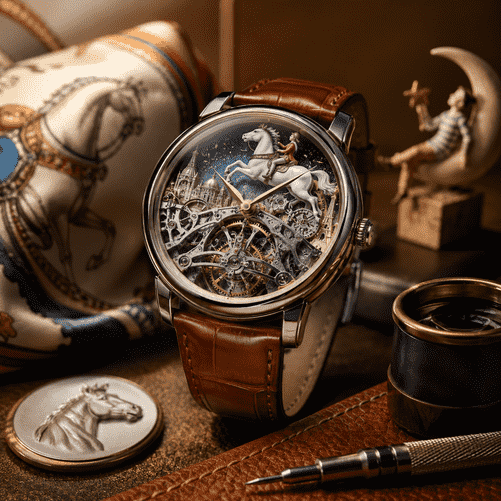
The French luxury house is using skeletonised movements, artistic craftsmanship and eccentric complications to persuade collectors that it belongs among the leading names in fine horology.

Hermès occupies an undisputed position at the summit of luxury leather goods. In the highly specialised world of mechanical watches, however, the French house still sees itself as a challenger.
That distinction has become the foundation of an increasingly ambitious strategy. Rather than attempting to imitate the restrained classicism of Switzerland’s most established watchmakers, Hermès is seeking credibility through a combination of technical sophistication, artistic craftsmanship and deliberate whimsy.
Its watches may feature floating balloons, mischievous horses, miniature landscapes or unconventional displays of time. Beneath those playful surfaces, however, the company is investing heavily in movements, dial production, case manufacturing and the specialist expertise expected of a serious horological brand.
Hermès began producing watches under its own name in the late 1970s, considerably later than manufacturers such as Patek Philippe, Rolex and Audemars Piguet. For years, many collectors therefore regarded its timepieces primarily as fashion accessories—beautifully designed objects whose prestige came from the Hermès name rather than from their mechanical substance.
The company has spent much of the past two decades trying to overturn that perception.
It has acquired stakes in movement specialists, expanded its Swiss production network and brought more of the manufacturing process under its control. Movements, cases, dials and straps are now produced through a collection of facilities that combine traditional Swiss watchmaking with the French house’s broader culture of craftsmanship.
That investment is becoming increasingly visible in its products.
At Watches and Wonders Geneva in 2026, Hermès presented the H08 Squelette, the first skeletonised version of its modern sports watch. Its open-worked construction exposes the gears, bridges and oscillating components that would normally remain hidden beneath the dial.
The watch is powered by the new automatic H1978 S calibre, made from titanium and composed of 168 components. It operates at a frequency of four hertz and offers approximately 60 hours of power reserve.
Its 39-millimetre case combines black-treated titanium with a ceramic bezel, producing a lightweight, technical appearance. Brightly coloured luminous numerals and interchangeable straps prevent the watch from becoming overly austere.
The result captures the broader Hermès philosophy: mechanical seriousness presented without solemnity.
The company also introduced new skeletonised interpretations of its Slim d’Hermès collection, including a model displaying the phases of the moon. These watches reveal delicate internal architecture while preserving the restrained proportions and typography associated with the line.
Elsewhere, Hermès has used even more elaborate techniques to attract collectors.
Its exceptional pieces combine mechanical movements with wood marquetry, enamel, engraving and miniature painting. A recent pocket watch featured the image of a roaring lion assembled from tiny pieces of several different types of wood—a demonstration of decorative craftsmanship normally associated with art objects rather than conventional wristwatches.
Other creations have treated time itself as something flexible and theatrical.
The Arceau Le Temps Suspendu allows the wearer to temporarily conceal the conventional display of hours and minutes. The Arceau L’Heure de la Lune presents two rotating moons beneath travelling time and date indicators. Another model depicts a horse that sticks out its tongue when its mechanical animation is activated.
Such devices might appear frivolous, but their execution requires considerable engineering. Animated figures, rotating displays and apparently suspended indications depend on complex mechanisms designed to perform reliably within the limited dimensions of a wristwatch.
Hermès’ argument is that technical sophistication does not have to be expressed through conventional complications alone. A watch can demonstrate mechanical mastery while also creating surprise, humour or emotion.
That approach separates the brand from competitors that emphasise precision, sporting heritage or historical continuity.
Hermès instead draws on the wider creative vocabulary of the house. Equestrian imagery recalls its origins as a Parisian harness workshop in 1837, while dial designs can incorporate motifs first seen on silk scarves, jewellery or decorative objects.
The company’s leather expertise also provides an advantage. Hermès produces many of its watch straps using the same materials, colours and hand-finishing traditions associated with its celebrated bags and saddlery.
Yet craftsmanship alone may not persuade the most demanding collectors.
Fine-watch enthusiasts often judge a manufacturer by the originality of its movements, the quality of its finishing, the historical importance of its designs and the long-term value of its watches. Hermès must compete for attention against companies with generations of uninterrupted mechanical-watch production.
Its earlier reliance on quartz movements remains part of the challenge. Although quartz watches can be precise and beautifully made, collectors frequently associate high horology with complex mechanical calibres constructed and decorated by specialist watchmakers.
Hermès’ growing ability to show its internal mechanisms is therefore symbolically important. Skeletonisation gives the company an opportunity to place the engineering itself at the centre of the design.
It also signals confidence. An open-worked movement leaves little room to disguise inelegant construction or ordinary finishing.
The brand’s expansion comes as the wider luxury-watch market faces a more difficult commercial environment. Demand surged during the pandemic-era collecting boom but later softened as consumers became more cautious and speculative prices declined.
In that climate, Hermès cannot rely solely on scarcity or the prestige of its name. It must offer watches distinctive enough to compete for collectors who already have access to established Swiss marques.
Its relative outsider status may ultimately prove useful.
Without centuries of rigid watchmaking tradition to defend, Hermès has greater freedom to experiment with unconventional displays, materials and narratives. The company can treat time as a creative subject rather than merely a quantity to be measured with increasing precision.
That does not mean technical performance has become secondary. The house’s strategy depends on convincing buyers that the playful exterior is supported by credible engineering and disciplined production.
Hermès is therefore building its reputation in two directions at once. It is becoming more mechanically serious while refusing to make its watches emotionally severe.
The company may remain an underdog beside the most powerful names in Swiss horology, but its objective is no longer simply to sell watches to existing Hermès customers.
It wants devoted collectors to judge its timepieces on their own merits—and to conclude that imagination can be as persuasive a sign of watchmaking mastery as tradition.