Seven-year-old Abdiqadir Salah urgently needs surgery after being wounded in an attack that reportedly killed 12 civilians, but his family has neither the money for treatment nor any prospect of compensation.

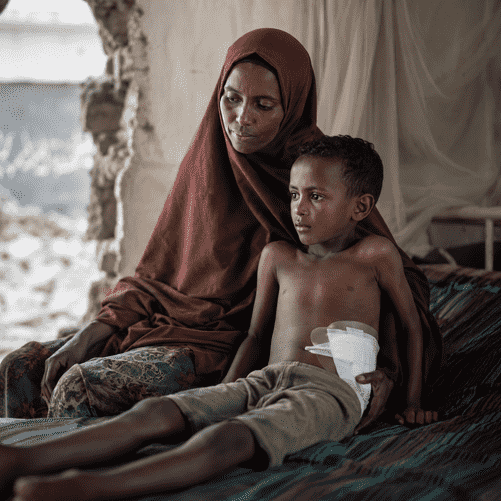
Seven-year-old Abdiqadir Salah may permanently lose his ability to walk unless surgeons remove pieces of shrapnel embedded near his hip—an operation his family cannot afford after he was wounded in a deadly US airstrike in southern Somalia.
The child was playing outside his family’s home in Jamaame on 15 November 2025 when missiles struck the town. According to an investigation by the Guardian, the attack killed at least 12 civilians, including eight children, and injured several members of Abdiqadir’s family.
The United States has rejected claims that civilians were killed or wounded during the operation, which was conducted against the Islamist militant group al-Shabaab. Survivors and witnesses, however, say bombs dropped from drones struck residential areas where children and families were present.
Abdiqadir’s mother, Marian Haji Abdi Guled, recalled finding three of her children lying wounded and covered in blood outside their home. She said there had been no warning before the explosions, although residents could hear drones circling loudly above the town.
As further strikes fell around them, Guled carried her injured children into the countryside. The family remained there throughout the night, afraid that movement might expose them to another attack.
Her eldest son, 16-year-old Mohamed, was wounded by fragments that remain lodged in his fingers. Her 14-year-old daughter, Sumaya, suffered three shrapnel wounds to her head, which were later treated. Abdiqadir sustained some of the most serious injuries, with metal fragments entering through his lower back and becoming lodged close to his hip socket and upper thigh.
The following day, Guled travelled approximately 60 kilometres to Jilib, the principal town in territory controlled by al-Shabaab. Doctors there were unable to provide the specialist treatment her children required.
After borrowing money, she embarked on a difficult two-day journey to Mogadishu with Abdiqadir and Sumaya. She was forced to leave her eldest injured child behind because she could not afford to bring all three of them.
Doctors in the Somali capital successfully removed the fragments from Sumaya’s head. Abdiqadir’s condition, however, requires more complicated surgery.
Medical staff have warned that the shrapnel must be removed urgently to prevent lasting damage to his hip and mobility. Without treatment, they fear the injury could eventually leave him unable to walk.
The operation costs about $1,000, or approximately £750—a sum far beyond the means of a family that survives through farming in a country devastated by decades of conflict, drought and poverty.
Guled has remained in Mogadishu because it is the only place where her son can receive the treatment he needs. Yet accommodation in the capital costs the family nearly £190 a month, making it almost impossible to save enough for the procedure.
Abdiqadir’s father stayed behind in Jamaame to protect the family’s crops from wild animals and cannot afford the journey to join them.
The family’s financial desperation has been compounded by the absence of any official acknowledgement or assistance from the United States. No Somali civilian harmed in an American airstrike is known to have received compensation from Washington.
The Jamaame attack was reportedly carried out as part of a joint operation involving the US military’s Africa Command and Somali ground forces. American officials have said the intended target was al-Shabaab, which controls territory across parts of southern and central Somalia.
Witnesses interviewed during the investigation said the civilian casualties were caused by bombs dropped from drones rather than weapons fired by troops on the ground.
The incident has raised serious questions about the intelligence behind the operation, the process used to identify targets and the safeguards intended to protect civilians. It has also highlighted the limited avenues available to families seeking accountability when the US disputes that civilian harm occurred.
American air operations in Somalia have intensified as Washington seeks to weaken al-Shabaab and the local branch of Islamic State. Supporters of the campaign argue that the strikes are necessary to confront armed groups capable of destabilising Somalia and threatening neighbouring countries.
Human-rights organisations and independent monitors, however, have repeatedly warned that civilian deaths are significantly underreported and that investigations into disputed strikes remain inadequate.
The Guardian described the Jamaame attack as one of the deadliest US operations for Somali civilians in recent decades. Despite the reported scale of the casualties, there has been no public indication that a formal American investigation has been opened.
For Abdiqadir and his family, the wider arguments over military strategy and accountability have been reduced to a far more immediate question: whether they can find enough money to prevent a seven-year-old boy from losing the ability to walk.
His mother remains in Mogadishu, separated from her husband and one of her wounded children, waiting for help that may never arrive.
Behind the official denial of civilian casualties is a child living with fragments of war inside his body—and a family being asked to bear the medical, financial and emotional cost alone.