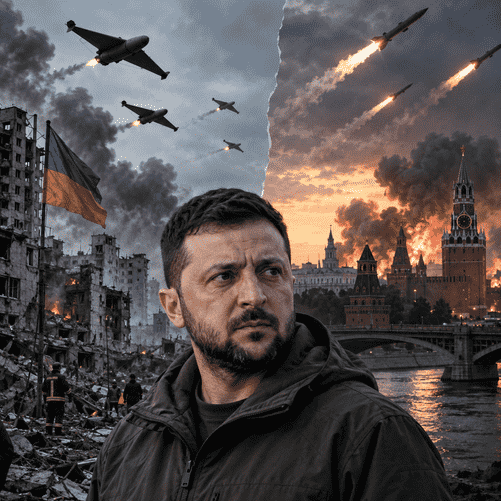
A major refinery fire, airport closures and explosions across the capital have exposed the growing reach of Kyiv’s long-range campaign against Russia’s energy infrastructure

MOSCOW — A large-scale Ukrainian drone attack struck Moscow and its surrounding region on Thursday, setting fire to a strategically important oil refinery and forcing authorities to suspend operations at several of the Russian capital’s airports.
Thick columns of smoke rose above the Moscow Oil Refinery in the southeastern district of Kapotnya after drones reached the facility during an intense overnight and morning barrage. Videos circulated online showing flames inside the industrial complex as emergency crews moved to contain the blaze.
The refinery, operated by Gazprom Neft, is one of the most important suppliers of petrol, diesel and aviation fuel to Moscow and the surrounding region. Its location inside the capital makes it both an economically valuable target and a powerful symbol of the expanding geographical reach of Ukraine’s long-range strike programme.
The latest assault marked the second reported attack on the refinery in three days, increasing concerns about the ability of Russian air defences to protect critical infrastructure near the political and economic centre of the country.
Moscow Mayor Sergei Sobyanin confirmed that drones had targeted the refinery but said emergency services were responding. Russian officials did not immediately provide a full assessment of the damage or indicate how long operations at the facility might be disrupted.
Industry sources had already reported that an earlier strike forced the refinery to suspend some processing. Repeated attacks now raise the possibility of more serious production interruptions at a time when Russia’s fuel sector is under growing pressure.
The scale of Thursday’s raid surprised many residents.
Explosions were reported across different areas of Moscow and its suburbs, while fragments from intercepted drones damaged buildings and other infrastructure. A fire was also reported at the vast Sadovod shopping centre, and damage was recorded near a high-rise building in the Zhukovsky district.
On social media, residents exchanged hurried messages about the sound of drones, air-defence fire and explosions. Some posted footage of smoke drifting across the skyline, while others sought information about whether specific districts or transport routes were safe.
The atmosphere contrasted sharply with the Kremlin’s long-standing presentation of Moscow as insulated from the direct consequences of the war.
Although the Russian capital has faced drone attacks before, the frequency, intensity and apparent ability of some aircraft to penetrate multiple defensive layers have heightened public anxiety. For many Muscovites, the attack offered a rare and immediate sense of a conflict normally experienced through television reports and government statements.
Russian authorities temporarily halted flights at Vnukovo, Sheremetyevo, Domodedovo and Zhukovsky airports, creating delays and cancellations across one of Europe’s busiest aviation networks.
Airport closures have become a regular defensive measure during drone alerts, but the disruption caused by such attacks extends well beyond aviation. Airlines must divert aircraft, passengers are stranded and businesses face additional transport costs even when drones are intercepted before reaching their targets.
Russia’s Defence Ministry said hundreds of Ukrainian drones had been destroyed across the country, including a large number approaching Moscow. These claims could not be independently confirmed, and the damage inside the capital demonstrated that at least some aircraft had penetrated the defensive network.
Ukraine did not immediately provide a detailed account of the operation. Kyiv generally avoids confirming individual strikes at the moment they occur, although Ukrainian officials have repeatedly defended attacks on Russian oil facilities as legitimate actions against infrastructure supporting Moscow’s invasion.
Ukraine’s long-range drone programme has become one of its most important tools for striking deep inside Russian territory.
Unable to match Russia’s larger missile arsenal and air force, Ukraine has invested heavily in domestically produced unmanned aircraft capable of travelling hundreds or even thousands of kilometres. These systems are considerably cheaper than conventional cruise missiles and can be launched in large numbers to overwhelm air defences.
The campaign has increasingly concentrated on refineries, fuel depots, pumping stations and export terminals.
Kyiv argues that Russia’s energy industry finances the war and provides fuel directly to its armed forces. By damaging refineries, Ukraine hopes to reduce military supplies, weaken state revenues and force Moscow to divert air-defence systems away from the front line.
The strategy appears to be imposing measurable costs.
Russian crude production fell significantly below government targets in May as Ukrainian attacks disrupted energy facilities. Several refineries have been forced to halt or reduce operations, placing pressure on domestic supplies of petrol, diesel and aviation fuel.
Russia has attempted to adapt by repairing damaged plants, restricting fuel exports and strengthening air defences around energy installations. Yet the country’s enormous size makes comprehensive protection difficult.
Every anti-aircraft system positioned around a refinery or fuel depot is a system unavailable for military bases, ammunition factories, border regions or occupied Ukrainian territory.
The Moscow refinery is particularly important because of its proximity to millions of consumers and major transport networks. Even limited damage can create uncertainty in wholesale markets and increase fears of shortages.
Russian fuel suppliers have already introduced restrictions in some areas, while the government is considering measures to guarantee domestic availability.
The attack therefore carried economic as well as psychological significance.
It demonstrated that a refinery serving Russia’s capital could be repeatedly targeted despite dense air-defence coverage. It also showed how Ukraine’s strategy is evolving from isolated symbolic raids towards sustained pressure on the infrastructure supporting Russia’s economy and military.
The strike followed another wave of Russian missiles and drones against Ukrainian cities. Moscow has continued to attack power stations, residential districts and industrial facilities throughout Ukraine, causing deaths, injuries and widespread damage.
The two countries are now engaged in an increasingly intense long-range air war.
Russia retains a considerable advantage in missiles, aircraft and explosive payloads, while Ukraine relies heavily on inexpensive drones and precision attacks against selected targets. The result is a cycle in which strikes on one side are quickly followed by retaliation from the other.
The escalation is occurring despite continuing diplomatic discussions about a possible settlement.
Neither government appears willing to reduce military pressure. Ukraine is attempting to demonstrate that Russia cannot wage war without experiencing consequences inside its own territory, while the Kremlin seeks to weaken Ukrainian cities and infrastructure sufficiently to force political concessions.
For Moscow residents, Thursday’s attack brought that strategic contest into daily life.
The refinery fire, airport suspensions and explosions across the suburbs exposed the vulnerability of a city that has been carefully protected from much of the war’s physical impact.
Russian authorities may repair the damaged infrastructure and reinforce the capital’s defences. But preventing every drone from reaching a city of more than 13 million people presents an immense technical challenge.
Ukraine does not need every aircraft to succeed. A small number reaching their targets can close airports, damage industrial sites and generate widespread uncertainty.
That may be the central purpose of the campaign: not only to destroy fuel-processing capacity, but also to challenge the perception that distance and air defences can keep Russia’s capital beyond the reach of the war.
As smoke rose above Kapotnya, that sense of protection appeared increasingly fragile.