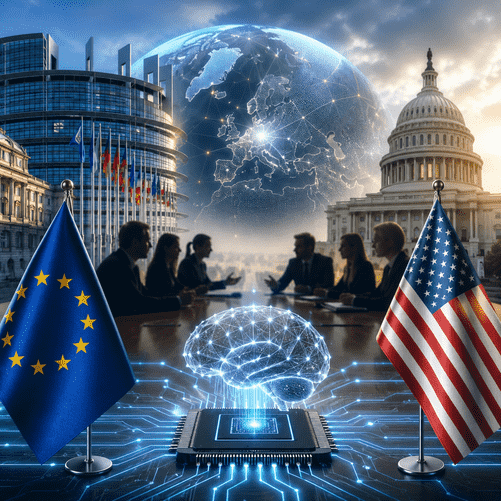
At high-level G7 discussions, European leaders urged closer cooperation with the United States to keep artificial intelligence open, competitive and democratically governed.

Europe is intensifying its push for access to the world’s most advanced artificial intelligence systems, as concerns grow that the next phase of AI development could be shaped by a small number of powerful companies and governments.
At recent G7-related discussions, European Commission President Ursula von der Leyen said it was in the mutual interest of both Europe and the United States for European institutions and companies to use the best available AI models. Her remarks reflected a broader European concern: that falling behind in AI infrastructure, computing power and frontier models could weaken the continent’s economic competitiveness and strategic autonomy.
The debate comes as governments move from abstract discussions about AI safety to concrete decisions over access, regulation and control. Advanced AI models are increasingly seen not only as commercial tools, but also as strategic assets with implications for cybersecurity, defense, scientific research and industrial productivity.
French President Emmanuel Macron also called for democratic countries to cooperate more closely on AI regulation, warning against overly national approaches that could fragment the technology landscape. European leaders argue that AI safety rules should not become a barrier that leaves smaller economies dependent on a narrow group of dominant providers.
For the United States, the issue is equally sensitive. American companies remain at the center of the AI boom, leading in model development, cloud infrastructure and chip demand. But Washington is also under pressure to prevent powerful systems from being misused, especially in areas such as cyber operations, disinformation and national security.
Europe’s position is shaped by a difficult balance. The EU wants access to cutting-edge AI while also maintaining its reputation as a global rule-setter on digital regulation. The bloc has already moved ahead with AI legislation, but its companies still face a gap in computing capacity and large-scale model development compared with U.S. and Chinese rivals.
The result is a new phase of technological diplomacy. AI is no longer only a Silicon Valley story or a consumer-product race. It is becoming a central issue in transatlantic relations, with questions over who builds the models, who controls access, who sets safety standards and who benefits from the economic gains.
For businesses, the outcome could determine whether AI becomes a widely available productivity tool or a restricted strategic resource. For governments, it raises a larger question: whether democratic allies can coordinate fast enough to shape the rules of a technology that is already transforming the global economy.
As AI becomes more powerful, the competition is not only about innovation. It is also about trust, sovereignty and influence in the digital age.