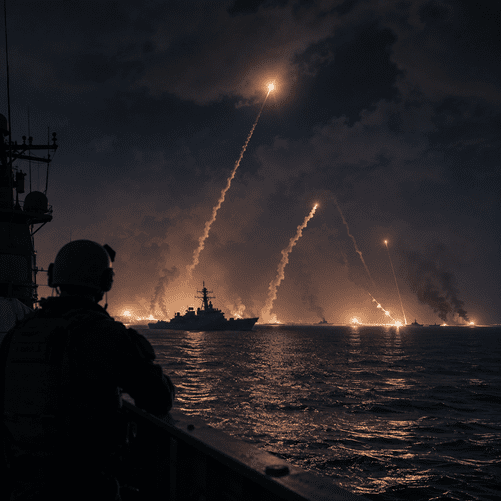
Beijing’s growing naval presence around the island is reshaping the balance of power in the Taiwan Strait and testing Taipei’s ability to respond without escalation.

China is steadily increasing maritime pressure around Taiwan, turning what were once periodic shows of force into a near-constant naval presence that is changing the security environment around the island.
Since the start of the decade, Beijing has expanded the scale and frequency of its naval operations near Taiwan, using warships, coast guard vessels and coordinated military patrols to signal its determination to bring the self-governed island under its control. The strategy is not only military. It is also psychological and political, designed to normalize Chinese activity in waters around Taiwan while forcing Taipei to remain on permanent alert.
For Taiwan, the challenge is growing more complex. Chinese ships now appear around the island with such regularity that each new patrol risks becoming part of a new baseline. What once might have been treated as an exceptional provocation is increasingly becoming routine. That gradual shift is central to Beijing’s approach: by maintaining pressure day after day, China can test Taiwan’s defenses, gather intelligence and reduce the political shock of future military activity.
The naval buildup also serves a broader strategic purpose. Taiwan depends heavily on maritime access for trade, energy and food supplies. Any sustained Chinese ability to operate around the island could raise fears of a blockade or quarantine scenario, even without an immediate invasion. Such pressure would allow Beijing to threaten Taiwan’s economy and political stability while stopping short of open war.
China’s navy has grown rapidly in recent years, giving Beijing more tools to operate farther from its coast and sustain longer missions near Taiwan. These operations are often paired with air force activity, coast guard maneuvers and military exercises that simulate elements of blockade, inspection or combat readiness. Together, they create a layered form of pressure that is difficult for Taiwan to ignore and difficult for outside powers to counter without raising the risk of escalation.
Taipei has responded by tracking Chinese vessels, deploying aircraft and ships, and strengthening cooperation with partners such as the United States and Japan. But the daily burden is significant. Constant monitoring consumes resources, strains personnel and increases the possibility of accidents or miscalculation in crowded waters.
The shift also carries major implications for Washington and its allies. The Taiwan Strait remains one of the world’s most sensitive flashpoints, and any attempt by China to restrict access to the island could disrupt global trade, destabilize Asian markets and draw in outside military forces. Taiwan is also central to the global semiconductor supply chain, making its security a matter of economic as well as strategic concern.
Beijing insists that Taiwan is part of China and has not ruled out the use of force to achieve unification. Taiwan’s government rejects Chinese sovereignty claims, arguing that only its people can decide the island’s future. Between those positions, the sea around Taiwan is becoming the central arena of confrontation.
China’s strategy appears designed to tighten pressure gradually rather than trigger an immediate crisis. But that does not make it less dangerous. A near-permanent naval presence around Taiwan changes the facts on the water, narrows Taipei’s room for maneuver and raises the risk that one miscalculation could transform a slow-motion standoff into a major regional conflict.