A public exchange over a summit photo has turned into a diplomatic embarrassment, revealing how quickly the once-warm relationship between Rome and Washington has deteriorated.

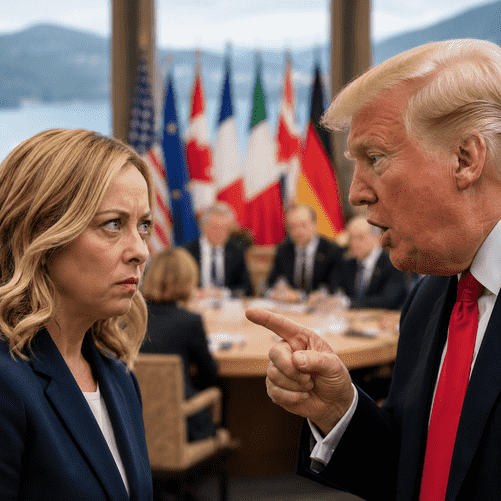
A dispute between Italian Prime Minister Giorgia Meloni and U.S. President Donald Trump has escalated into an unusually personal diplomatic clash, after Trump claimed that Meloni had “begged” him for a photo during this week’s G7 summit in France.
The accusation, made in an interview with Italian broadcaster La7, drew an immediate and forceful response from Meloni, who said the story was “completely made up” and expressed astonishment that the U.S. president would speak that way about a close ally. In a public video statement, she rejected the claim and framed the episode as an insult not only to herself but to Italy.
The quarrel marks a sharp turn in a relationship that had once been among the warmer links between Trump and a European leader. Meloni, a conservative nationalist who had cultivated ties with Trump and his political movement, was often viewed as a potential bridge between Washington and Europe. But the latest exchange suggests that political affinity is no longer enough to contain tensions over foreign policy, personal style and the changing balance inside the Western alliance.
The dispute began after Trump said Meloni had repeatedly asked him for a photograph at the G7 summit in Évian-les-Bains. He suggested that he agreed only out of pity. Meloni rejected that account, saying that neither she nor Italy “ever beg.” Her remarks were echoed by Italian officials, with Foreign Minister Antonio Tajani canceling a planned visit to the United States in protest.
The incident comes after months of strain between the two governments. Differences over the war in Iran, U.S. policy toward European allies, and Trump’s criticism of Pope Leo XIV had already placed Meloni in a difficult position at home. While she has sought to maintain strong relations with Washington, she has also faced pressure to defend Italian interests and avoid appearing subordinate to the American president.
For Italy, the controversy has become about more than a photograph. Meloni’s response was designed to protect her image as a strong national leader, particularly before a domestic audience that expects her to stand firm on questions of sovereignty and dignity. Opposition politicians, normally critical of her government, also condemned Trump’s remarks, showing how quickly the episode became a matter of national pride.
For Trump, the exchange fits a familiar pattern of personalizing diplomacy, using public comments to reward allies or punish those seen as insufficiently loyal. But the risks are considerable. Italy remains a key NATO member, a major European economy and an important partner on issues ranging from Ukraine to the Mediterranean. A prolonged quarrel could complicate coordination at a moment when Western governments are already divided over security, trade and the Middle East.
The G7 summit was intended to project unity among leading democracies. Instead, the aftermath has highlighted the fragility of that unity, especially when personal grievances collide with strategic interests.
What began as a dispute over a photo has become a symbol of a broader transatlantic strain. Meloni and Trump may still share elements of political ideology, but their latest clash shows that even close political allies can quickly become adversaries when diplomacy turns personal.