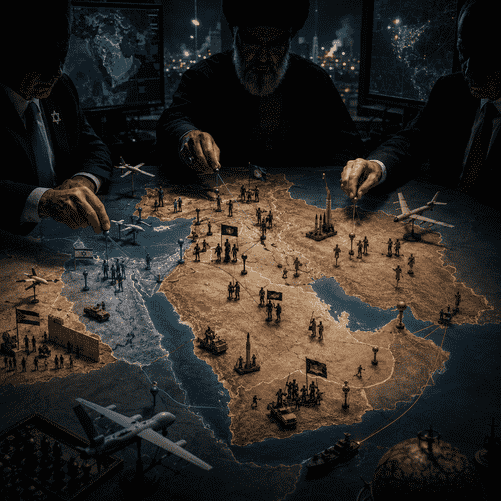
Iran, Israel and the United States continue to rely on allied militias and indirect partners, even as governments across the region push to restore state authority and reduce the power of armed groups.

Across the Middle East, a familiar pattern is re-emerging: states say they want stability, sovereignty and stronger national institutions, yet powerful actors continue to use proxy forces as tools of influence.
Iran, Israel and the United States have all relied, in different ways, on armed partners, local militias, ethnic groups or non-state forces to advance strategic goals without always engaging directly. The result is a shadow war that spreads instability across borders, weakens fragile governments and makes conflicts harder to contain.
Iran has built the most extensive proxy network in the region. For decades, Tehran has supported groups such as Hezbollah in Lebanon, the Houthis in Yemen and militias in Iraq and Syria. These forces have allowed Iran to project power far beyond its borders, pressure rivals and create deterrence against Israel and the United States.
But that model has come under strain. Hezbollah’s ability to deter Israeli attacks has been weakened, Iraqi militias face growing domestic pressure, and Yemen’s Houthis have drawn international military responses through attacks linked to Red Sea and Gulf shipping. Even so, Iran is unlikely to abandon its proxy strategy. For Tehran, these groups remain a central part of national security and regional influence.
Israel has also used indirect methods to weaken its enemies. In Gaza, Israeli efforts to support or tolerate rival Palestinian armed groups against Hamas have raised questions about whether short-term tactical gains are creating longer-term disorder. Such strategies may weaken an adversary temporarily, but they can also fragment authority and produce new armed actors with uncertain loyalties.
The United States has likewise relied on local partners, particularly Kurdish-led forces in Syria, as well as other regional allies, to fight extremist groups and counter Iranian influence. Washington has often viewed proxy partnerships as a way to reduce the need for large U.S. troop deployments. But these arrangements can create new political complications, especially when local partners clash with the interests of NATO allies or central governments.
The danger is that proxy warfare rarely remains limited. Militias develop their own agendas, funding networks and political ambitions. Once armed and empowered, they are difficult to control. What begins as a tactical partnership can become a long-term threat to state sovereignty.
That problem is now visible across the region. In Iraq, debates over the future of the Popular Mobilization Forces have become central to the country’s political order. Analysts warn that removing militia power from state institutions would require a deep restructuring of Iraq’s post-2003 system, not simply a security decision. In Lebanon, Hezbollah’s weapons remain at the heart of the state’s unresolved sovereignty crisis. In Yemen, the Houthis have become both a local power and a regional actor capable of disrupting international trade.
This is why calls for disarmament are growing. Governments and international actors increasingly argue that long-term stability requires restoring the state’s monopoly over force. In theory, that means militias should be integrated into national armies, transformed into political movements or disarmed entirely.
In practice, the process is extremely difficult. Militias often provide salaries, protection and political identity to their members and communities. They may also control territory, smuggling routes, ministries or parts of the economy. Disarming them can therefore threaten entire power structures.
The temptation to use proxies remains strong because the benefits are immediate. Proxy forces are cheaper than direct military intervention. They offer plausible deniability. They allow outside powers to test rivals, pressure governments and shape conflicts without formally declaring war.
But the costs are long-lasting. Proxy warfare erodes state authority, prolongs civil conflicts and creates overlapping chains of command. It also makes diplomacy harder, because ceasefires between governments may not bind militias on the ground.
The recent escalation involving Iran, Israel and the United States has shown how quickly indirect conflict can become direct confrontation. Even when formal ceasefires are announced, armed partners can trigger new rounds of retaliation through drone attacks, missile fire or cross-border operations.
The Middle East is therefore caught between two competing impulses. Regional governments increasingly recognize that militias weaken states and deepen instability. Yet the major powers involved in the region continue to see proxy forces as useful instruments.
Until that contradiction is resolved, disarmament efforts will remain fragile. States may call for sovereignty, but proxy networks will continue to operate in the shadows.
The region’s wars are no longer fought only by armies. They are fought through partners, militias and deniable networks — and that is precisely why they are so difficult to end.