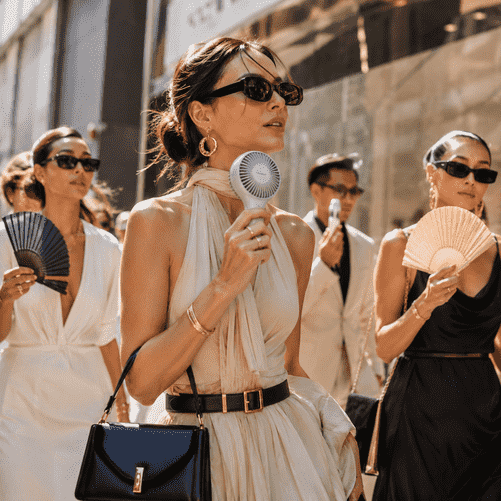
As heatwaves reshape summer dressing, luxury labels and tech brands are turning personal cooling devices into the next functional accessory.

At Paris Fashion Week, one of the season’s most telling accessories was not a handbag, a shoe or a piece of jewellery. It was a fan.
As Europe and the United States face increasingly punishing summer heat, fashion insiders, luxury brands and beauty retailers are embracing a new category of climate-era style: portable cooling. From elegant paper fans to high-tech handheld devices, the fan is being repositioned as both a practical necessity and a visible expression of taste.
The trend has been especially visible at recent fashion events, where editors, influencers and buyers have been seen carrying branded paper fans and compact electronic cooling devices. What once might have been considered a tourist object or a purely practical tool is now entering the same visual language as designer water bottles, headphones and phone cases: useful, personal and deliberately styled.
Consumer interest is rising quickly. Searches for portable fans have surged more than 100% year on year on platforms such as Pinterest, while several premium devices have reportedly sold out across major markets. New products are also moving beyond simple airflow, combining misting, quiet motors and compact design for customers who want comfort without compromising appearance.
The opportunity is not limited to technology companies. Beauty and fashion retailers including Sephora, Ulta and Bloomingdale’s are beginning to stock cooling devices, placing them alongside cosmetics, skincare and seasonal lifestyle products. That shift matters because it reframes the fan as part of a personal-care routine rather than an emergency response to hot weather.
Luxury brands are also experimenting with the category. High-end and artisanal paper fans are being priced as premium accessories, with some reaching hundreds of dollars. At the same time, fashion labels are using fans as event giveaways, collaboration objects and branding tools — a low-cost item that becomes highly visible in street-style photography and social media coverage.
The timing reflects a broader change in the luxury market. After years of aggressive price increases and slower consumer demand, brands are under pressure to offer products that feel useful, beautiful and emotionally relevant. Bain has forecast only modest growth for personal luxury goods in 2026, with spending expected to rise between 2% and 4% to about €365 billion to €373 billion. In that environment, small functional accessories can become powerful entry points for consumers seeking everyday luxury.
The fan trend also fits the industry’s growing focus on experience-led consumption. Analysts have noted that fashion and luxury are shifting from purely product-centred selling toward lifestyle, wellness and meaning. A cooling accessory speaks directly to that evolution: it is not just decorative, but tied to comfort, health, travel, beauty routines and climate adaptation.
For designers, the challenge will be to avoid turning the trend into a novelty. The most successful products are likely to combine design credibility with genuine performance: quieter motors, better battery life, lighter materials, elegant packaging and branding subtle enough to fit into luxury wardrobes.
For consumers, the appeal is immediate. A fan offers relief from heat, but it also signals awareness of a changing world. Just as sunglasses became both protection and style, portable fans may become part of the new summer uniform — an accessory born from climate pressure but transformed by fashion into a statement.
The rise of the fan is a reminder that trends no longer come only from runways. They also come from weather forecasts, city streets and the physical realities of daily life. In the climate era, fashion’s next must-have item may be the one that helps people stay cool.