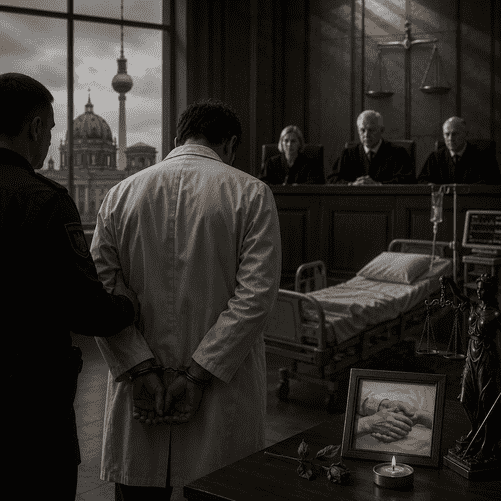
The palliative-care physician was convicted of killing 15 seriously ill patients, while investigators examine dozens of additional deaths linked to his work.

A Berlin court has sentenced a German palliative-care doctor to life in prison after finding him guilty of murdering 15 patients under his care, in one of the country’s most disturbing medical crime cases in recent years.
The 41-year-old doctor, identified under German privacy rules only as Johannes M., was convicted on Wednesday, July 8, 2026, after a long trial in the Berlin state court. Prosecutors said he administered lethal combinations of drugs to vulnerable patients between September 2021 and July 2024, many of whom were receiving care at home.
According to the case presented in court, the doctor used a mixture that included an anesthetic and a muscle relaxant, causing rapid respiratory failure. Prosecutors argued that the patients did not consent to the injections and that the killings were not acts of medically assisted end-of-life care, but deliberate murders.
The case first emerged from a smaller group of suspicious deaths before investigators expanded the charges. During the trial, the doctor admitted killing 12 patients, saying he had acted to relieve suffering. The court, however, rejected any interpretation that would reduce the crimes to mercy killings and imposed a life sentence with a finding of particularly severe guilt, a decision that makes release on parole highly unlikely.
The victims ranged widely in age, from young adults to elderly patients, and were among the most vulnerable people in the healthcare system. The nature of palliative care — where patients are often seriously ill, isolated, and receiving powerful medication — made the case especially difficult and emotionally charged for families, medical authorities, and prosecutors.
Investigators are now examining dozens of additional deaths. Authorities are reportedly looking into 76 further cases connected to the doctor’s work, raising the possibility that the scale of the crimes could grow significantly.
The conviction has reopened painful questions in Germany about oversight in home-based medical care, especially for patients near the end of life. Palliative medicine depends on trust between doctors, patients, families, and care providers. This case has exposed how difficult it can be to detect abuse when a physician has direct access to medication and to patients whose deaths may initially appear medically expected.
The ruling also permanently bars the doctor from practicing medicine. For prosecutors, the sentence marks a decisive legal conclusion to the first phase of the case. For families and investigators, however, the broader search for answers may not be over.
As Germany absorbs the shock of the verdict, the case stands as a grim reminder of the power entrusted to medical professionals — and of the safeguards needed when that trust is betrayed.