Paris Haute Couture Week closed with a clear message for the luxury industry: in a slower, more cautious market, the world’s most exclusive fashion houses are betting on spectacle, craft, and technological experimentation to keep desire alive.

Paris Haute Couture Week 2026 ended not as a quiet celebration of handmade fashion, but as a declaration that couture is being reinvented for a more uncertain luxury era.
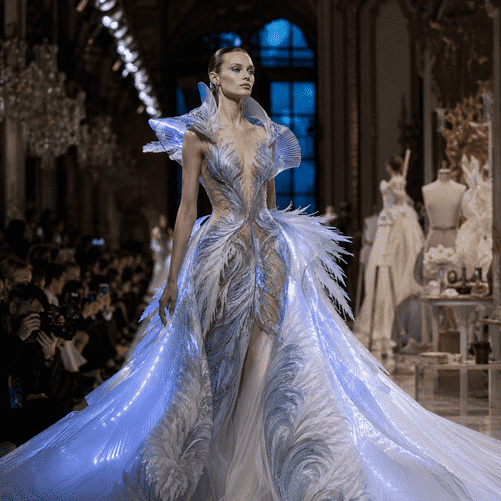
Across the runways, designers leaned into fantasy, sculptural silhouettes and experimental techniques, creating collections that seemed designed to remind clients why couture still matters when much of the fashion industry is under pressure from cautious spending, shifting consumer priorities and digital saturation.
The most closely watched moment came at Balenciaga, where Pierpaolo Piccioli made his couture debut for the house. His first outing placed drama at the center of the conversation, with extravagant volumes, balloon-like gowns and feathered constructions that pushed the human figure into theatrical proportions. Gigi Hadid’s rooster-feather finale became one of the week’s defining images, underlining the show’s ambition to restore grandeur to a house better known in recent years for provocation and street-coded luxury.
But Balenciaga was only part of a broader shift. Paris couture this season was marked by a fascination with the body: reshaped, hidden, exaggerated or transformed. Designers explored molded torsos, architectural gowns and silhouettes that blurred the line between clothing and object. The result was a season less concerned with everyday elegance than with the power of fashion to create illusion.
Fantasy also dominated the week. Houses including Elie Saab, Zuhair Murad, Stéphane Rolland, Chanel and Dior turned to dreamlike settings, mythic references, feathers, pleats and elaborate surface work. In a luxury market where many consumers are questioning value after years of aggressive price increases, couture offered an answer rooted in emotion: escape, rarity and spectacle.
Technology was the other major force. Iris van Herpen continued to challenge the boundaries between science and fashion, including a dress developed through particle-accelerator experimentation, while Schiaparelli and Balenciaga explored new materials such as lab-grown silk alongside painstaking handcraft. The message was not that machines are replacing couture, but that the most advanced luxury now depends on a careful tension between innovation and the human hand.
That tension matters commercially. Luxury brands are entering 2026 with expectations of modest recovery, but the market remains fragile. Bain & Company has warned that while global luxury sales may grow again after stagnation, years of price increases have left some shoppers feeling alienated. BNP Paribas has also described the outlook as cautiously optimistic, forecasting organic growth but noting that uncertainty remains high.
In that environment, couture plays a strategic role beyond direct sales. It functions as a laboratory for brand identity. Even if only a small number of clients buy couture pieces, the images, celebrities and craftsmanship radiate through ready-to-wear, accessories, fragrance, beauty and social media. For luxury groups, couture is not simply a product category; it is a form of cultural advertising at the highest level.
The week also suggested that couture’s center of gravity is widening. Newer and less historically dominant designers gained attention alongside the established French houses. Robert Wun, Rahul Mishra, Manish Malhotra and Ashi Studio were among the names highlighted as part of a broader “new guard,” reflecting the growing influence of designers from Hong Kong, India and Saudi Arabia in a space once tightly controlled by European heritage maisons.
This shift mirrors the changing geography of luxury consumption itself. Clients in the United States and China remain central to the sector’s future, but their expectations are becoming more fragmented. McKinsey’s latest luxury research points to changing ideas of desirability, exclusivity, discovery and brand experience in both markets, suggesting that heritage alone is no longer enough.
The trend emerging from Paris is therefore clear: luxury fashion is trying to move beyond price and logo power. In their place, houses are emphasizing technical mastery, emotional storytelling, visual fantasy and cultural distinction.
For consumers, that means the next phase of high fashion may feel more theatrical and less restrained. For brands, it means the battle for attention will increasingly be fought through moments that feel impossible to copy: a sculpted gown, a futuristic textile, a celebrity finale, a handcrafted surface that cannot be reduced to a trend cycle.
Paris Couture Week 2026 showed an industry under pressure, but not without imagination. At its best, couture offered a persuasive argument for luxury’s survival: not as excess for its own sake, but as a rare space where craft, technology and fantasy can still make fashion feel extraordinary.