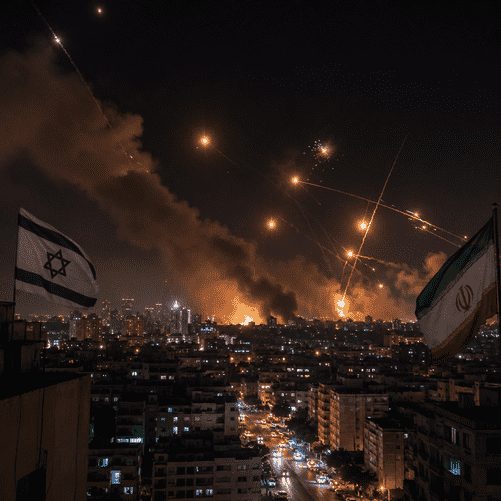
Israel’s defence minister says the military is prepared to resume attacks on Iran “with even greater force,” as Tehran launches further strikes amid a widening regional escalation.

Israel has warned it is ready to strike Iran again if necessary, raising the prospect of another major military campaign as Tehran continues retaliatory attacks across the region.
Defence minister Israel Katz said on Thursday that Israel’s armed forces were “alert and prepared” to resume operations against Iran, adding that any renewed campaign would be carried out “with even greater force.” His remarks came as the latest round of hostilities between Iran, Israel and the United States deepened fears that a fragile ceasefire framework was collapsing.
Katz said Israel was ready to launch independent “blue-and-white” strikes against Iran “even for a third time,” a phrase suggesting that Israel would not necessarily wait for direct US involvement before acting. The warning followed renewed Iranian missile and drone attacks, including strikes aimed at US-linked targets and regional states, according to live reporting on the crisis.
The escalation marks one of the most dangerous phases of the confrontation since the latest ceasefire arrangement was extended. US and Iran have traded their most intense strikes since that agreement, with Washington launching new attacks on Iranian targets and Tehran responding with further strikes in the Gulf region.
Iran has framed its actions as retaliation for attacks on its territory, while Israel says Tehran remains a direct strategic threat. The confrontation has increasingly drawn in the wider region, with concern focused on Gulf states, US military installations and the Strait of Hormuz, one of the world’s most important energy corridors.
Katz’s comments were intended to signal deterrence, but they also underscored Israel’s willingness to escalate if it believes Iran is rebuilding military capabilities or preparing further attacks. Israeli officials have repeatedly argued that pressure on Tehran must continue until Iran’s ability to threaten Israel and its allies is significantly weakened.
The risk now is that each side’s deterrent message is being interpreted by the other as preparation for a wider war. Iran’s strikes are presented in Tehran as defensive retaliation, while Israel’s threats are framed in Jerusalem as necessary readiness. In practice, both positions leave little room for de-escalation.
Regional governments have called for restraint, but the diplomatic space appears increasingly narrow. Qatar and other mediators have been trying to preserve channels for negotiation, while military alerts and defensive measures have intensified across the Gulf.
For Israel, a third campaign against Iran would carry high strategic and political stakes. It could further degrade Iranian military infrastructure, but it would also risk broader retaliation against Israeli cities, US bases, shipping lanes and regional partners. For Iran, continued strikes may demonstrate resolve, but they also increase the likelihood of a renewed Israeli or US response.
The confrontation has already moved beyond a bilateral exchange. It now involves the credibility of US deterrence, the security of Gulf states, global energy flows and the possibility that a regional conflict could become harder to contain with every new strike.
Katz’s warning therefore marks more than another statement of military readiness. It is a clear sign that Israel believes the confrontation with Iran is not over — and that the next phase, if triggered, could be more forceful than the last.