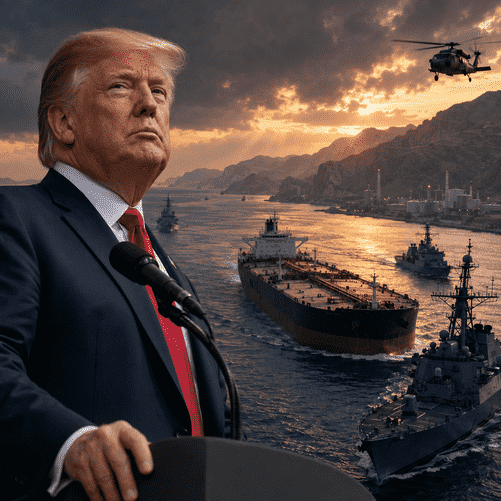
The US president has restored a naval blockade targeting Iran and proposed a 20 percent charge on cargo crossing the strategic waterway, deepening a confrontation that could disrupt oil supplies and test the limits of American maritime power.

President Donald Trump has reopened one of the most dangerous fronts in the conflict with Iran, announcing the restoration of a US naval blockade and renewing his threat to take control of the Strait of Hormuz, the narrow maritime passage through which a substantial share of the world’s energy supplies normally travels.
Trump said the United States would act as the “guardian” of the strait and demanded reimbursement equal to 20 percent of the value of cargo transported through it. His statements suggested that Iranian ships would be barred while other vessels could be permitted to pass under American protection after paying the proposed charge. The White House had not immediately explained how the levy would be calculated, collected or enforced.
The announcement followed renewed exchanges of strikes between US and Iranian forces, which have undermined a fragile agreement intended to reduce hostilities and restore commercial traffic through the waterway. Trump accused Tehran of violating its commitments and said Washington would again blockade Iranian maritime activity.
The Strait of Hormuz lies between Iran and Oman and connects the Persian Gulf with the Gulf of Oman and the Arabian Sea. Before the current conflict, approximately one-fifth of global daily oil and liquefied natural-gas supplies passed through the route, making it one of the most consequential shipping corridors in the world.
Any prolonged disruption can therefore affect fuel prices far beyond the Middle East. Oil markets reacted rapidly to Trump’s announcement, with Brent crude rising by more than 4 percent and moving close to $80 a barrel as traders assessed the risk of reduced tanker traffic and further military escalation.
The proposed 20 percent charge adds an unprecedented commercial dimension to the confrontation. Trump has argued that the United States should be compensated for the military cost of protecting international shipping. Yet it remains unclear whether the measure would function as a tariff, a security fee, a maritime toll or a compulsory payment imposed through naval control.
That uncertainty is likely to concern shipping companies, insurers and governments whose economies depend on Gulf energy exports. A charge calculated against the value of cargo could be enormous, particularly for fully loaded oil and liquefied-natural-gas tankers. Even the possibility of such a cost could encourage companies to delay voyages, reroute vessels where possible or demand higher prices from customers.
Trump’s position also appears to conflict with earlier statements from members of his own administration. Secretary of State Marco Rubio had previously argued that international shipping through the strait should remain toll-free, reflecting the longstanding American view that commercial vessels should enjoy freedom of navigation through international waterways.
Legal specialists are likely to question Washington’s authority to impose a charge on cargo belonging to third countries. The navigation channels through the Strait of Hormuz pass through waters associated with both Iran and Oman, while transit rights are governed by international maritime principles. The United States is not a coastal state in the strait, making any attempt to administer or commercialise passage particularly controversial.
A naval blockade presents separate legal and military risks. Blockades have historically been treated as acts of war and require forces capable of identifying, stopping and potentially seizing vessels across a large operational area. The United States originally imposed a blockade on ships entering or leaving Iranian ports in April after negotiations failed, although military officials subsequently described the operation more narrowly than Trump’s initial public threat against all traffic.
That earlier blockade was later lifted under a US-Iran memorandum of understanding that was promoted by the White House as reopening the Strait of Hormuz to toll-free international shipping. Trump’s latest announcement effectively reverses a major element of that agreement and signals that Washington no longer considers the arrangement sufficient to guarantee maritime security.
Iran has rejected US claims to authority over the strait. Its senior military command has warned that any American attempt to manage the waterway without Iranian approval would be confronted, while the Islamic Revolutionary Guard Corps has accused Washington of threatening global energy security and violating Iranian sovereignty.
Tehran retains several means of disrupting maritime traffic even if it cannot defeat the US Navy in a conventional confrontation. These include coastal missiles, drones, fast attack boats, mines and the boarding or seizure of commercial vessels. Such tactics can raise insurance costs and discourage shipping without requiring Iran to maintain a complete physical closure of the strait.
The narrow geography of the passage makes commercial shipping especially vulnerable. Tankers must travel through defined navigation lanes, limiting their ability to avoid threats. A single damaged ship, mine incident or missile strike could slow traffic and intensify pressure on global energy markets.
The latest escalation has already reduced confidence in the diplomatic process. A US official said in June that Washington and Tehran were close to an agreement that would reopen the strait to normal oil traffic and lift the American blockade. Iran publicly disputed parts of Washington’s description of the proposed deal, particularly provisions involving nuclear restrictions and control of maritime passage.
The disagreement exposed a fundamental conflict between the two sides. The United States has sought guaranteed freedom of navigation and restrictions on Iran’s nuclear and military capabilities. Iran has insisted that it cannot surrender its strategic influence over a waterway bordering its territory, particularly while US forces remain active across the Gulf.
Trump’s renewed threat to take control of the strait transforms that disagreement into a direct contest over sovereignty. It also places American allies in a difficult position. Gulf states depend on US security support, but they are vulnerable to Iranian retaliation and have strong economic interests in avoiding a wider regional war.
Oman faces particular pressure because it controls the southern side of the strait and has traditionally acted as an intermediary between Washington and Tehran. Any American plan to administer commercial passage would be difficult to implement without cooperation from Muscat, yet Oman is likely to resist steps that could undermine its neutrality or turn its territorial waters into part of a military enforcement zone.
Asian economies would also be heavily exposed to sustained disruption. China, India, Japan and South Korea import large quantities of Gulf oil and gas. Higher shipping charges or reduced supply could increase manufacturing and transport costs, weaken growth and place renewed pressure on consumer inflation.
Europe would not be insulated. Even when European refiners obtain crude from other regions, oil is traded in a global market. A shortage affecting Asian importers can increase prices everywhere, while higher liquefied-natural-gas costs may intensify competition for shipments between European and Asian buyers.
The consequences would extend beyond energy. The Strait of Hormuz carries petrochemicals, fertiliser materials, industrial commodities and consumer goods. More expensive freight and insurance could eventually raise prices for food, plastics, aviation, manufacturing and road transport.
Financial markets will therefore watch whether Trump’s proposal becomes an operational policy or remains a negotiating threat. The practical challenges are considerable. US forces would need to determine which vessels are subject to the blockade, how cargo values would be verified and what action would follow if a ship refused payment.
Enforcement against neutral commercial vessels could provoke diplomatic resistance from countries that otherwise support freedom of navigation. It could also create disputes with shipping registries, insurers and port authorities and expose American forces to accusations of unlawful seizure or coercion.
Trump may be using the threat to pressure other countries into contributing more to Gulf security. He has repeatedly argued that nations dependent on the strait should share the cost of protecting it. Presenting the United States as the route’s guardian may therefore be intended partly as leverage against major energy importers and regional allies.
However, the combination of blockade, military strikes and a compulsory cargo charge risks making de-escalation more difficult. Iran is unlikely to accept an arrangement that appears to transfer control of a neighbouring waterway to Washington. The more explicitly the dispute is framed as a contest for ownership or authority, the less room either government may have to compromise without appearing to retreat.
For global markets, the immediate danger is not necessarily a complete and permanent closure. Even an inconsistent pattern of attacks, inspections and delayed passages can reduce available supply and drive up transportation costs. Traders respond not only to barrels physically lost but also to the possibility that future deliveries may not arrive on time.
Trump’s announcement has therefore introduced a new level of uncertainty into an already volatile conflict. The proposed 20 percent charge raises serious questions about international law and commercial feasibility, while the restored blockade increases the likelihood of direct confrontation between US and Iranian forces.
Washington says it is acting to keep the Strait of Hormuz open. Tehran argues that American intervention is itself the principal threat to stability. Between those competing claims sit the tankers, crews and economies that depend on the waterway.
Whether Trump’s strategy produces a new agreement or a wider war may depend on what happens during the next movements of commercial ships through the strait. For the moment, the world’s most important energy corridor has again become both a military front line and an instrument of economic pressure.