Strong demand for Cartier, Van Cleef & Arpels and Buccellati is reviving investor confidence, while fashion houses search for a broader recovery beyond watches and handbags

The global luxury industry has spent much of the past two years waiting for convincing evidence that affluent consumers were ready to spend freely again. Richemont has now provided one of the strongest signals yet that a recovery may be taking shape—but it is jewellery, rather than traditional fashion, that is setting the pace.
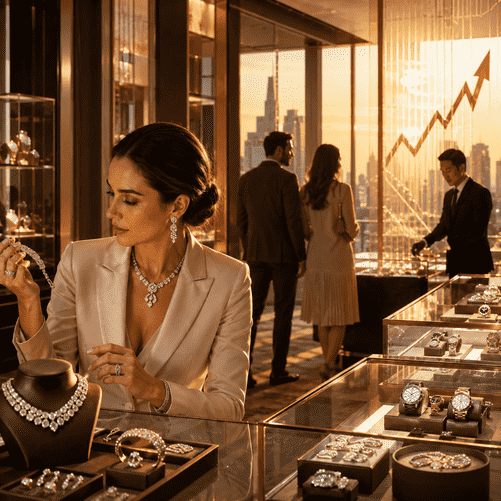
The Swiss luxury group reported a 20% increase in sales for the three months ending in June, comfortably exceeding market expectations and sending its shares sharply higher. The performance was powered by Richemont’s jewellery maisons, including Cartier, Van Cleef & Arpels and Buccellati, whose combined sales rose by 24%.
The results offered a rare burst of optimism for a sector that has struggled with weak Chinese demand, economic uncertainty and growing resistance to years of aggressive price increases. Richemont’s jewellery division has now recorded double-digit growth for seven consecutive quarters, suggesting that its strength is more than a temporary rebound.
Demand was particularly resilient in Asia and the Americas, helping Richemont outperform much of the wider luxury market. Its specialist-watch division also returned to growth, with sales rising by 8%, while fashion and accessories—long one of the group’s weaker areas—advanced by almost 10%.
The figures strengthened European luxury shares and encouraged investors to reconsider whether the industry’s prolonged slowdown may be approaching a turning point. The broader recovery, however, remains uneven, with jewellery performing far more strongly than many fashion and leather-goods businesses.
Jewellery has increasingly become the luxury sector’s most dependable category. High-end pieces are often perceived as enduring assets rather than seasonal purchases, giving consumers a stronger justification for spending during uncertain economic periods. Precious materials, recognisable designs and limited production can also reinforce the impression that a purchase will retain emotional or financial value.
That proposition has become especially important after several years in which luxury brands repeatedly raised prices. Bain & Company has warned that aggressive increases have left some consumers feeling alienated and questioning whether products still offer sufficient craftsmanship, exclusivity or innovation to justify their cost.
Jewellery houses have been better positioned to defend premium pricing because the intrinsic value of gold, diamonds and gemstones is easier to understand than the cost of a leather bag or ready-to-wear garment. Brands such as Cartier and Van Cleef & Arpels also benefit from highly recognisable collections that remain desirable across generations and national markets.
Richemont’s results therefore reveal an important shift in luxury consumption. Customers are not necessarily abandoning expensive goods, but they are becoming more selective about what deserves their money. Purchases that combine craftsmanship, heritage and permanence appear to be winning over products driven primarily by seasonal fashion cycles.
The geographical pattern is equally significant. The United States and South Korea are currently among the luxury market’s stronger sources of growth, supported in part by rising wealth and high compensation in technology and finance. China, once the industry’s most powerful expansion engine, remains comparatively subdued, although analysts continue to expect a gradual and uneven recovery.
North America has consequently become a greater strategic priority for luxury groups. The region accounted for approximately 27% of global luxury store openings in 2025, slightly ahead of Europe and well above China, as brands sought access to wealthy American consumers—including a growing class of entrepreneurs and executives enriched by the artificial-intelligence boom.
The industry will now examine upcoming financial reports from LVMH, Hermès, Kering and other leading groups to determine whether Richemont’s performance represents the beginning of a broad revival or merely the continued strength of a few exceptional jewellery brands.
LVMH’s fashion and leather-goods business will be watched particularly closely after an extended period of declining growth. Dior, Gucci and Chanel are also undergoing significant creative transitions, with new designers and collections expected to play an important role in restoring excitement around major fashion houses.
Creative renewal alone may not be sufficient. Luxury groups are also under pressure to improve the in-store experience, reduce dependence on relentless price increases and create products that appear distinctive rather than repetitive. Industry forecasts suggest that the sector is likely to achieve only low single-digit growth in 2026, meaning brands will have to compete more aggressively for a limited pool of consumer spending.
Richemont’s success demonstrates that consumers will still spend heavily when they believe the object carries lasting meaning and credible value. That lesson may influence the wider market’s approach to design, merchandising and pricing.
Fashion houses could respond by placing greater emphasis on craftsmanship, smaller production runs and signature products intended to remain relevant beyond a single season. Jewellery, watches and collectible accessories may also receive greater investment as companies seek categories less exposed to rapidly changing trends.
The latest results do not confirm that the luxury downturn is over. Geopolitical instability, energy costs, trade tensions and weaker demand in China continue to threaten the industry’s outlook. Even analysts expecting improvement predict only a cautious recovery rather than a return to the extraordinary growth recorded after the pandemic.
Nevertheless, Richemont has shown that the luxury consumer has not disappeared. Instead, that consumer has become more demanding, more selective and increasingly focused on products that promise longevity.
For an industry built on desire, the emerging trend is clear: the next phase of luxury may depend less on producing more seasonal novelty and more on convincing shoppers that an object is worth keeping for life.