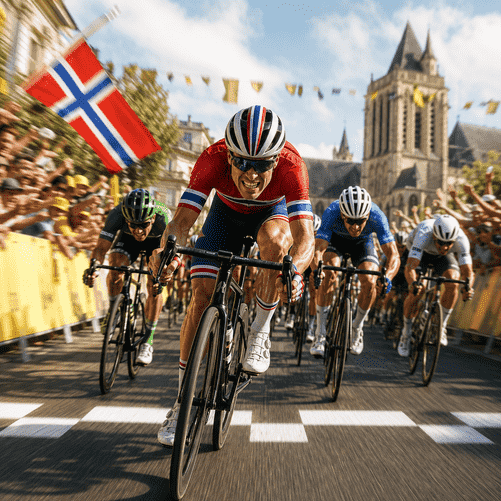
The Norwegian powered through a chaotic sprint to win Stage 11 at an average speed of 50.9km/h, completing the fastest road stage in Tour de France history

Søren Wærenskjold produced one of the most unexpected victories of the 2026 Tour de France, launching a powerful late sprint into Nevers to claim a historic Stage 11 win on the fastest road stage the race has ever recorded.
The Norwegian rider completed the 161.3-kilometre route from Vichy at an average speed of 50.9km/h, surpassing the Tour’s previous benchmark for a mass-start stage. The peloton covered the distance in little more than three hours as favourable conditions, determined sprint teams and efficient drafting drove the race at an extraordinary pace.
Wærenskjold, riding for Uno-X Mobility, held off Dutch sprinter Olav Kooij in a frantic finish, with Jasper Philipsen taking third place after race officials reviewed his movement during the sprint. The result gave Wærenskjold his first stage victory in a Grand Tour and delivered only the second Tour de France stage success in Uno-X’s history.
The triumph was particularly striking because it came only one day after the Norwegian had finished last on the demanding stage to Le Lioran. That difficult afternoon had offered little indication that he would be capable of defeating the Tour’s specialist sprinters less than 24 hours later.
Wærenskjold entered the closing kilometres without the status of overwhelming favourite. Much of the attention had focused on Tim Merlier, who was pursuing a third sprint victory of the race, along with Kooij, Philipsen and Biniam Girmay.
Instead, the Norwegian capitalised on hesitation among his rivals. As the lead-out formations fragmented and riders searched for a clear path, Wærenskjold accelerated early from the right side of the road. His long sprint initially appeared vulnerable, but he maintained enough speed to resist Kooij’s late challenge at the line.
The margin was narrow, but the significance was immense. At 26, Wærenskjold became the seventh Norwegian rider to win a Tour de France stage and strengthened Uno-X Mobility’s growing reputation as a team capable of competing against the sport’s wealthiest organisations.
The stage had been expected to favour the sprinters. Its mostly flat profile contained only two minor categorised climbs and approximately 1,400 metres of total elevation gain, while the long approach to Nevers gave the sprint teams sufficient road to organise their pursuit.
A four-man breakaway featuring Julian Alaphilippe, Nelson Oliveira, Anthon Charmig and Mathis Le Berre attempted to disrupt that plan. The group worked efficiently at the front, benefiting from the aerodynamic advantages of a rotating paceline, but the peloton never allowed its advantage to become decisive.
The escapees were eventually caught inside the final six kilometres, setting up the high-speed battle that most teams had anticipated. The relentless chase contributed to the record average, as riders spent almost the entire afternoon travelling at speeds more commonly associated with short time trials than a full Tour stage.
The new record continued a remarkable sequence of performances in the opening half of the Tour. Days earlier, Tadej Pogačar had demolished the established climbing time on the Col du Tourmalet, completing the 17-kilometre ascent in approximately 43 minutes and 12 seconds—more than two minutes faster than the previous mark.
Taken together, the Tourmalet and Nevers records illustrate the increasingly extreme speeds being achieved in modern professional cycling. Advances in equipment, aerodynamic positioning, training, nutrition and team organisation have all contributed to faster racing across dramatically different terrain.
On the road to Nevers, drafting was particularly important. Riders positioned within the peloton expend substantially less energy overcoming air resistance than those riding alone, allowing a coordinated group to sustain speeds that would be almost impossible for an individual cyclist over the same distance.
The record also reflected the tactical urgency of the day. With difficult climbing stages approaching, the sprinters knew that their opportunities were limited. Their teams therefore had little incentive to permit a breakaway to survive, ensuring that the pace remained high from the opening kilometres to the finish.
Despite the speed and tension, the stage produced no significant change in the general classification. Pogačar retained the yellow jersey and his 3min 36sec advantage over Jonas Vingegaard, while Remco Evenepoel remained third at 4min 06sec. Juan Ayuso and French teenager Paul Seixas completed the leading five.
Mads Pedersen also maintained control of the points classification, extending his advantage in the green-jersey competition through the intermediate sprint and the stage finish.
For Wærenskjold, however, the day was not about classifications. It was the breakthrough result of his career, achieved against a field containing several of the world’s most accomplished fast finishers.
His victory also demonstrated the unpredictability of sprinting. Superior reputation and an organised lead-out can provide an advantage, but positioning, timing and instinct often decide the outcome in the final seconds. Wærenskjold chose his moment before several rivals were prepared to respond—and then possessed the strength to complete the move.
The Tour will soon return to the terrain where Pogačar, Vingegaard and the other general-classification contenders are expected to dominate the headlines. Yet Stage 11 will remain one of the race’s defining statistical moments.
On a day when the peloton travelled faster than any Tour road stage before it, Wærenskjold proved fastest when it mattered most.