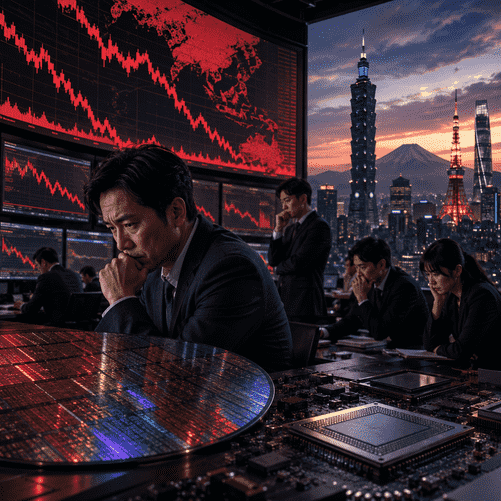
Sharp losses across Japan, Taiwan and other Asian markets reveal growing unease over technology valuations, heavy speculative borrowing and the vast investment required to sustain artificial-intelligence growth.

Asian financial markets suffered a sweeping technology-led sell-off on Friday, July 17, as investors abruptly reassessed whether the extraordinary enthusiasm surrounding artificial intelligence had pushed semiconductor valuations beyond economically sustainable levels.
The retreat was particularly severe in the region’s major chip-producing economies. Japan’s Nikkei index fell by more than 5 percent, leaving it over 13 percent below its recent peak, while Taiwan’s stock market declined by more than 6 percent in its worst session since 2018. Technology shares also weakened in mainland China and Hong Kong, helping drive the broader MSCI Asia-Pacific index down approximately 2.7 percent.
The scale of the decline was striking because it followed seemingly positive corporate news. Taiwan Semiconductor Manufacturing Company, the world’s leading producer of advanced chips, reported a 77 percent increase in earnings. In Europe, semiconductor-equipment manufacturer ASML raised its sales outlook. Yet neither announcement reassured investors who have become increasingly concerned about the enormous spending commitments underpinning the global AI expansion.
Instead, the strong results appeared to prompt a more fundamental question: whether even exceptional earnings can justify the prices investors have been willing to pay for companies linked to artificial intelligence.
For much of the past several years, semiconductor shares have been treated as the clearest beneficiaries of rising demand for data centres, cloud-computing infrastructure and generative AI systems. Governments and corporations have committed billions of dollars to advanced processors, memory chips and manufacturing capacity, turning technology exports into an increasingly important source of economic growth for countries such as Taiwan, South Korea and Japan.
That dependence has also created vulnerabilities. Market gains have become concentrated among a relatively small number of large technology companies, leaving national indices exposed whenever sentiment toward the sector changes. The use of leveraged retail investments—positions financed partly through borrowed money—may have intensified Friday’s decline as falling prices forced some traders to reduce their holdings rapidly.
South Korean regulators had already moved to limit risks by temporarily restricting certain technology-linked exchange-traded funds, illustrating growing official concern that speculative activity could amplify market volatility.
The downturn is unlikely to eliminate the long-term economic significance of artificial intelligence. Demand for high-performance computing remains strong, and several Asian governments continue to support domestic semiconductor manufacturing as a strategic industry. South Korea recently raised its 2026 growth forecast to 3 percent, largely because of strong chip exports and investment in AI infrastructure.
Nevertheless, Friday’s losses underline the widening gap between industrial optimism and investor expectations. Semiconductor manufacturers may continue reporting rapid revenue growth, but markets are beginning to demand clearer evidence that the vast sums being spent on AI will generate equally substantial and durable profits.
The financial pressure is also spreading beyond Asia. European stock futures fell as investors prepared for weakness in companies such as ASML, Infineon and STMicroelectronics, while US technology futures pointed lower. The global nature of the decline reflects how tightly connected the AI supply chain has become, linking Taiwanese manufacturers, Japanese equipment suppliers, South Korean memory producers, European machinery companies and American technology platforms.
Markets are simultaneously confronting higher geopolitical and inflation risks. Oil prices were on course for weekly gains of more than 10 percent amid escalating tensions between the United States and Iran, raising concerns that more expensive energy could increase production costs and restrict the ability of central banks to support economic growth through lower interest rates.
For Asia’s export-driven economies, the immediate danger is that a prolonged technology correction could weaken business investment, household wealth and confidence at the same time as energy costs rise. Semiconductor demand may remain structurally strong, but Friday’s sell-off demonstrated that investors are no longer prepared to assume that every company associated with artificial intelligence will deliver unlimited growth.
The AI boom has not ended. Its financial foundations, however, are facing one of their most serious tests.