Huawei’s powerful new computing system and Beijing’s global governance initiative signal that the artificial-intelligence contest is expanding from chips and software into diplomacy, infrastructure and international influence.

China has used the opening of a major technology conference in Shanghai to present its most ambitious challenge yet to American leadership in artificial intelligence, combining a new generation of domestically powered computing infrastructure with a diplomatic campaign to shape how the technology is governed around the world.
Speaking at the World Artificial Intelligence Conference on Friday, July 17, Chinese President Xi Jinping called for broader international cooperation and warned against allowing AI to be controlled by a small number of countries. His appearance marked the first time he had personally attended the annual gathering, underlining the strategic importance Beijing now places on artificial intelligence as both an economic engine and an instrument of global power.
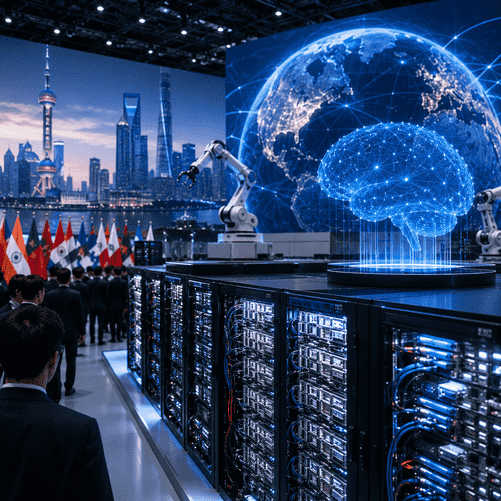
The centrepiece of the technology exhibition was Huawei’s Atlas 950 SuperPoD, a vast computing system designed to train and operate advanced AI models without relying on the most powerful processors produced by the American chipmaker Nvidia.
Rather than functioning as a single conventional supercomputer, the Atlas system links thousands of Huawei Ascend processors through high-speed connections so that they can operate as one coordinated computing platform. Huawei says the design can support the development and operation of extremely large AI models while offering customers an alternative to computing systems based on American hardware and software.
The system illustrates the technological strategy China has adopted in response to US export restrictions. Chinese manufacturers remain unable to obtain some of the world’s most advanced semiconductor-production equipment and AI accelerators, creating a performance gap with leading American suppliers.
Huawei is attempting to overcome that disadvantage through scale. By connecting a much larger number of domestically produced processors and improving the speed with which they exchange data, the company hopes to produce computing clusters capable of competing with systems built around fewer but more powerful Nvidia chips.
The approach is more complex and may require considerably more energy, physical space and equipment. Yet its development suggests that American export controls have not stopped China’s AI progress. Instead, they have accelerated Beijing’s investment in an independent technological ecosystem encompassing processors, networking equipment, data centres, operating software and AI models.
Huawei had previously introduced the Atlas 950 to international customers at the Mobile World Congress in Barcelona, describing it as part of a broader portfolio intended to create a more resilient global computing foundation. Its prominent display in Shanghai, however, carried a more explicitly geopolitical message: China intends to remain a major AI power even without unrestricted access to US technology.
The conference also showcased systems developed by Chinese chip and AI companies including DeepSeek, Biren Technology and MetaX. Their presence reflected the growing depth of China’s domestic industry, which now extends beyond consumer applications into the advanced infrastructure needed to train increasingly sophisticated models.
One of the other high-profile announcements came from Moonshot AI, which presented its open-source Kimi K3 model. The company says the system contains 2.8 trillion parameters, potentially placing it among the largest AI models disclosed publicly. Independent testing will be required to determine how its practical performance compares with leading systems from American and Chinese competitors.
Technology, however, was only one part of Beijing’s message.
Xi used the conference to promote a Chinese vision of global AI governance that emphasises open access, cooperation with developing economies and opposition to restrictions imposed in the name of national security. He argued that artificial intelligence should not become the exclusive domain of wealthy countries or powerful corporations.
China announced initiatives to provide AI-related training and technology to developing nations, including thousands of training opportunities over the next five years and meteorological AI systems for dozens of countries. Beijing is particularly targeting partnerships with members of the Association of Southeast Asian Nations, the African Union and the BRICS group.
The programme forms part of a wider effort to position China as an accessible technology partner for the Global South. Many developing countries want the economic benefits of AI but lack the computing infrastructure, specialist workers and financial resources required to build advanced systems independently.
By supplying training, open-source models and technical platforms, China could gain influence over the standards, infrastructure and software adopted by those countries. That influence may eventually translate into commercial advantages for Chinese cloud providers, telecommunications companies and chipmakers.
Beijing also introduced a new World Artificial Intelligence Cooperation Organization, supported initially by 29 countries. The initiative appears designed to provide an alternative forum for discussing AI governance and technological development, particularly for governments that believe existing international structures are dominated by the United States and its allies.
The organisation could become a rival to American-led efforts to create secure AI and semiconductor supply chains. Washington has argued that restrictions on advanced technology are necessary to protect national security and prevent powerful computing systems from being used for military development, cyber operations or mass surveillance.
China rejects that reasoning, accusing the United States of using security concerns to preserve its economic and technological dominance. The disagreement has produced two increasingly distinct approaches to the global AI system.
The United States and its partners are attempting to maintain control over the most advanced chips, manufacturing equipment and sensitive technologies. China is responding by developing domestic alternatives while promoting open-source systems and infrastructure partnerships abroad.
That competition is likely to shape the next phase of the AI industry. The contest will not be determined solely by which country produces the most capable chatbot or the fastest semiconductor. It will also depend on which side can build reliable data centres, attract developers, establish technical standards and persuade governments to adopt its platforms.
Huawei’s Atlas 950 is therefore significant not simply as a computing product but as evidence that the AI race is becoming a struggle between complete technological ecosystems.
China still faces serious obstacles. Its domestic chips generally lag behind the most advanced American designs, while producing leading-edge semiconductors without access to Western equipment remains difficult. Large clusters composed of less powerful processors may also be costly to operate and harder to programme efficiently.
The Chinese industry nevertheless benefits from enormous domestic demand, strong government support and a large pool of engineering talent. Restrictions that were intended to slow its progress have also created a powerful commercial incentive for Chinese companies to replace foreign components.
For international businesses and governments, the emergence of competing AI systems presents both opportunities and risks. Greater competition could reduce prices and broaden access to computing power. At the same time, a divided technology landscape could force countries and companies to choose between incompatible Chinese and American standards.
Questions about security, censorship, intellectual property and data protection will also influence those decisions. Western governments have accused some Chinese technology companies of enabling state surveillance and benefiting from the misuse of foreign intellectual property. Beijing and the companies involved have repeatedly rejected such allegations.
The Shanghai conference demonstrated that China is no longer presenting itself merely as a country attempting to catch up with the United States. It is increasingly claiming the right to define how artificial intelligence should be developed, distributed and governed.
Huawei’s massive new computing platform provides the industrial foundation for that ambition. Beijing’s diplomatic initiatives are intended to build the international coalition around it.
The result is a technology rivalry that now reaches far beyond laboratories and semiconductor factories. Artificial intelligence has become a contest over economic influence, national security and the architecture of the future digital world.