More than 200 national associations are reported to have backed the FIFA president’s 2027 re-election campaign, even as the controversial suspension reprieve granted to United States striker Folarin Balogun intensifies scrutiny of political influence inside world football.

Gianni Infantino appears firmly positioned to secure another term as FIFA president after receiving formal support from more than 200 national football associations, an extraordinary display of institutional loyalty that contrasts sharply with the unrest surrounding the governing body’s handling of the Folarin Balogun disciplinary controversy.
The endorsements would give Infantino an overwhelming advantage ahead of FIFA’s 2027 presidential election. FIFA has 211 member associations, each holding one vote regardless of its population, footballing strength or financial importance. Support from more than 200 members would leave any potential challenger with almost no realistic path to victory.
Infantino confirmed at the FIFA Congress in Vancouver on April 30, 2026, that he would seek re-election for the 2027–2031 term. FIFA’s official account said he thanked all 211 member associations for their support during his decade in office. The Confederation of African Football had already announced that its members unanimously supported his candidacy.
The strength of his position demonstrates the effectiveness of the global coalition Infantino has constructed since becoming president in 2016. Under his leadership, FIFA has increased financial distributions to national associations, expanded its major competitions and placed greater emphasis on investment in countries outside Europe’s traditional centres of football power.
For many smaller federations, FIFA funding is essential to maintaining national teams, training coaches, developing youth football and constructing facilities. Infantino’s administration has repeatedly presented its development programmes as a redistribution of football’s enormous commercial revenues to every region of the world.
That approach has created a durable political base across Africa, Asia, the Americas and Oceania. Even when criticism of Infantino becomes intense in Europe, the mathematics of FIFA elections continues to favour a president capable of maintaining support among a broad majority of smaller and developing football nations.
His anticipated re-election, however, comes during one of the most contentious periods of his presidency.
The controversy began after United States forward Folarin Balogun received a red card during his country’s World Cup round-of-32 victory over Bosnia and Herzegovina. The dismissal normally carried an automatic one-match suspension, which would have ruled him out of the United States’ subsequent match against Belgium.
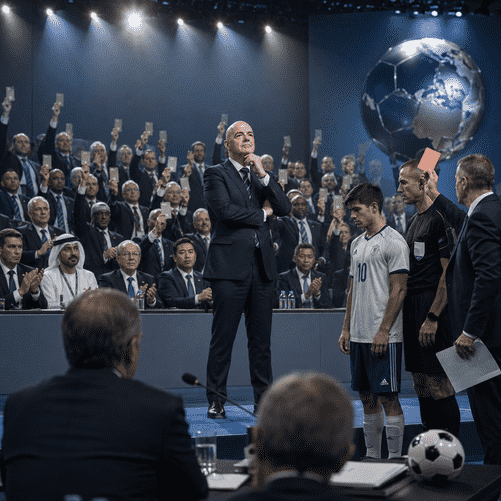
FIFA instead converted the sanction into a suspended one-match ban subject to a one-year probationary period. The decision allowed Balogun to play against Belgium and was issued after US President Donald Trump publicly revealed that he had contacted Infantino and requested a review of the case.
FIFA cited Article 27 of its disciplinary code, which allows certain sanctions to be suspended under specified circumstances. Yet critics argued that the exceptional timing, the intervention of a sitting president and the apparent departure from standard disciplinary expectations created the perception that political influence had affected a sporting decision.
The controversy became especially damaging because of Infantino’s highly visible relationship with Trump. Critics have pointed to the FIFA president’s previous public praise for the US leader, his attendance at political events and FIFA’s presentation of a peace award to Trump as evidence that the relationship has moved beyond the neutrality traditionally expected from an international sporting official.
FairSquare, a human-rights advocacy organisation, subsequently filed a complaint with the International Olympic Committee accusing Infantino of repeated violations of political-neutrality rules. The complaint asked the IOC to examine his possible role in the Balogun decision and whether his relationship with Trump had compromised the independence of FIFA’s disciplinary process.
The allegations have not established that Infantino personally ordered the suspension to be lifted. FIFA’s disciplinary committee formally stated that Balogun had been found responsible for the offence and that the one-match sanction had been suspended rather than erased. FIFA and the IOC had not issued detailed public responses to all of the allegations at the time of reporting.
Nevertheless, the episode has produced significant reputational damage.
Belgian officials and other critics argued that the ruling undermined competitive fairness by allowing a host-nation player to avoid a suspension after intervention from the country’s political leadership. Former referees, football administrators and governance organisations have warned that the decision could create a precedent in which disciplinary outcomes appear vulnerable to diplomatic or commercial pressure.
Opposition has been particularly visible within European football. Germany’s football association reportedly declined to sign a letter formally supporting Infantino’s candidacy, while officials in several UEFA countries have discussed whether a challenger should be encouraged to stand.
That resistance remains fragmented. No credible opponent has yet assembled the international coalition required to threaten Infantino, and potential candidates would have limited time to persuade associations that have already pledged their support.
The dispute therefore exposes a widening gap between FIFA’s electoral legitimacy and its public credibility.
Within FIFA’s political system, Infantino appears exceptionally secure. He can point to broad support from national associations, rising tournament revenues and increased funding for football development. The expanded 48-team World Cup has also given more countries access to the sport’s most prestigious competition, strengthening his appeal outside the traditional elite.
Beyond that electoral structure, however, FIFA faces persistent questions about transparency, political neutrality and the concentration of power around its president.
Infantino originally rose to office after the corruption crisis that ended Sepp Blatter’s leadership and severely damaged FIFA’s reputation. He promised reform, accountability and a clearer separation between football governance and private political interests.
A decade later, critics argue that FIFA has once again become excessively dependent on the authority and personal relationships of a dominant president. The Balogun case has become powerful not merely because of one suspension, but because it appears to confirm broader fears that formal rules can be adjusted when powerful political or commercial interests are involved.
Infantino’s supporters reject that interpretation. They argue that FIFA’s development spending, global expansion and record commercial performance demonstrate successful leadership. They also maintain that European critics often underestimate the priorities of associations in Africa, Asia and other regions that have historically received a smaller share of football’s wealth and influence.
That division explains why a scandal capable of generating outrage among players, supporters and governance campaigners may have little immediate effect on the presidential election.
FIFA’s voting system treats every national association equally. Germany, England and France each possess the same single vote as far smaller football nations. Infantino has mastered that structure by developing direct relationships with federation leaders and ensuring that FIFA’s revenues reach associations whose support can collectively outweigh European opposition.
The reported endorsements from more than 200 countries suggest that this political architecture remains intact.
The central question is therefore no longer whether Infantino can win another term. Unless a major bloc withdraws its support or a powerful alternative candidate emerges, his re-election appears close to assured.
The more difficult question is what his victory would mean for FIFA’s legitimacy.
A president can command nearly unanimous support from member associations while still facing deep distrust among supporters, players, referees and independent observers. The Balogun controversy has demonstrated that institutional endorsement does not automatically resolve concerns about fairness or political interference.
Infantino is likely to enter the 2027 election as one of the most electorally dominant figures in international sport. But the strength of his mandate may only sharpen demands for FIFA to explain how its decisions are made—and whether the rules apply equally when presidents, host nations and the commercial success of a World Cup are involved.