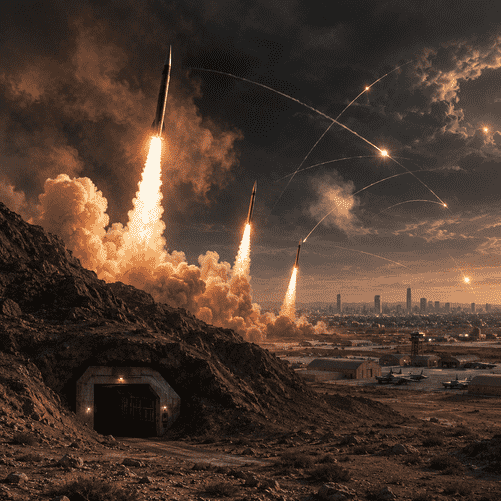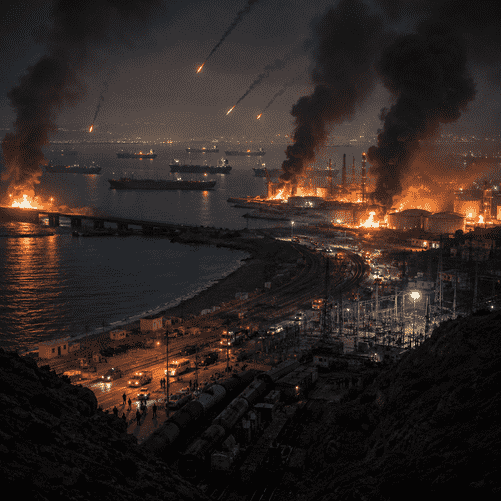
Six consecutive nights of American strikes, Iranian retaliation and attacks on transport and energy infrastructure are deepening a conflict that threatens civilians, regional security and global oil supplies.

The United States launched another extensive round of strikes against Iran early Friday, marking the sixth consecutive night of attacks as Washington and Tehran intensified their struggle over the Strait of Hormuz, one of the world’s most strategically important shipping routes.
The US Central Command said its forces struck dozens of targets linked to Iran’s ability to threaten commercial vessels in and around the waterway. Washington has presented the campaign as an effort to weaken Iranian military capabilities, protect international shipping and prevent Tehran from asserting unilateral control over the strait.
Iranian authorities, however, accused the United States of expanding its operation beyond military installations and damaging civilian infrastructure. State media reported strikes on bridges near the coastal city of Bandar Khamir, a railway station in Bandar Abbas and Iranshahr airport in southeastern Iran. Electrical facilities were also reportedly damaged as the country struggled with extreme summer temperatures and existing power shortages.
The claims from both sides could not all be independently verified. The United States has maintained that it is targeting military assets and infrastructure used to support Iranian operations against shipping, while Tehran has sought to emphasise the civilian consequences of the campaign.
The latest attacks also reportedly brought down a surveillance tower at Chabahar, a major Iranian port on the Gulf of Oman. Unlike ports inside the Persian Gulf, Chabahar opens directly onto the Indian Ocean and plays an important role in Iranian trade with India, Afghanistan and Central Asia. Damage to the port could therefore widen the economic effects of the conflict beyond the immediate contest over Hormuz.
Iran responded with further missile and drone attacks against locations associated with the United States and its regional partners. Sites in Bahrain, Kuwait, Qatar and northern Iraq were reportedly targeted, extending the security crisis across a region that hosts major American military installations and critical energy infrastructure.
The escalating confrontation has transformed the Strait of Hormuz from a source of geopolitical tension into an active theatre of conflict. Iran has repeatedly argued that it has the right to regulate passage through the waterway, while the United States insists that the strait must remain open to international navigation.
Only a small number of commodity vessels passed through the strait on Thursday, according to shipping data cited by Reuters. No very large crude carriers or liquefied natural gas tankers completed the passage for a second consecutive day, reflecting the growing reluctance of shipowners and insurers to expose vessels and crews to attack.
The decline is especially significant because the narrow waterway connects the Persian Gulf with the Arabian Sea. Oil and gas exports from Saudi Arabia, Iraq, Kuwait, Qatar, the United Arab Emirates and Iran normally depend heavily on safe passage through the strait.
Any sustained interruption can rapidly affect global energy markets. Oil prices have risen sharply since the renewed fighting began, as traders calculate the risk that physical supplies could be delayed or removed from the market. The threat is not limited to oil: Qatar’s liquefied natural gas exports are also heavily dependent on the route, making the crisis a potential danger to electricity and heating markets in Asia and Europe.
The United States has reinstated a naval blockade aimed at Iran-linked shipping and has intercepted vessels it considers to be violating its restrictions. Iran’s Revolutionary Guards have responded by warning that oil and gas exports through Hormuz could be blocked if American attacks continue.
The result is an increasingly dangerous contest in which commercial ships risk being caught between Iranian enforcement actions and American naval operations. Tankers have halted outside the strait, altered their routes or turned back rather than attempt the passage.
The military campaign is also placing increasing pressure on civilians. Iranian officials have accused the United States of striking near medical facilities and damaging essential transport and power networks. One reported attack near a children’s hospital in Ahvaz forced the evacuation of more than 200 young patients, according to Iranian accounts. The precise circumstances and intended target of that incident remain disputed.
American officials argue that Iran bears responsibility for the escalation because of its attacks on merchant vessels and military sites across the Gulf. CENTCOM said its latest strikes targeted forces and equipment involved in attacks against ships passing through Hormuz during the previous week.
Yet the expanding list of targets suggests the operation is no longer confined to small boats, missile launchers or coastal military positions. Bridges, airports, ports, electrical equipment and transportation links are becoming part of the battlefield, raising the prospect of longer-term disruption to Iran’s economy and civilian life.
The widening conflict has also placed neighbouring governments in a difficult position. Gulf states host American forces and depend on US security guarantees, but they are equally vulnerable to Iranian retaliation. Missile or drone attacks on ports, refineries, airports or desalination plants could disrupt daily life and inflict substantial economic damage even without developing into a full regional war.
Diplomatic efforts have so far failed to halt the attacks. A previous understanding intended to reduce tensions and reopen maritime traffic collapsed amid disagreements over shipping routes, enforcement authority and Iran’s broader role in the strait.
Both governments now appear to believe that military pressure can strengthen their negotiating position. Washington is attempting to demonstrate that Iran cannot close or control the waterway without facing overwhelming retaliation. Tehran, meanwhile, is using its geographic position, missile forces and regional reach to show that the United States cannot guarantee safe navigation without incurring substantial costs.
That calculation carries severe risks. An attack causing large numbers of civilian casualties, the sinking of a major tanker or a successful strike on a Gulf energy facility could trigger a much broader response. Misidentification and technical failures present additional dangers in a region crowded with military aircraft, naval vessels, drones and commercial shipping.
For the global economy, the immediate concern is whether energy shipments can resume before shortages and higher prices begin to undermine growth. For the people living around the Gulf, the greater danger is that a confrontation originally framed around maritime security is rapidly expanding into a war against the infrastructure on which millions of civilians depend.
After six nights of strikes, neither side has shown signs of retreat. Instead, the battle for the Strait of Hormuz is becoming a test of endurance—one with consequences extending far beyond the shores of Iran and the United States.