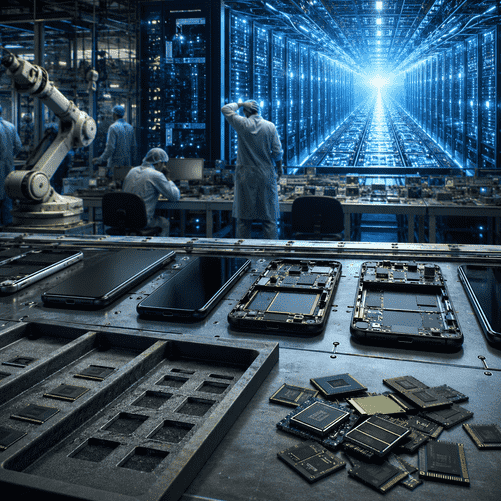
Worldwide handset shipments have fallen to their lowest second-quarter level in 13 years as memory manufacturers prioritise artificial-intelligence data centres, driving up device prices and placing affordable smartphones under growing pressure.

The global smartphone market has suffered its sharpest second-quarter contraction in more than a decade, as the artificial-intelligence investment boom consumes increasing quantities of memory chips and leaves consumer-electronics manufacturers competing for limited supplies.
Worldwide smartphone shipments fell by an estimated 11 per cent during the second quarter of 2026, reaching their lowest level for that period since 2013, according to preliminary figures from Counterpoint Research. The decline reflects a prolonged shortage of memory components that has raised production costs, increased retail prices and discouraged consumers from replacing older devices.
The downturn demonstrates how the rapid expansion of artificial intelligence is reshaping technology markets far beyond data centres. Companies including Microsoft, Amazon, Google and Meta are investing heavily in computing infrastructure capable of training and operating advanced AI models. Those systems require enormous quantities of high-bandwidth memory, encouraging semiconductor manufacturers to devote more factory capacity to lucrative enterprise customers.
The result is an increasingly direct competition between the infrastructure supporting generative AI and the chips required for smartphones, personal computers and other everyday electronics.
Memory suppliers have favoured AI data-centre operators because they are often prepared to make large, long-term orders and pay significantly higher prices. Conventional memory used in smartphones has consequently become more expensive and harder to secure, forcing handset manufacturers either to absorb the additional costs, reduce specifications or pass the increases on to consumers.
The impact has been most severe in the entry-level and mid-range segments, where profit margins are narrow and buyers are highly sensitive to price changes. Even a relatively modest increase in the cost of storage or memory can significantly affect the final price of an affordable handset.
Chinese manufacturers Xiaomi, Oppo and Vivo recorded some of the steepest shipment declines among the world’s five largest smartphone companies. Their exposure to developing markets and lower-priced devices left them particularly vulnerable to rising component costs and weakening demand.
Manufacturers now face difficult design decisions. Some may reduce camera quality, processor performance, battery capacity or storage options to protect retail prices. Others are expected to concentrate more heavily on premium devices, where higher margins make it easier to absorb expensive components.
That shift could transform the structure of the smartphone industry. For years, competition among Asian brands helped make capable mobile devices accessible to hundreds of millions of consumers. A sustained memory shortage could slow that progress, widening the gap between premium users and those who depend on affordable models.
Realme previously warned that extreme memory-cost increases could eventually force smartphone prices substantially higher. Xiaomi has also indicated that it would respond by raising prices and placing greater emphasis on more profitable premium handsets.
Apple proved more resilient than most of its competitors. Its shipments increased by approximately 3 per cent during the quarter, lifting its global market share to a record 20 per cent for the period. Strong demand for the premium iPhone range and the company’s decision to hold prices steady helped it resist the broader decline, although analysts expect price increases may eventually become unavoidable.
Apple’s performance illustrates the growing advantage enjoyed by companies with loyal customers, strong supply-chain relationships and substantial financial reserves. Premium buyers are generally more willing to tolerate higher prices, while large manufacturers can negotiate supply agreements that may be unavailable to smaller competitors.
Samsung regained its position as the world’s largest smartphone vendor during the quarter, securing an estimated 24 per cent market share. Its performance was supported by sales of the Galaxy S26 series, stronger product availability and relatively limited price increases in important markets including India and the Middle East.
Yet neither Apple nor Samsung is insulated from the underlying shortage. If memory prices continue rising, both companies may eventually have to increase retail prices, change device specifications or accept lower margins.
The current imbalance began as memory producers shifted investment toward high-bandwidth memory, or HBM, which is used in the advanced processors that power AI systems. This category has become one of the semiconductor industry’s most profitable and strategically important products.
South Korea’s Samsung Electronics and SK Hynix together control a large proportion of global memory production. Both have been expanding output, but building and equipping new semiconductor factories is a lengthy and expensive process. Significant new capacity for conventional memory is not expected to become available until 2027 or 2028.
SK Hynix has indicated that its supply constraints could continue into late 2027. Major technology companies have meanwhile sought extensive allocations from manufacturers, with some reportedly offering to purchase virtually everything suppliers can produce.
The scale of anticipated AI demand is extraordinary. OpenAI’s planned Stargate infrastructure project has reached preliminary supply arrangements with Samsung and SK Hynix that could ultimately require hundreds of thousands of semiconductor wafers each month. Such demand illustrates why suppliers are prioritising AI customers over lower-margin consumer devices.
Counterpoint expects global smartphone shipments to decline by approximately 14 per cent across 2026 and predicts that the memory shortage will persist into next year. That would represent a substantial reversal for an industry that had expected a stronger replacement cycle driven by new AI functions, foldable designs and improved cameras.
Ironically, the AI features promoted as the next major reason to purchase a smartphone may be contributing indirectly to the market’s decline. Consumers are being encouraged to upgrade to devices capable of running generative assistants and advanced image-processing tools, while the data centres behind those services are absorbing the same semiconductor resources needed to manufacture the phones.
This contradiction exposes the increasingly interconnected nature of the technology supply chain. AI is not simply another software feature added to consumer devices; it is an infrastructure-intensive industry capable of redirecting investment, manufacturing capacity and raw materials on a global scale.
The shortage may also affect the pace of innovation. Manufacturers under cost pressure could delay new models, limit storage configurations or reserve advanced features for expensive flagship products. Smaller brands may struggle to compete if they cannot secure reliable component supplies.
Emerging economies are likely to experience the consequences most sharply. In countries where consumers keep devices for longer periods and depend on low-cost Android phones, price increases could significantly reduce sales. The effects may extend beyond consumer spending because smartphones provide access to banking, education, healthcare, government services and employment opportunities.
There are potential beneficiaries. Memory-chip manufacturers have gained considerable pricing power, and investors have rewarded companies positioned to supply the AI infrastructure boom. Huawei is also pursuing an ambitious expansion strategy, reportedly seeking to increase smartphone shipments in 2026 while several Chinese competitors reduce their targets because of shortages and higher component expenses.
Huawei’s ability to rely more heavily on domestic Chinese supply networks may provide an advantage, although geopolitical restrictions and the availability of advanced processors remain important constraints.
For the wider smartphone industry, the immediate priority is securing enough memory to protect product launches and market share. The longer-term challenge is more fundamental: balancing the enormous demand created by artificial intelligence with the need to keep personal technology affordable.
Smartphones have become the primary computing device for much of the world. A supply crisis that makes them significantly more expensive would therefore carry social and economic consequences extending far beyond the technology sector.
The AI boom has often been presented as a source of limitless innovation. The smartphone downturn reveals its physical limits: factories, materials, production capacity and competing customers. As data centres consume a growing share of the semiconductor industry’s output, consumers may increasingly find that the cost of building the AI future is reflected in the price of the device in their hands.