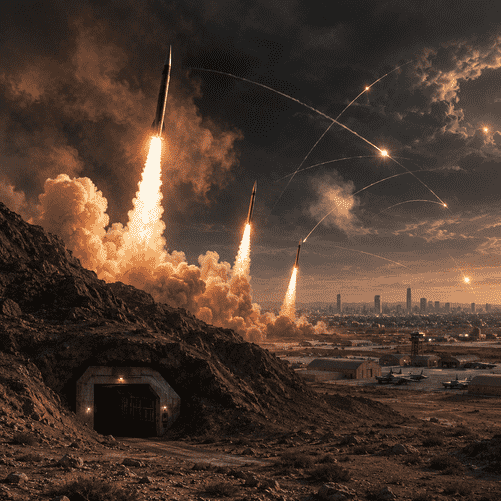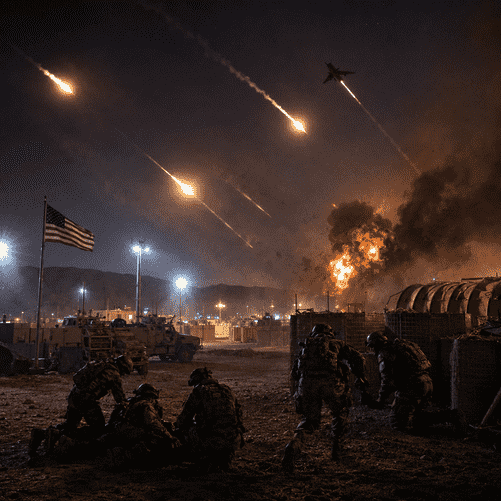
Two American service members were killed, four were wounded and another remains missing after an Iranian missile-and-drone barrage, raising the prospect of further retaliation as a fragile diplomatic effort collapses.

Two United States service members have been killed in an Iranian attack on a military base in Jordan, marking a sharp escalation in a conflict that has expanded across the Middle East after another week of strikes and counterstrikes.
The U.S. military said one additional service member remained missing after the assault, while four wounded troops were treated at medical facilities in Jordan and later released. Other personnel who suffered less serious injuries were able to return to duty. The identities of those killed have not yet been publicly released, pending notification of their families.
The attack occurred on Friday, July 17, and involved ballistic missiles and drones directed at American and allied forces in Jordan. Reporting identified Muwaffaq Salti Air Base, a strategic installation that hosts U.S. personnel and combat aircraft, as the target. At least two Iranian missiles were involved in the strike, although the full extent of the damage remained unclear.
The deaths are the first American military fatalities caused directly by an Iranian attack since the latest phase of fighting began. They bring the reported U.S. military death toll in the broader conflict to 16, while more than 430 personnel have been wounded, many of them in missile and drone attacks on installations across the region.
Iran described its latest operations as retaliation for seven consecutive nights of American airstrikes against Iranian military and infrastructure targets. Tehran has accused Washington of attacking civilian facilities and attempting to impose control over the Strait of Hormuz, the narrow waterway through which a significant share of the world’s oil supplies passes.
The Jordan attack was part of a wider Iranian barrage against countries hosting American forces. Missile and drone strikes also targeted Kuwait and Bahrain, while Saudi Arabia issued alerts following suspected launches toward areas containing military and energy infrastructure.
In Kuwait, Iranian weapons reportedly struck an oil facility and a desalination plant, damaging infrastructure essential to both energy production and drinking-water supplies. The expansion of attacks beyond conventional military targets has intensified concerns that the conflict is entering a phase in which civilian services and regional economies are increasingly exposed.
American forces have continued their own campaign inside Iran, striking surveillance facilities, weapons-storage sites and maritime capabilities. Some attacks have also affected electricity and water infrastructure in southern Iran, disrupting transport and public services. Iranian authorities said recent U.S. strikes had killed at least 50 people, although that figure could not be independently confirmed.
The immediate question facing Washington is how forcefully it will respond to the deaths in Jordan. The killing of American troops has historically placed intense political pressure on U.S. presidents to retaliate, particularly when the attacking state has openly claimed responsibility.
A limited response could be intended to demonstrate resolve while avoiding a wider war. A larger operation against Iranian missile forces, command centres or strategic infrastructure, however, could invite further attacks on U.S. bases and allies across the Gulf.
The current escalation follows the breakdown of a preliminary diplomatic agreement that had briefly raised hopes of containing the conflict. Both sides now accuse the other of violating earlier commitments, while Iran has suspended its participation in the interim arrangement.
At the centre of the confrontation is the Strait of Hormuz. Iran considers control of the waterway a vital national-security interest, while the United States insists that international vessels must retain freedom of navigation. Shipping through the strait has declined sharply amid blockades, attacks and threats against commercial traffic, contributing to volatility in global oil markets.
The conflict has also placed Jordan in an increasingly precarious position. A close American security partner, the kingdom hosts U.S. troops but has generally sought to avoid being drawn directly into regional confrontations. An attack causing fatalities on Jordanian territory risks undermining that balancing strategy and could prompt Amman to strengthen its military cooperation with Washington.
For other Gulf governments, the strike reinforces the danger of allowing American forces to operate from their territory while attempting to maintain political and commercial relations with Tehran. Iran has repeatedly argued that bases used to support U.S. attacks are legitimate targets, even when they are located in countries that are not formal parties to the war.
The rising casualty count is likely to deepen debate inside the United States over the costs and objectives of the campaign. Public support for prolonged military involvement has remained limited, while lawmakers have questioned how the administration intends to prevent an open-ended regional war.
The missing service member adds further uncertainty to the crisis. U.S. forces are continuing search and recovery efforts, but officials have released few details about the circumstances of the disappearance or whether it occurred during the initial impact, subsequent fires or defensive operations.
As families await further information, the attack has transformed an already dangerous military confrontation into a more politically combustible one. What began as an exchange of limited strikes has expanded to include military bases, maritime routes, oil facilities, power systems and water infrastructure across several countries.
The deaths in Jordan may now become the point at which both governments must choose between renewed diplomacy and another cycle of retaliation. With each side claiming that it is acting defensively, the risk is that neither will recognise the moment when escalation becomes impossible to control.