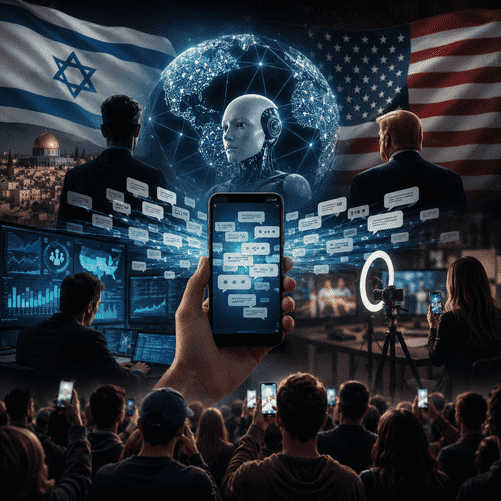
A multimillion-dollar campaign involving conservative media, Trump-linked strategists and mass-produced digital messages reflects growing concern in Jerusalem over its deteriorating image in the United States.

WASHINGTON — Israel has launched an unusually ambitious campaign to improve its standing among Americans, spending tens of millions of dollars on social-media influencers, conservative media, targeted advertisements and artificial-intelligence strategies designed to shape the information reaching voters.
The approximately $50 million initiative represents a significant expansion of traditional public diplomacy. Rather than relying primarily on official speeches, embassy events and established advocacy organisations, the Israeli government is adopting techniques associated with modern political campaigns: mass text messaging, algorithmically optimised content, influencer partnerships and digital targeting aimed at specific ideological communities.
Millions of messages have reportedly been sent to American mobile phones from groups using names such as Friends for Peace. Some of the texts, presented as survey questions from senders called Emma or Sarah, ask recipients for their opinions on Israel, Iran and global security. The messages are generated or adapted using artificial intelligence and distributed through a company associated with a longtime adviser to President Donald Trump.
The campaign comes at a moment of mounting concern in Jerusalem over the erosion of American support. A Pew Research Center survey cited in recent reporting found that 60 per cent of American adults held an unfavourable view of Israel, compared with 53 per cent a year earlier. Disapproval has been especially pronounced among younger voters and Democrats, although scepticism has also become more visible within parts of the conservative movement.
Israel’s wars in Gaza and Iran have placed its conduct, strategic objectives and relationship with Washington under sustained scrutiny. Graphic images of civilian casualties, disagreements over ceasefires and criticism of Prime Minister Benjamin Netanyahu have weakened the broad bipartisan consensus that once characterised American support for the country.
The government’s response has been to treat public opinion as a strategic battlefield.
One of the most prominent figures involved is Brad Parscale, the digital strategist who helped lead Trump’s online campaign operations and later served as his 2020 campaign manager. Israel hired Parscale to oversee elements of a pro-Israel communications effort, reportedly paying his firm $9 million and extending its contract as the campaign expanded.
Parscale’s involvement appears intended partly to help Israel communicate with Trump supporters and younger conservatives. These groups have become increasingly important as debates over foreign military commitments divide the Republican coalition.
Traditional pro-Israel Republicans continue to regard the alliance as strategically and morally essential. However, a more isolationist faction associated with the “America First” movement has questioned military assistance, criticised Israeli influence in Washington and opposed further American involvement in Middle Eastern conflicts.
Israel’s campaign has therefore focused not only on the American public generally but also on conservative audiences whose support can no longer be taken for granted.
The strategy extends beyond advertisements and political messaging. Parscale-linked teams have sought to influence the information that artificial-intelligence systems retrieve when answering questions about Israel, Hamas and the wider conflict.
Market Brew, a search and AI-modelling company associated with Parscale’s operation, reportedly helped create nine websites containing material presented in a structured, factual style. The objective was to make pro-Israel information more likely to be discovered and incorporated by systems such as ChatGPT, Claude and Gemini.
The project reflects a new reality in international communications. Governments have traditionally attempted to influence newspapers, television networks and social-media platforms. They must now also consider how AI assistants summarise historical events, describe military conflicts and evaluate competing political claims.
Unlike conventional advertising, the campaign does not necessarily try to purchase space directly inside an AI response. Instead, it produces searchable online material that algorithms may identify as relevant when generating answers.
The effectiveness of that method remains uncertain. Parscale’s team has said that major AI systems have begun incorporating information from the new websites, but it has not publicly released evidence demonstrating the scale of the effect. An Axios test found that ChatGPT did not cite the campaign’s websites when asked questions using language drawn from them.
The initiative nevertheless illustrates how artificial intelligence is becoming part of geopolitical competition. States and political organisations increasingly understand that the information used to train or guide AI systems may influence how millions of people interpret controversial events.
Israel has also recruited social-media personalities to produce favourable material for platforms including TikTok, Instagram, YouTube and X. Influencers can reach audiences that rarely follow conventional news or official diplomatic accounts, often presenting political messages through personal stories, interviews and entertainment-focused content.
Supporters of the strategy argue that Israel must compete more aggressively in a digital environment where emotionally powerful anti-Israel material can spread globally within minutes. They contend that the country has frequently failed to explain its security concerns, the threat posed by armed groups and the circumstances surrounding its military operations.
Critics, however, say undisclosed or insufficiently transparent government-funded content risks being perceived as propaganda. The use of influencers, automated messaging and political consultants can also create suspicion that a foreign government is attempting to manipulate domestic American debate rather than participating openly in it.
The backlash has reached the highest levels of the United States government. Vice President JD Vance has accused Israeli-linked figures of conducting a discreet and heavily financed operation intended to influence American arguments over the administration’s Iran policy. Israeli reporting has suggested that the controversy generated distrust inside Washington and may have damaged the relationships the campaign was designed to protect.
Vance’s remarks were particularly significant because they reflected a widening dispute within the Trump movement. His criticism suggested that opposition to foreign influence campaigns is no longer confined to progressive Democrats or longstanding critics of Israel.
Israeli officials and diplomats have also questioned whether the money has been used effectively. According to Ynet, Israel allocated 545 million shekels to international public-diplomacy efforts before securing an additional 2 billion shekels for 2026 and 2027. Some Foreign Ministry personnel complained that outside advisers and companies operated without adequate coordination with professional diplomats or Israeli embassies. The ministry said its work plan and budget had been coordinated with the relevant officials.
Internal critics have argued that some programmes reached people who already supported Israel rather than persuading sceptical audiences. Others questioned whether short digital campaigns could reverse attitudes shaped by years of war, civilian suffering and political disagreement.
That problem lies at the centre of Israel’s experiment. Modern campaign technology can deliver millions of messages, identify receptive audiences and generate content at extraordinary speed. It cannot guarantee that recipients will accept the argument being presented.
Public opinion is influenced not only by communication but also by events. No advertising campaign can be separated from developments in Gaza, negotiations with Iran, the policies of Netanyahu’s government or the daily images reaching American television screens and smartphones.
There is also a risk that the exposure of a government-funded campaign could reinforce the very distrust it was intended to overcome. Audiences who discover that influencers or seemingly independent organisations received foreign support may become more sceptical of the underlying message.
The use of AI adds another layer of controversy. Efforts to make information more accessible and visible online are common among governments, companies and advocacy groups. But deliberately producing content to affect what AI systems tell users raises unresolved questions about transparency, manipulation and the future integrity of digital knowledge.
For Israel, the campaign is ultimately an admission that its relationship with the American public has entered a more uncertain period. Military cooperation and support from political leaders remain extensive, but popular backing is becoming less automatic and more divided by age, ideology and party affiliation.
The $50 million programme may improve Israel’s ability to distribute its arguments. Whether it can rebuild trust is a much more difficult question.
The experiment demonstrates that diplomacy in the AI era is no longer conducted only through ambassadors and official negotiations. It now takes place through influencers, algorithms, search results and text messages arriving from unfamiliar names on millions of personal phones.
Israel is investing heavily in that new arena. The political reaction in Washington suggests that controlling the message may prove considerably easier than controlling its consequences.